



Mega escalator system brings convenience to residents in mountainous county in SW China
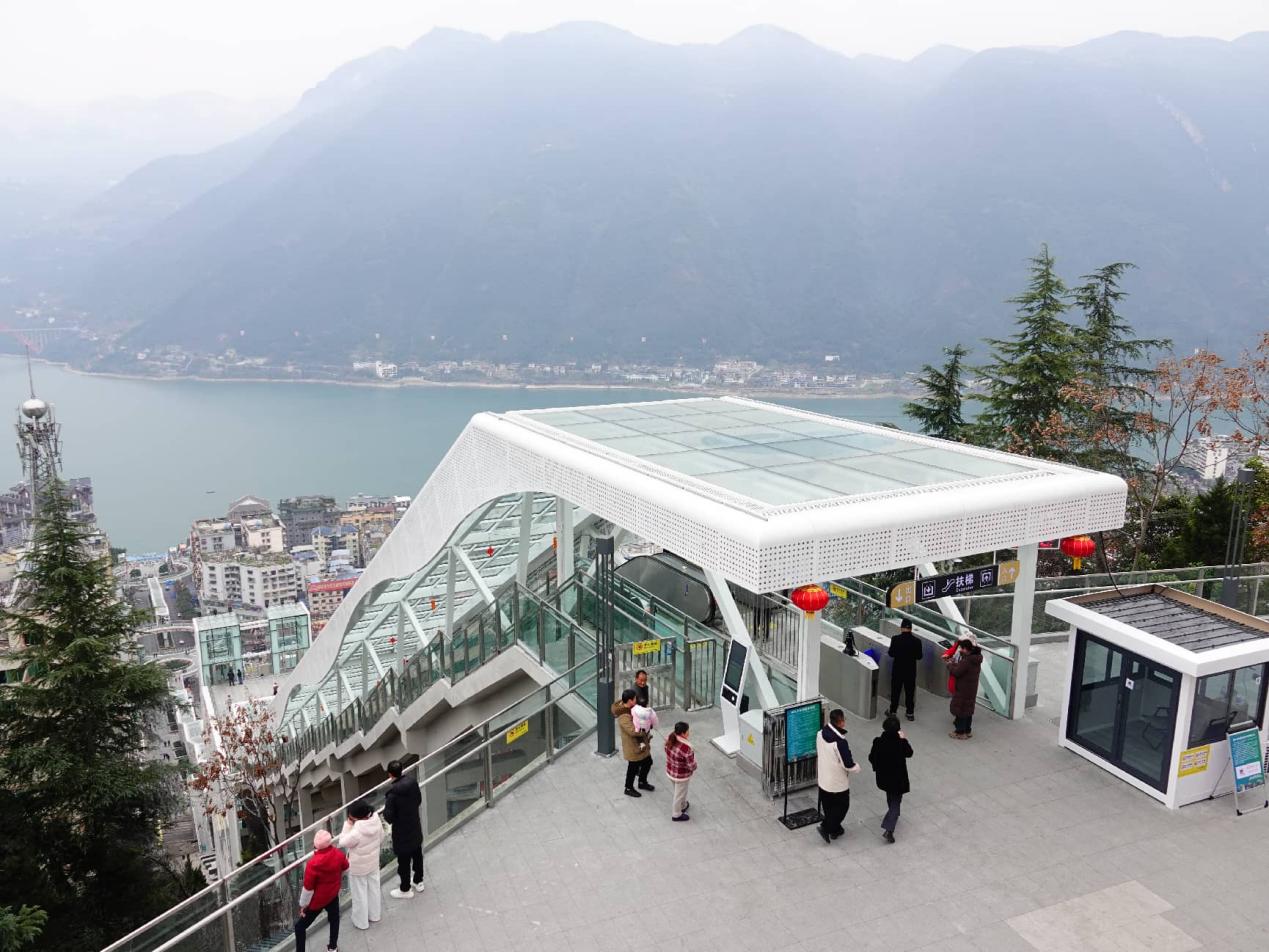
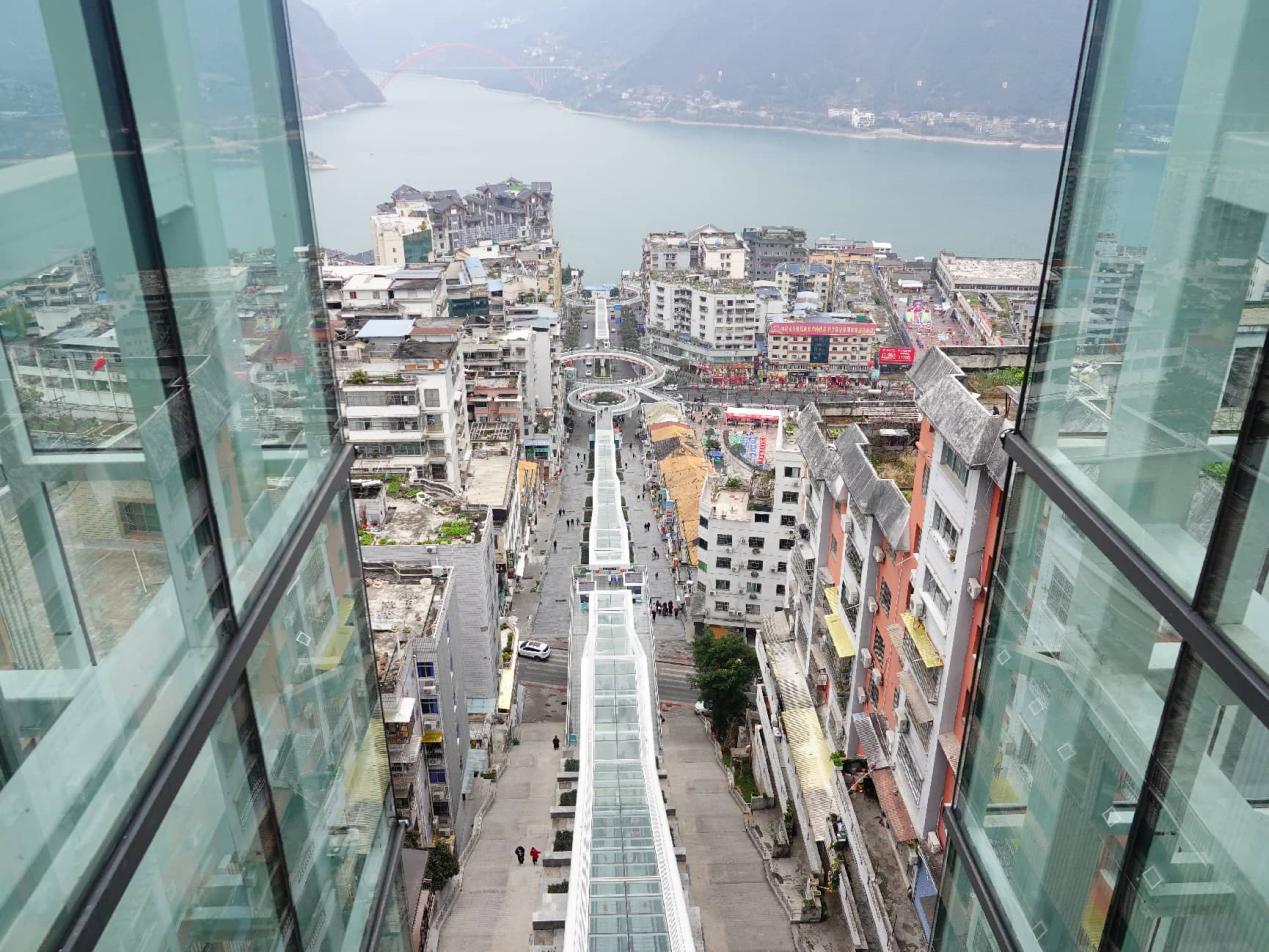
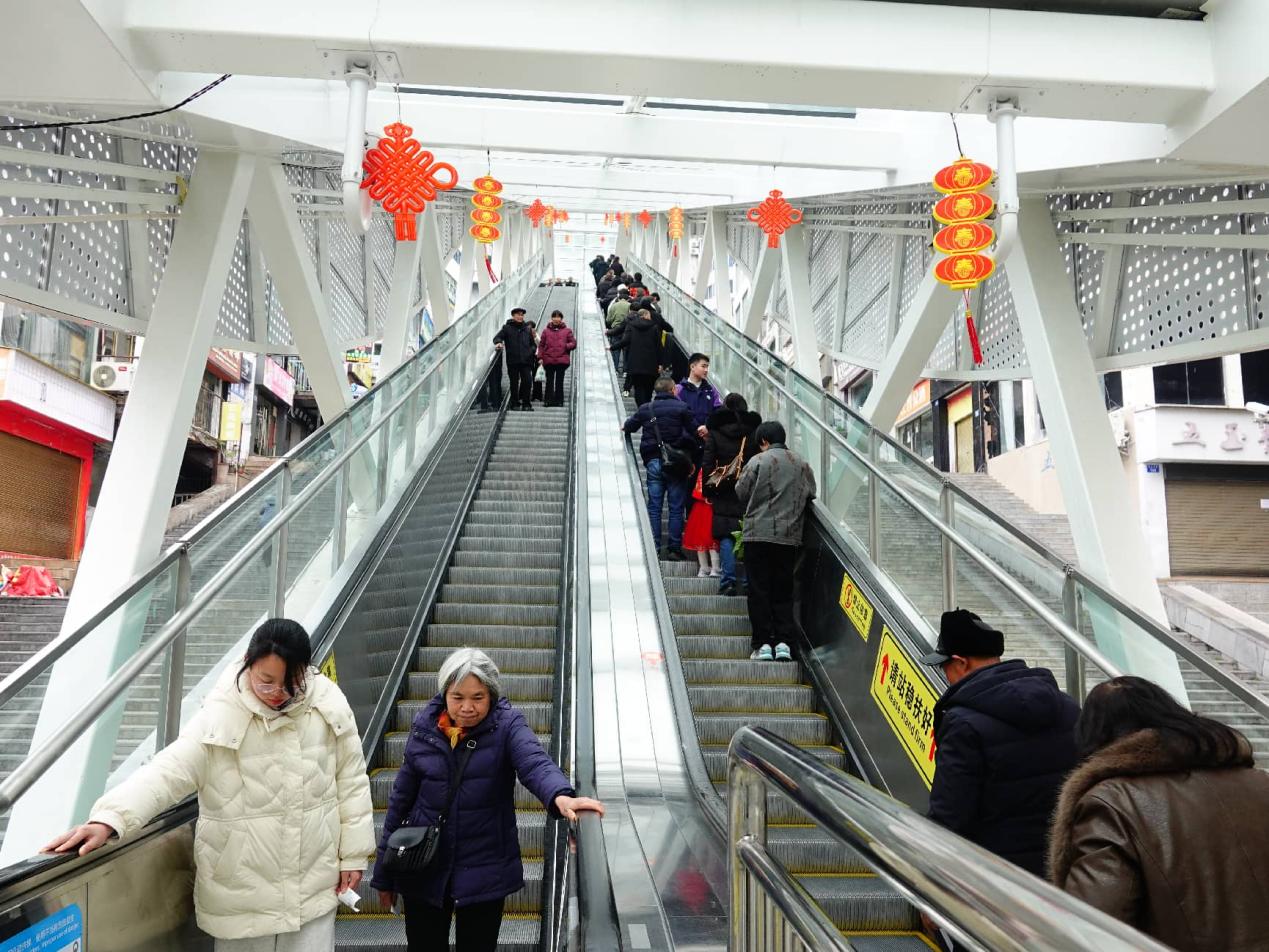
Photos show the escalator system in Wushan, southwest China's Chongqing municipality. (Photo/Liu Junfeng)
Nestled against steep mountainsides in Wushan county, Chongqing municipality, southwest China, flat terrain is scarce. For generations, navigating the town meant arduous climbs up slopes and staircases.
Running along the county's central axis, Shennv Avenue once linked the upper and lower parts of the urban area with 1,136 steps. Walking the full route could take up to an hour. Those who chose to drive had to navigate winding mountain roads that zigzagged upward across multiple terraces, where traffic jams and parking difficulties were common.
Consequently, building a more convenient vertical transportation link has been a long-cherished aspiration of local residents.
This aspiration materialized in February of this year when a large escalator system, constructed along Shennv Avenue, commenced trial operations. Stretching about 905 meters in total length with a vertical rise of 242 meters, roughly equivalent to an 80-story building, the system includes 21 escalators, eight elevators, and four moving walkways.
It connects key urban facilities such as government offices, hospitals, schools, and docks, benefiting more than 50,000 residents. Travel time between the upper and lower town has been reduced from one hour to just 20 minutes. So far, the escalator system has served over 1.32 million trips.
"The idea of building escalators dates back to 2002, coinciding with the stairway's initial completion," said Li Jinbo, an official with the county's housing and urban-rural development bureau. "But at the time, both technology and funding were insufficient."
As a relatively less-developed county, Wushan had to carefully manage its budget while meeting public demand for better infrastructure. With the acceleration of urban renewal in recent years, the project was finally put on the agenda.
During planning, professional institutions were commissioned. After extensive research on similar cases at home and abroad, 12 possible solutions, including light rail, rack railway, and escalators, were shortlisted. Expert evaluation prioritized safety, feasibility, and convenience, ultimately selecting the escalator system.
Public consultation confirmed strong resident support. "Easier travel between the upper and lower town was the paramount desire," Li emphasized. Following thorough planning, civil engineering construction commenced in June 2024.
Designers prioritized preserving Wushan's unique character. Given the shops lining Shennv Avenue's middle and upper sections, the escalators were built on elevated corridors, allowing pedestrian movement underneath and maintaining access to storefronts. Multiple access points along the route support local business. Along the riverside section, the escalators were built close to the ground to minimize excavation and ensure safety.
Construction proved exceptionally challenging. The escalators follow the steep path of the original stairway, averaging a 40-degree gradient, which severely limited the use of heavy machinery. Much of the building materials had to be carried up manually, step by step.
"In certain sections, construction was almost entirely done by hand," said Zhang Jie, a project technical manager. "The site was narrow, and underground pipelines were densely packed, so every dig had to be extremely careful."
The region's karst terrain also posed challenges due to its soft foundation. "Foundation piles had to be driven 20 to 50 meters underground to ensure stability," Zhang added.
For residents like 58-year-old Zeng Xiangui, who lives in Jixian community, the change is significant. He used to walk up and down Shennv Avenue twice a day.
"The stairs provided exercise, but at my age, my eyes and knees struggle," he shared. "The escalators have made a tremendous difference."
Wushan's rugged terrain has long scattered public spaces like schools, hospitals, and parks across different elevations, almost as if they were "hanging" on the mountainside. The new escalator system connects these fragmented spaces, forming a vital "artery" for the city.
It is now an important part of the city's pedestrian transport network, linking seamlessly with public transit, encouraging greener travel, and easing traffic pressure.
"This livelihood project has made travel safer and more convenient, bringing people closer to their city," said Wang Xicai, deputy director of the county's housing and urban-rural development bureau.
Photos

Related Stories
- 2026 China Medical Equipment Conference & Medical Equipment Exhibition held in Chongqing
- Tea gardens enter peak picking season in China's Chongqing
- View of Wulong District shrouded in mist and clouds in China's Chongqing
- Flower-themed scenic areas drive rural tourism in Chongqing's village
- View of rapeseed flower field in Tongnan, China's Chongqing
- Fisheries research base in China's Chongqing conserves rare fish species
- View of rapeseed flower fields in China's Chongqing
- Chongqing pioneers senior-focused fitness facility
- Drone light show staged in SW China's Chongqing
- Chongqing's 'digital roads' serve as training grounds for smarter vehicles
Copyright © 2026 People's Daily Online. All Rights Reserved.
