



Boao Moments 2026: Reframing ESG, the China way
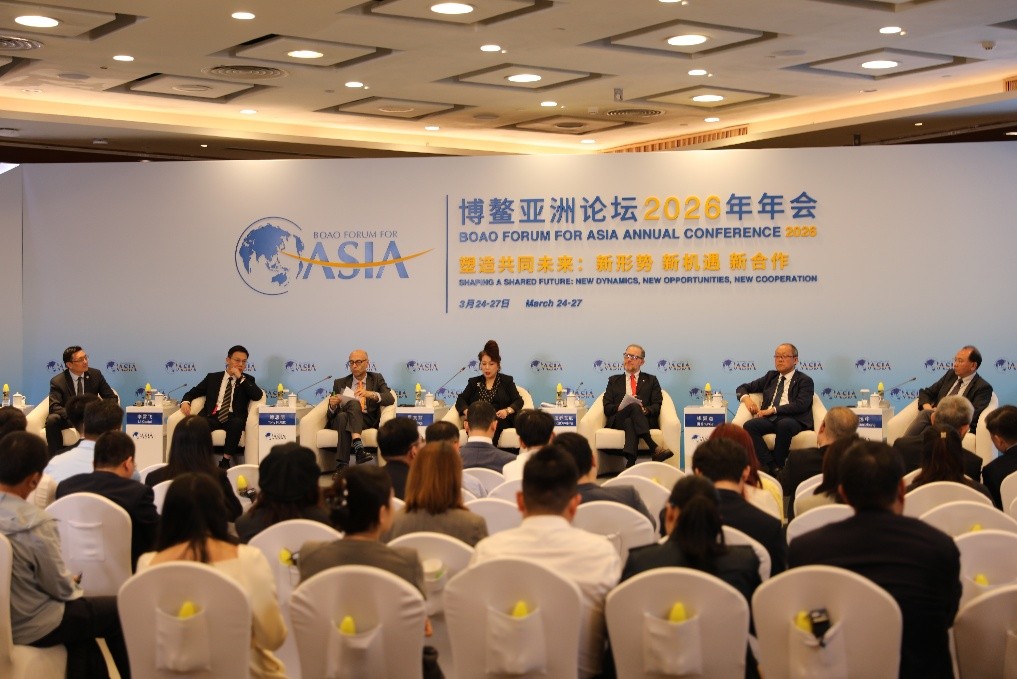
Speakers at the "Reinterpreting ESG: Corporate Responsibilities and Opportunities" session of the Boao Forum for Asia 2026 Annual Conference, in Boao, south China's Hainan Province. (People's Daily Online/Li Ze)
As global economic conditions grow more complex and climate challenges mount, environmental, social and governance (ESG) standards have evolved from a peripheral corporate responsibility concept into a core measure of long-term enterprise value. The Boao Forum for Asia (BFA) Annual Conference 2026 brought this conversation to the fore on March 26, with a dedicated session bringing together executives from energy, pharmaceuticals, manufacturing and professional services to examine how businesses can turn ESG commitments into genuine strategic advantage.
ESG in the Chinese context
China's ESG landscape has matured considerably in recent years. The China Securities Regulatory Commission has made ESG disclosure an increasingly formal requirement for listed companies. That momentum looks set to continue under the 15th Five-Year Plan, which places science and technology innovation and industrial upgrading at the center of China's development model, with green transformation woven throughout. For Chinese enterprises, this means ESG is no longer a matter of meeting external expectations but of aligning with the direction the national economy is heading. The dual carbon goals, carbon peaking by 2030 and carbon neutrality by 2060, provide a long-term policy anchor that gives businesses a clear horizon to plan against, while initiatives like green finance and green credit are making sustainability a factor in how capital flows through the economy.
From compliance to core strategy
A recurring theme throughout the discussion was the shift in how companies perceive ESG, moving away from a regulatory checkbox and toward a driver of competitive strength. Bi Shunjie, managing partner of EY Greater China, traced this evolution through the firm's own practice. When EY established its first dedicated climate-focused advisory team in China over a decade ago, the concept was largely unfamiliar to domestic clients. Today that landscape has fundamentally changed, with ESG reporting requirements firmly in place and corporate attitudes shifting from reluctant compliance to genuine strategic buy-in. Bi also pointed to artificial intelligence as an increasingly important factor, noting that advances in AI efficiency could meaningfully reduce the energy footprint of large-scale computing. He highlighted that EY had recognized DeepSeek at a recent sustainability summit precisely because breakthroughs in low-cost, high-performance AI carry real implications for how efficiently the economy uses energy.
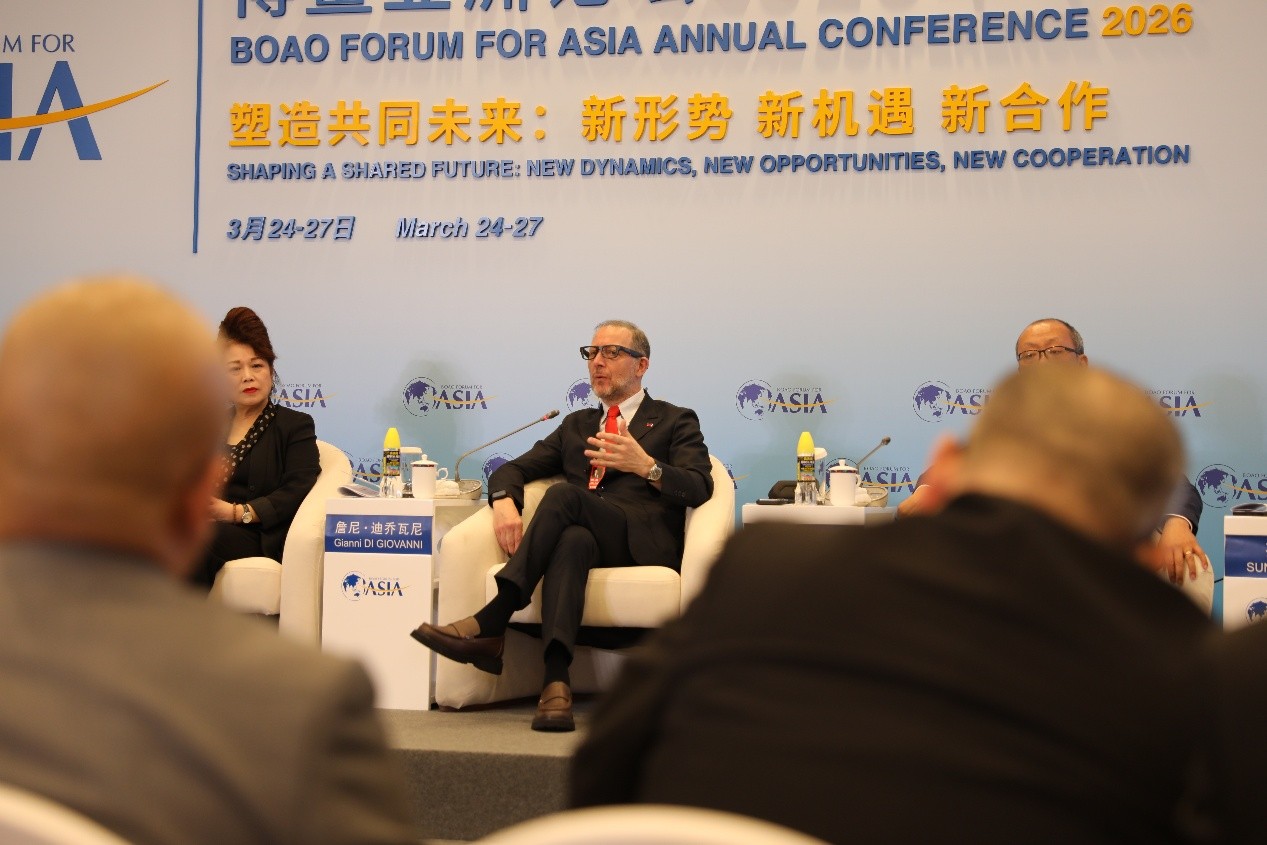
Gianni Di Giovanni, chairman of Eni China, speaks during the "Reinterpreting ESG: Corporate Responsibilities and Opportunities" session of the Boao Forum for Asia 2026 Annual Conference, in Boao, south China's Hainan Province. (People's Daily Online/Li Ze)
Green innovation as a growth lever
Li Xiaofei, vice president of China Datang Corporation, shared how the state-owned energy group is channeling ESG principles into its overseas expansion under the Belt and Road Initiative. Datang's first overseas renewable energy project, a photovoltaic power station in Bukhara, Uzbekistan, was connected to the grid last September, with a second phase of solar and energy storage now under construction. Beyond project delivery, the company has established a joint technology research and innovation center with Uzbekistan's Ministry of Energy, focused on standard-setting, technology transfer and local talent development across Central Asia. For Li, the goal is not simply to build and operate clean energy infrastructure abroad, but to cultivate resilient local industrial ecosystems that carry Chinese technical standards and expertise into new markets.
Zhai Jingli, deputy CEO of Sinar Mas Group APP, offered a perspective from the pulp and paper industry, one of China's most resource-intensive manufacturing sectors. She outlined a three-pronged approach centered on raw material innovation, advanced materials development and full value-chain integration, and drew a direct line between the 15th Five-Year Plan's emphasis on deeply integrating technological and industrial innovation and what her company is trying to do on the ground. She urged businesses to embed zero-carbon targets from the earliest stages of project planning and to write ESG metrics into performance evaluations rather than leaving them as aspirational statements in strategy documents.
Supply chain resilience and decarbonization
Tony Pusic, AstraZeneca's senior vice president of Regional Supply for the Asia-Pacific region and Japan, described how the pharmaceutical company has built a deliberately distributed supply network across the region, with major logistics centers spread across China, to reduce geographic concentration risk and better absorb geopolitical disruptions. He noted that AstraZeneca's approach aligns closely with China's own priorities around supply chain security and domestic manufacturing capacity, and that the company sees its commitments under China's Healthy China initiative and the UN 2030 Agenda for Sustainable Development as integral to its ESG strategy rather than separate from it. The company has cut its carbon footprint by 98 percent against a 2015 baseline, with all internal operations now running at net zero and new facilities designed to be carbon-neutral from day one.
Rethinking enterprise value
Sun Xuanzhong, founding dean of the School of Business at China University of Political Science and Law, provided a theoretical grounding for the discussion. He argued that ESG fundamentally redefines what a company is for, shifting the focus beyond profit maximization to encompass environmental stewardship, social contribution and sound governance. Many corporate risks today, he noted, do not stem from economic missteps but from failures in exactly these areas, a point he illustrated with real cases from his own consulting work involving Chinese enterprises operating overseas. ESG, properly understood, is not an optional extra but a compulsory discipline, and one that becomes a source of competitive advantage for companies that take it seriously.
Photos



Related Stories
- Welcome to Boao Forum for Asia Annual Conference 2026 — a forum for an uncertain world
- Robot dancing to 'Dahuajiao' steals the show at Boao, S China's Hainan
- Boao Moments 2026 | Advancing regional cooperation between China and ASEAN
- Boao Moments 2026: Investing for the future, cooperation is the path
- Boao Moments 2026: China's APEC hosting year a chance to reinject confidence into fragmented world
- Green, smart technologies shine at Boao Forum for Asia Annual Conference 2026
- Boao Moments 2026 | Michele Geraci shares views on China's 15th Five-Year Plan and the Hainan FTP
- Boao Moments 2026: China's economic outlook centers on high-quality development
- Boao Moments 2026 | Want to do business in China? Read the five-year plan
- In pics: press conference for Boao Forum for Asia annual conference 2026
Copyright © 2026 People's Daily Online. All Rights Reserved.
