



Interest-driven consumption fuels rise of second-hand stores among China's youth
Second-hand shops have carved out a new kind of retail experience — one that blends warmth with environmental consciousness — and young Chinese consumers are taking notice.
Three Hares, a second-hand store on Chaoyangmen Beixiao Street in Beijing, occupies the second floor of a fruit shop — accessible only by passing through it. The compact space is a treasure trove of eclectic finds: jewelry in different styles, ornaments and furniture from different eras, board games, stationery and musical instruments, while racks of second-hand clothing line the back wall.
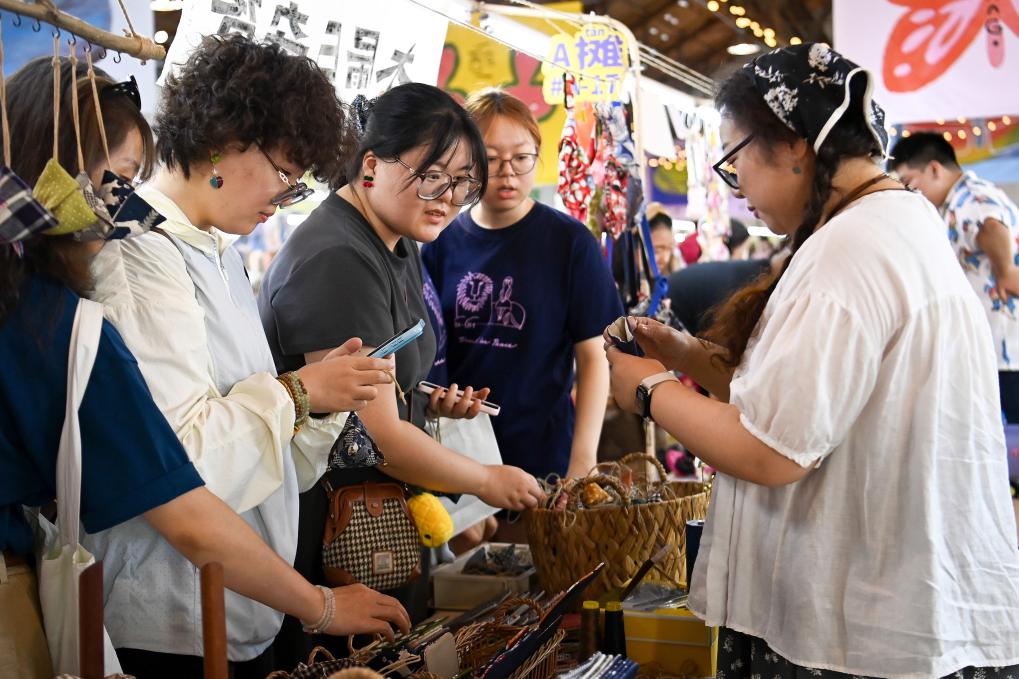
Tourists purchase products at a second-hand market of the Xicang Urban Memories Park in Lianhu District of Xi'an, northwest China's Shaanxi Province, July 5, 2025. (Xinhua/Zou Jingyi)
"It's a completely immersive hunting experience," said a customer who goes by the online handle Alin. "Everything has a clear price tag and notes about where it came from — giving the whole place a very personal feel." He once spent an entire afternoon browsing and came away with a beautiful plate.
Founder Zhang Jin runs the shop primarily on a consignment model, where people leave their unwanted items to be sold at an agreed price. She is the only full-time staff member, with the rest of the team made up of part-timers whom she has trained herself. The shop's initial customer base came largely through social media, Zhang said, but word spread and local residents began dropping in to browse and consign their own goods. The business is now profitable, and Zhang plans to open a second store in Shougang area after 2026. She is also looking to expand the brand's reach through offline markets.
By contrast, Eco Shop, a circular retail store located on the second floor of a building in an industrial park in Chaoyang district, Beijing, offers a considerably more spacious experience. Its roughly 300 square meters of floor space provide ample room to display a wide variety of pre-owned items. The shop is neatly divided into zones for toys and figurines, authenticated luxury goods, electronics, outdoor equipment and everyday household items.
Eco Shop features a notably large selection of figurines and decorative pieces, priced anywhere from a few yuan (1 yuan equals about $0.14) to several dozen yuan depending on condition. IP-branded collectibles are the shop's biggest draw, and they tend to sell out quickly as soon as new stock arrives, according to Liu Li (a pseudonym), the shop's manager.
A very different kind of second-hand store can be found on the ground floor of the Xueyan Building in the Tsinghua University Science Park. Buy42 Charity Store stands out for its explicitly charitable mission. Volunteer recruitment notices cover the pillars and public-interest messaging is visible throughout, a constant reminder of the store's founding purpose.
All four staff members at the Beijing branch are people with disabilities. Most of the goods on sale come from donations.
Unlike ordinary second-hand stores, Buy42 Charity Store has had a clear charitable mission from the very start. The core logic is to bring together underused space, unwanted goods and untapped human potential, creating dignified employment for people with disabilities and allowing shoppers to contribute to a social cause simply by making a purchase. It is a model designed for long-term sustainability, said Qiaoqiao, manager of the Beijing branch, who herself has hearing loss.
Alongside Qiaoqiao, the team includes two staff members with physical disabilities and one with an intellectual disability.
Notably, Buy42 Charity Store does not fit the conventional second-hand store model: more than 70 percent of its stock is brand new, donated by individuals and companies alike. The Beijing branch of Buy42 Charity Store operates primarily through an online community, with most customers arriving via word of mouth from regulars. Qiaoqiao said it is the warm moments from donors and buyers that keep the team going.
Three Hares, for its part, weaves a quieter kind of social purpose into its day-to-day operations: refurbishing discarded items for reuse, helping elderly residents in the neighborhood recycle unwanted belongings, and even funding sterilization programs for stray cats in the local community.
On the operational side, most brick-and-mortar second-hand shops rely on volunteers to sort and shelve items. Buy42 Charity Store has also launched a mini-program allowing donors to pre-sort their items before dropping them off. Three Hares, meanwhile, has developed an upcycling service that transforms seemingly unusable objects into decorative pieces, many of which have proved popular with customers.
What sets physical second-hand stores apart from online platforms is their unique atmosphere and emotional appeal. Qiaoqiao noted that browsing in person allows customers to get a real feel for the goods, particularly the new donated items, where they can sense firsthand the goodwill behind each contribution. Zhang pointed out that offline shops also address practical pain points. The high communication costs and logistical hassle of online selling put many people off, while the ability to test items — including electronics — on the spot is another draw. These factors explain why many individual sellers prefer consigning goods in person.
For buyers, the appeal is often less about need than serendipity. Many come in with no particular purchase in mind, simply enjoying the hunt. It is a sense of surprise and discovery difficult to replicate online.
Industry data backs up the trend. A report by a leading circular commerce company found that interest-driven purchasing accounted for a significantly larger share of the second-hand market in 2025, with offline transactions in categories such as designer toys and celebrity merchandise reaching 41 percent. Physical second-hand shops hold a clear advantage in this niche.
The outlook for offline second-hand retail remains bright. As environmental awareness grows and younger consumers' attitudes toward spending evolve, buying and selling pre-owned goods is gradually becoming a lifestyle choice in its own right.
Qiaoqiao has observed a generational shift: today's young people are less interested in chasing luxury labels and more drawn to value-for-money options that align with their environmental and social values. She believes this helps explain why Buy42 Charity Store attracts so many university students and white-collar workers.
Zhang echoes the sentiment: more and more young people are open to second-hand goods, and both supply and demand are growing. "People selling their unwanted items mostly want to clear out unwanted belongings. Buyers are looking for good value and something a little different. That shift in attitudes is creating real opportunities for offline second-hand stores," she said.
The report also found that consumers born after 2005 are emerging as a powerful new force in the second-hand market, with their numbers growing by more than 30 percent in 2025. Among this cohort, 72 percent said they were willing to visit second-hand shops in person, with a particular preference for interest-driven categories such as celebrity merchandise and designer toys.
Photos


Related Stories
- China ramps up consumption push as policy priorities set through 2030
- China to promote imports of high-quality consumer services: minister
- 'Guzi' economy goes mainstream as young people spend on emotion-driven merchandise
- China's consumer market scale tops world measured by purchasing power parity: minister
- Policies to lift spending in focus this year
Copyright © 2026 People's Daily Online. All Rights Reserved.
