



Beijing-Tianjin-Hebei region deepens opening-up push
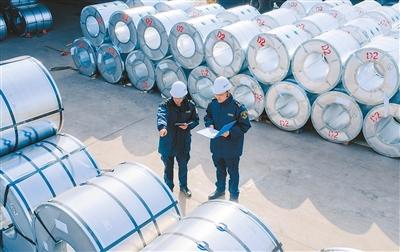
Customs officers with Tianjin Customs in north China's Tianjin Municipality inspect a batch of steel coils produced in north China's Hebei Province before they are loaded onto a vessel for export at Tianjin Port. (Photo/Peng Xiaoyi)
During the 14th Five-Year Plan period (2021-2025), the Beijing-Tianjin-Hebei region's annual imports and exports stayed above 4 trillion yuan ($581 billion), according to China's customs data. The region is home to more than 240,000 customs-registered enterprises, reflecting steady progress in coordinated development and opening-up.
The Communist Party of China Central Committee and the State Council have approved a spatial coordination plan for the modern capital metropolitan area (2023-2035), outlining practical measures to further advance opening-up across the region.
On Jan. 14, the north China branch of Cosco Shipping Specialized Carriers Co., Ltd. was officially inaugurated. The upgrade from a general department to a full regional branch signals the company's commitment to deeper integration with the Beijing-Tianjin-Hebei region and stronger customer responsiveness in north China.
"Our routes cover the globe, and we can transport drilling platforms, wind power equipment, bridge cranes and complete sets of equipment requiring specialized handling and loading," said Sun Ke, general manager of the company's north China branch. The Beijing-Tianjin-Hebei region's growing openness has steadily raised its profile in global shipping, he added.
The Beijing-Tianjin-Hebei region is home not only to the headquarters of many companies that are expanding overseas, but also to well-developed industries such as automobiles, steel and textiles, all of which generate strong demand for import and export transportation, Sun said.
As coordinated regional development deepens, ports in the Bohai Rim — including Jingtang, Tianjin, Qinhuangdao and Caofeidian — have steadily expanded their throughput capacity and lifted service standards, Sun noted.
These ports are also increasingly absorbing spillover shipping demand from the broader hinterland, including Shandong, Liaoning and Heilongjiang provinces and the Inner Mongolia Autonomous Region.
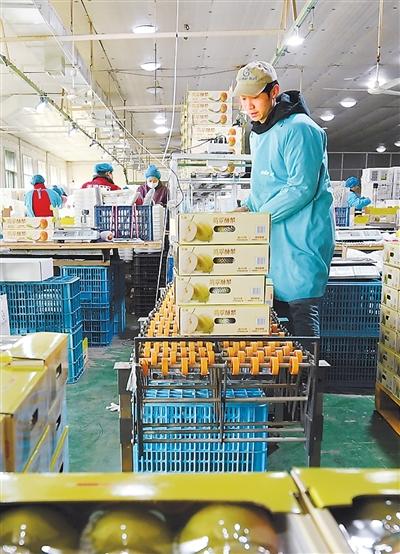
Employees work at an export-oriented fruit company in Jinzhou, north China's Hebei Province. (Xinhua/Yang Shiyao)
Sun added that the document proposes measures such as expanding international shipping routes, promoting the coordinated construction and operation of key logistics parks and hubs in Beijing and Tianjin, and ensuring the stability and smooth operation of the two cities' international logistics supply chains. These measures will deliver fresh momentum for opening-up in the Beijing-Tianjin-Hebei region and across northern China, he said.
"Following the establishment of the north China branch, we are striving to increase our shipping business in the Beijing-Tianjin-Hebei region by at least 30 percent this year," he added.
As more concrete measures take effect, the region's coordinated development is gaining momentum, with new frontiers of opening-up beginning to take shape.
In December 2025, a batch of reed blinds made from materials sourced at Baiyangdian Lake completed customs clearance at Xiong'an Customs — administered by Shijiazhuang Customs in north China's Hebei Province — before being shipped overseas from Tianjin Port.
The shipment marked the first export of bamboo, wood and grass products from Xiong'an New Area, opening a new pathway for the outward development of its distinctive ecological industries.
Li Jianguang, head of Zhaolong Reed Craft Cooperative, said the exported reed blinds were woven from natural reeds harvested in Baiyangdian Lake using traditional techniques. Since the 2025 harvest season, the cooperative has processed and exported reed blinds worth nearly 600,000 yuan, with destinations including France, Canada, the United Kingdom, Hungary, Spain and Chile.
"We are less than 200 kilometers from Tianjin Port. Our products can reach the port within three hours after loading, and customs clearance services provided by Xiong'an Customs are highly efficient," Li said.
"With strong national support for the capital metropolitan area and a series of new opening-up measures, we see more opportunities to expand into overseas markets," Li added.
Beyond facilitating the export of specialty products, Beijing-Tianjin-Hebei's coordinated development is also enhancing the international integration of local industrial and supply chains.
The document calls for better connectivity between Beijing's air and land ports and Tianjin Port, and accelerated transfer and commercialization of scientific and technological achievements to build a globally oriented innovation hub. It also calls for stronger support from the pilot free trade zones in Beijing, Tianjin and Hebei in areas such as trade and investment, industrial development, government services and the flow of production factors.
These measures will lay a solid foundation for the Beijing-Tianjin-Hebei region to explore new horizons of opening-up.
The document has also boosted confidence among market entities across the Beijing-Tianjin-Hebei region.
Photos



Related Stories
- China to unswervingly expand high-standard opening up: spokesperson
- China's opening-up gains momentum in 2025
- GE HealthCare's CEO emphasizes confidence in China market investments
- An open China delivers opportunities, confidence globally
- One Country, Two Systems: Forging a shared future through openness
- China builds development momentum through self-reliance and global engagement
- Chinese vice premier meets chair of Citigroup, CEO of Carlyle Group respectively
- China remains committed to high-level opening up
- China expands pilot programs to accelerate service opening up
- China continues to expand high-level opening up in 2025
Copyright © 2026 People's Daily Online. All Rights Reserved.
