



'Smart' cotton fields boost productivity, farmer incomes in Shaya, NW China's Xinjiang
"Cotton cultivation is much less stressful and the yields are more stable now," cotton farmer Ababekri Memet of Shaya county, Aksu prefecture, northwest China's Xinjiang Uygur Autonomous Region, told People's Daily Overseas Edition as he checked last year's harvest data on his smartphone with a satisfied smile.
Over the past few decades, China's cotton industry has undergone a remarkable transformation, moving from a labor-intensive, single-crop-focused industry to an integrated industrial chain featuring fully mechanized operations.
Shaya county, a major producing area of high-quality commercial cotton, serves as a microcosm of this modernization.
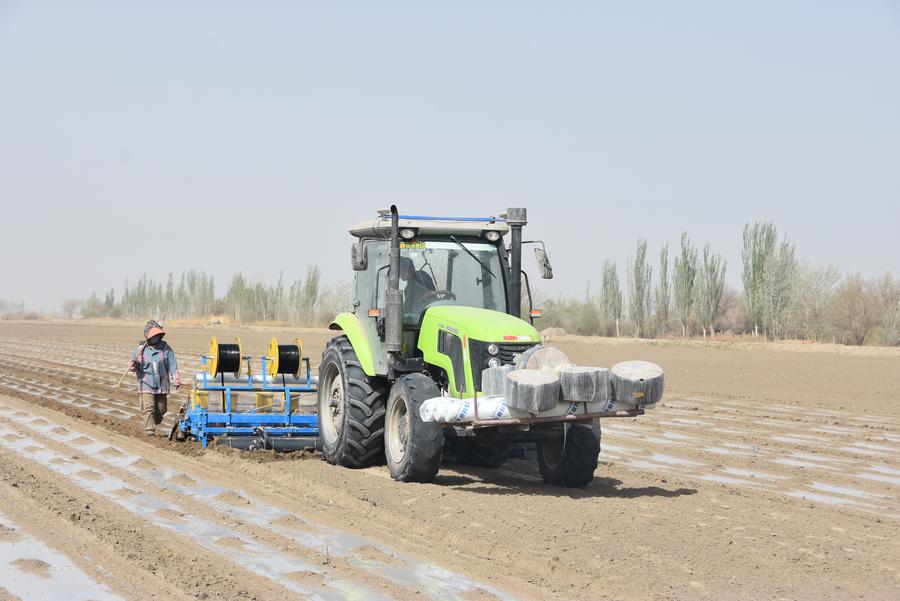
Farmers plant cotton in Shaya county, northwest China's Xinjiang Uygur Autonomous Region, April 11, 2025. (Xinhua/Gu Yu)
Comparing today to the old days when cotton picking relied heavily on manpower, Ababekri Memet marveled at how technology has reshaped cotton farming.
According to Ababekri Memet, mechanization now spans every stage of cotton production.
In spring, seeders empowered by China's homegrown BeiDou Navigation Satellite System (BDS) plant along pre-set routes with an error margin of less than 5 centimeters. Specialized spraying machines operate up to 50 times faster than manual labor during the crop protection stage, and even seedling management and fertilization are executed with precision by machinery.
At harvest, cotton pickers operate with remarkable efficiency. In the past, it took 12 workers two months to harvest 100 mu (6.67 hectares) of cotton; today, a single machine can harvest 5,000 mu in just 12 days.
Data from Shaya county's Bureau of Agricultural and Rural Affairs show that the county is equipped with 54,700 pieces of agricultural machinery and has maintained a mechanization rate above 95 percent for five consecutive years.
With more cotton farmers forming agricultural cooperatives, purchasing advanced machinery, and providing mechanized farming services, Shaya county is currently home to 112 agricultural machinery cooperatives, which provide services covering all cotton fields in the county.
Ababekri Memet runs one such cooperative himself. Last year, his cooperative provided mechanized farming services for over 7,000 mu of farmland, he said.
The cooperative's total annual revenue exceeded 1.1 million yuan ($158,000) last year, with around 40 percent coming from mechanized services, according to Ababekri Memet, who added that besides local farmers, the cooperative also receives orders from neighboring counties.
The winter off-season is a key period for selecting cotton varieties, a process that is now increasingly data-driven, according to Ababekri Memet.
Each year, the Seed Industry Development Center of Shaya county holds variety promotion events and distributes comparative test reports.
"I choose varieties by analyzing the data and matching it to my fields, which ensures informed and efficient decisions," Ababekri Memet explained.
Shaya county has established comprehensive crop-testing stations to provide reliable, science-based guidance to farmers, according to Lei Yabin, a staff member of the Seed Industry Development Center.
For years, these stations have conducted systematic trials comparing the main cotton varieties from seedling to harvest, tracking yields, fiber quality, and disease resistance, Lei said.
Through area-based promotion of high-yield and high-quality varieties, Xinjiang has raised the coverage rate of superior cotton seeds to over 98 percent.
In 2025, the Cotton Research Institute of the Xinjiang Academy of Agricultural Sciences introduced more than 3,400 domestic and international germplasm samples, developed over 40 valuable drought-, heat-, and saline-tolerant new germplasm lines, and released seven new multi-type cotton varieties.
These breakthroughs, combined with a robust countywide seed propagation and promotion system, have led to tangible improvements in yield and quality.
According to the latest data released by China's National Bureau of Statistics, Xinjiang's cotton production in 2025 surpassed the 6-million-tonne mark for the first time, reaching nearly 6.17 million tonnes and accounting for 92.8 percent of the national total.
In Shaya, cotton yield per mu rose from 285 kilograms in 2017 to 442 kilograms in 2025, increasing farmers' per-mu income by 1,000 yuan.
"Cotton farming can create wealth," said Ababekri Memet, who plans to expand his operations this year with a new cotton picker and two high-powered tractors, aiming to provide mechanized services for over 10,000 mu of farmland.
Photos



Related Stories
- China's Xinjiang reports vigorous foreign trade growth in 2025
- Xinjiang posts robust tourism growth in 2025
- Remote Chinese city Altay thrives in long winter, turning snow into tourism success
- Third Winter Games Around the Altai Mountains opens in Xinjiang
- 19 Chinese provinces, municipalities allocate 19.7 bln yuan in 2025 to support Xinjiang's development
- China's wind frontier learns to build an industry
- Chinese VP meets OIC secretary-general
- Xinjiang launches China's first express cotton freight train service
- Xinjiang reports highest foreign trade growth in China
- Xinjiang's foreign trade in 2025 hits new record
Copyright © 2026 People's Daily Online. All Rights Reserved.
