



Ancient Cham dance finds new life in SW China's Xizang

A dancer performs Cham dance. (Photo courtesy of Yu Chao)
During the Tibetan New Year each year in southwest China's Xizang Autonomous Region, Cham dance, an ancient ritual dance that reflects the region's cultural traditions, unfolds across the plateau.
Wearing solemn masks, performers take the stage in vibrantly colored costumes, their flowing garments adorned with embroidered auspicious patterns that ripple with every movement.
The history of Cham dance dates back to the 8th century. It records and conveys the religious beliefs, folk customs and daily life of the Tibetan ethnic group. Over more than a thousand years, it has absorbed elements from folk dances, evolving into a cultural treasure that embodies both spiritual meaning and artistic value.
In the 1990s, few young people could perform a full Cham dance routine, and the craft of mask-making was on the brink of disappearance, recalled Tashi, a representative inheritor of Cham dance from Tashilhunpo Monastery in Xigaze.
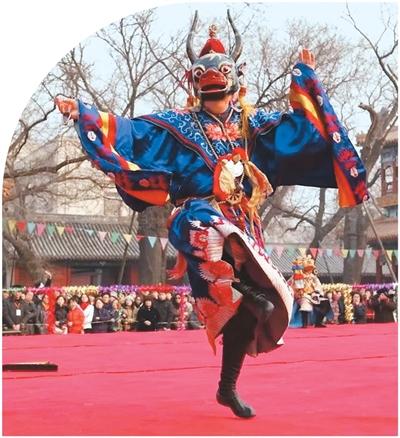
A dancer performs Cham dance. (Photo courtesy of Yu Chao)
Since then, national and local governments have actively strengthened preservation efforts, including designating inheritors, establishing training centers, setting up master-apprentice programs, incorporating Cham dance into intangible cultural heritage tourism routes, and formulating special protection regulations. These measures aim to help more people understand, appreciate and participate in safeguarding this ancient art form.
In 2006, Cham dance from Tashilhunpo Monastery in Xigaze was included in the first batch of national intangible cultural heritage. To date, eight types of Cham dance have been incorporated into the national protection system.
In recent years, Cham dance has reached new audiences through inter-regional exchanges, culture-tourism integration and cross-cultural dialogue.
In 2024, one form of Cham dance was featured in Nyingchi's intangible cultural heritage performance exchange activities in Hong Kong and Macao, where many audience members expressed hope for opportunities to explore up close the cultural codes embedded in the masks and dance steps.
The same form of Cham dance once again captivated audiences at the 2025 China (Guangdong) International Tourism Industry Expo. Numerous cultural and tourism organizations expressed interest in collaboration, hoping to integrate this intangible cultural heritage into educational tour products and offer a window for firsthand experiences of Tibetan culture.
Masks are key to understanding the characters in Cham performances. Each represents a fusion of craftsmanship and faith, encapsulating the history of cultural exchange between the Tibetan and Han peoples.
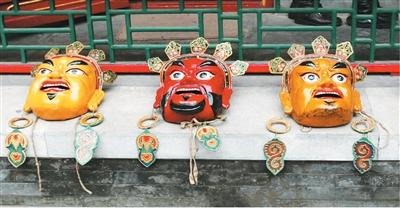
Photo shows masks for performing Cham dance. (Photo courtesy of Yu Chao)
"The colors of Cham masks carry profound meaning. Red signifies auspiciousness, blue represents bravery, yellow symbolizes learning, white denotes purity, and black indicates antagonists. These five colors originate from the Wuxing, or five elements, wood, fire, earth, metal and water, of Central Plains culture, marking the integration of Han and Tibetan cultures," said Tsering, a craftsman living near Tashilhunpo Monastery.
Tsering was sent by his family to Barkhor Street in Lhasa, capital of Xizang, at the age of 15 to learn the craft. After eight or nine years of apprenticeship under veteran artisans, he completed his training and has since gained recognition.
Materials used to make Cham masks are mostly sourced in Xizang, including wood, fabric and pigments. Some precious masks also incorporate gold leaf and gemstones. Craftsmen must complete dozens of processes, from material selection and carving to painting and lacquering. It takes months or even years to finish a single piece.
Cham performances at Beijing's Yonghe Temple offer a vivid example of how the tradition thrives beyond its place of origin. Performers there faithfully preserve the core elements of masks, movements and musical instruments, maintaining the essence of this intangible cultural heritage. At the same time, they adapt movement range and presentation styles to suit different performance spaces, allowing the ancient art to flourish in new settings.
Photos
Related Stories
- New Year concert held in Lhasa, China's Xizang
- In six decades, Xizang's civil aviation soars to new heights
- Tailoring inbound travel to Xizang
- World's highest organic tea farm brews new vitality in SW China's Xizang
- Over 1,000 student teachers help transform education in SW China's Xizang
- Panchen Rinpoche concludes Xizang tour
- Trans-Himalaya Tibetan medicine research center opens in China's Xizang
- Devoted guardians make protection efforts more engaging
- Xizang conducts 42 archaeological excavations over past five years
- Lhalu Wetland in China's Xizang confirmed as world's highest altitude natural urban wetland
Copyright © 2026 People's Daily Online. All Rights Reserved.
