



China's 2025 box office exceeds 50 bln yuan as film market thrives
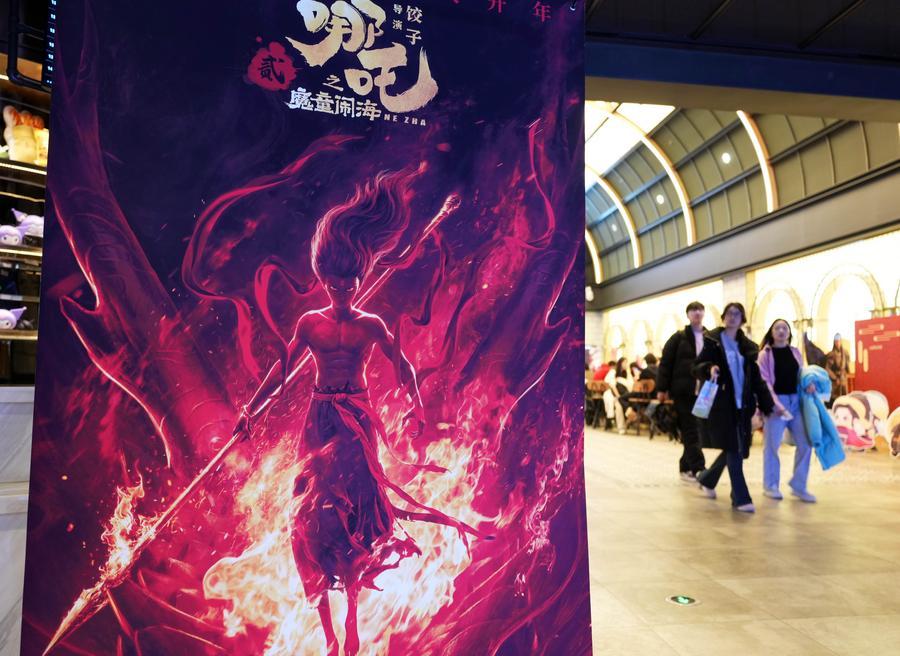
People walk past a poster of the animated feature "Ne Zha 2" at a cinema in Shenyang, northeast China's Liaoning Province, Feb. 6, 2025. (Xinhua/Li Gang)
China's 2025 box office revenue exceeded 50 billion yuan ($7.09 billion) at 2:30 p.m. on Dec. 13, surpassing the 2024 full-year total by 7.5 billion yuan, according to the China Film Administration.
More than 400 films have hit screens nationwide this year. A series of high-quality domestic productions has emerged, including the Chinese animated blockbuster "Ne Zha 2" and the Chinese historical film "Dead to Rights" about the 1937 Nanjing Massacre. These films tell compelling Chinese stories that resonate with audiences while achieving both strong box office results and critical acclaim.
This year marks the 80th anniversary of the victory in the Chinese People's War of Resistance Against Japanese Aggression and the World Anti-Fascist War. Consequently, films depicting the Chinese people's wartime struggle have drawn widespread attention. Notable entries include "Dead to Rights" and "Evil Unbound," a Chinese production portraying the atrocities committed by the notorious Japanese germ warfare Unit 731 during World War II.
The rising influence of domestic cinema is now widely recognized. In recent years, an increasing number of Chinese films have incorporated traditional cultural elements with contemporary values, better aligning with modern aesthetic preferences and spiritual pursuits. The industry has made significant strides in genre diversification and production quality, reaching world-class standards in both storytelling and visual effects.
Domestic films have won over Chinese audiences with compelling content. The Chinese film market no longer relies on imports, and homegrown productions occupy a dominant position. Quality domestic films have become blockbusters, repeatedly breaking box office records.
"Ne Zha 2," with its captivating story and stunning visual effects, became a global phenomenon. The film grossed over 15.9 billion yuan, making it the highest-grossing film in a single market worldwide, the highest-grossing animated movie of all time, and the fifth-highest-grossing film in global box office history.
The surge of innovative genre films demonstrates the creative vitality of Chinese cinema. "Blue Planet Outside the Window," China's first space documentary filmed in space, offers an awe-inspiring visual experience and has become another standout production of the year.
Driven by cultural confidence and technological innovation, Chinese films have not only created spectacular on-screen experiences but also extended their influence into broader consumer sectors.
Through "film plus cultural and creative products" and "film plus retail," Chinese films have entered a new stage of full industry-chain intellectual property (IP) development. The market for film-related merchandise has reached 100 billion yuan, while cross-sector film IP collaborations continue to generate ripple effects.
"Ne Zha 2" partnered with dozens of brands across sectors, including food, cosmetics, automobiles, designer toys, electronics and coffee, with cumulative merchandise sales reaching tens of billions of yuan.
"Film plus tourism" and "film plus dining" have emerged as new trends in the culture and tourism sectors. Since the beginning of this year, the China Film Administration and China Media Group have jointly spearheaded the "China Film Consumption Year" campaign, featuring a wide range of cinema-related promotional events and discount programs.
CCTV News has rolled out a series of "film plus" consumption initiatives. These include a program in partnership with airlines and ticketing platforms Maoyan and Taopiaopiao, which allows moviegoers to win flight vouchers, as well as dining promotions offering movie vouchers with food purchases.
Many regions have also actively explored new ways to integrate films with cultural tourism. Shanghai unveiled the Wu'an Film District, a film-themed block that combines cinema with bookstores, dining, performances, exhibitions and sports. Additionally, four film-themed routes have been launched to further integrate cinema with consumer experiences.

A boy views a poster of "Dead To Rights" at a cinema in Chaoyang district of Beijing, capital of China, on Aug. 4, 2025. (Xinhua/Zhu Weixi)
The "film plus" model is not only shifting the Chinese film industry from a box-office-driven approach toward a diversified consumption ecosystem but also positioning the film economy as a key engine for boosting consumption and upgrading the industry.
The thriving Chinese market, marked by record-breaking revenue, provides fertile ground for domestic films. Simultaneously, through high-level opening-up, it offers solid support for the global box office and diversified revenue channels for quality international productions.
China boasts the world's most digitalized ticketing system and one of the most efficient film scheduling networks. Consumer demand is growing rapidly, with the share of box office revenue from third- and fourth-tier cities and county-level cinemas continuing to rise.
Meanwhile, the Chinese film market has developed a rich industrial ecosystem. From the world's first Zootopia-themed land at Shanghai Disney Resort to the more than 70 brands partnering with "Zootopia 2" in the Chinese mainland market alone, China has built a complete film IP industrial chain.
Behind the vibrant market and the steady emergence of domestic blockbusters lies the continuous maturation of China's film industry, accompanied by rapid advancements in technical capabilities.
China's vigorous development of new quality productive forces has provided strong momentum for the digital and intelligent transformation of the industry. The full integration of technology has brought sweeping changes, from production to the viewing experience.
China's film industry has broken previous monopolies on special effects production, driving deeper integration of artificial intelligence with filmmaking. Several new film production hubs equipped with cutting-edge technologies have emerged.
China now operates more than 90,000 cinema screens and has developed a world-leading cinema projection sector. Its domestically produced projection systems, backed by proprietary technology, particularly stand out.
The CINITY LED system — developed independently in China — integrates seven core technologies, including 3D, 4K resolution and high frame rates of up to 120 fps, delivering an immersive viewing experience.
"Going global" has become another key phrase for China's film market in 2025.
As early as October, overseas box office revenue for Chinese films reached $140 million, exceeding the full-year total for 2024.
Films promoting traditional Chinese culture have resonated with international audiences. "Ne Zha 2" premiered in major markets including North America, Europe and Oceania. Its overseas revenue reached $69 million, making it the highest-earning domestic film abroad in recent years and a prominent calling card for cultural exchange.
Meanwhile, mainstream films have articulated China's position and promoted international fairness and justice. Films such as "Dead to Rights" and "Evil Unbound" have been released in multiple countries and regions, promoting a correct historical perspective on World War II, highlighting China's historical role and major contributions as the main battlefield in the East of the World Anti-Fascist War, and drawing wide attention from the international community.
Photos




Related Stories
Copyright © 2026 People's Daily Online. All Rights Reserved.
