



Jade carving thrives in county in E China's Jiangsu
Although it is not a jade-producing region, Pizhou, a county-level city administered by Xuzhou in east China's Jiangsu Province, has cultivated a jade-carving industry with an annual output value exceeding 8 billion yuan ($1.14 billion).
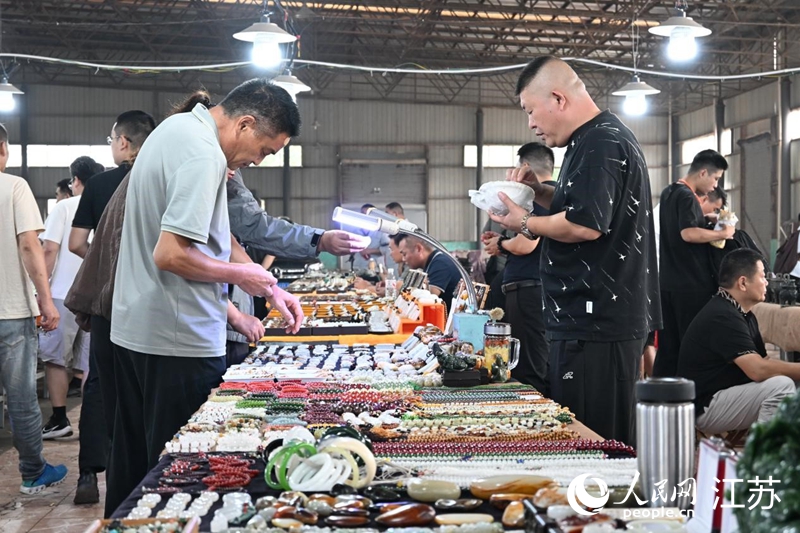
Jade professionals gather at a jade fair in Pizhou, a county-level city administered by Xuzhou, east China's Jiangsu Province, in October 2025. (People's Daily Online/Zhang Hantian)
Modern jade carving in Pizhou dates back to the 1970s, according to Liu Yinqiang, deputy director of the Pizhou Jade Carving Association. The industry started with a jade processing factory that trained a generation of skilled professionals. In the early 1990s, however, the factory closed due to slow business. Over 200 employees went on to start their own businesses, passing on their skills through apprenticeships and forming a tight-knit community of jade-carving specialists.
Today, the number of jade artisans in Pizhou has grown from a few hundred to nearly 100,000. The city has developed five specialized jade trading markets, creating a complete industrial chain.
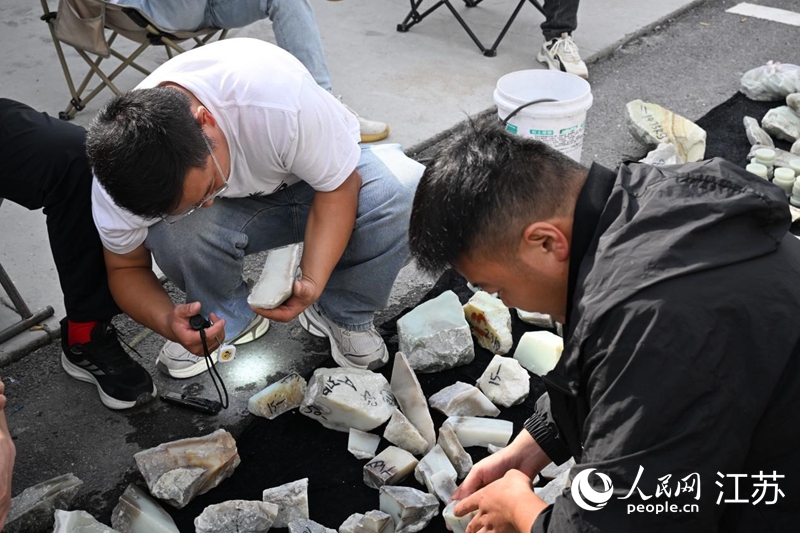
Jade buyers check the quality of raw jade at a jade fair in Pizhou, a county-level city administered by Xuzhou, east China's Jiangsu Province. (People's Daily Online/Zhang Hantian)
At the newly built 50,000-square-meter Huaihai Hanyu Cultural and Creative Park, 200 digital carving workshops run around the clock.
"Ten years ago, a single intricately carved jade pendant would take a master a full week to complete, with labor costs alone reaching 3,000 to 4,000 yuan. Today, combining computer-aided design with hand finishing, the same piece costs only a few hundred yuan," Liu said.
Thanks to digital technology, production is now nearly 15 times more efficient, and custom orders have grown by 40 percent. This shift has not only delivered benefits but also unlocked new markets for jade carving.
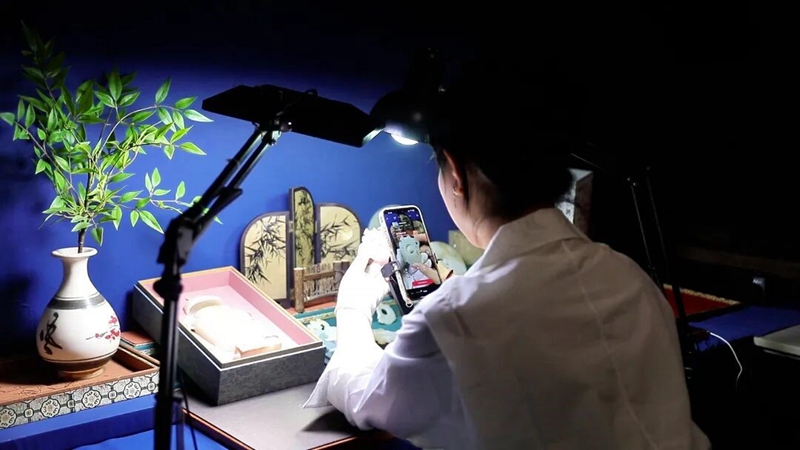
A woman sells jade products during a livestreaming session in Pizhou, a county-level city administered by Xuzhou, east China's Jiangsu Province. (Photo courtesy of the Publicity Department of the Communist Party of China Pizhou Municipal Committee)
In 2024, online sales of jade carvings exceeded 2.5 billion yuan, accounting for a third of the industry's total revenue.
Liang Chuanxing, president of the Pizhou Jade Carving Association, said the city has been actively reshaping its jade-carving brands in recent years.
In 2023, the association partnered with Pizhou Museum to launch a line of creative cultural products, combining Han Dynasty (202 B.C.-220 A.D.) craftsmanship with modern design concepts. The first batch of products generated more than 10 million yuan in sales within just three months.
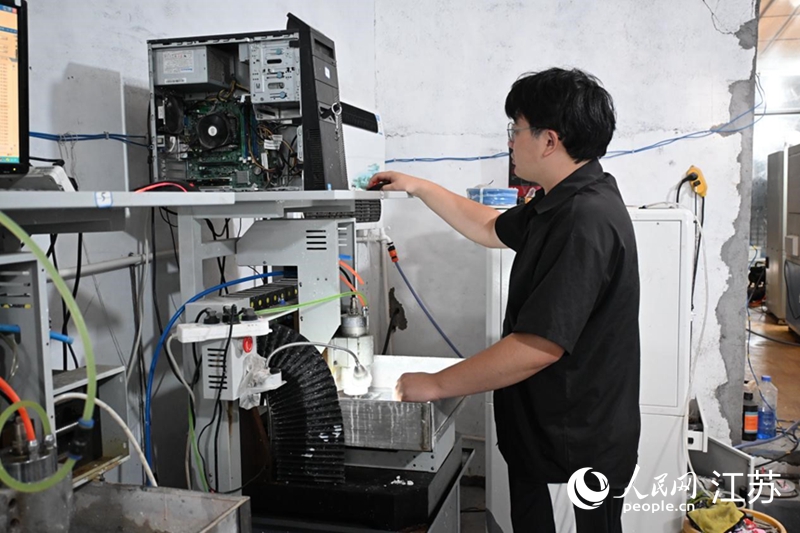
A young professional uses a carving machine to design jade products. (People's Daily Online/Zhang Hantian)
Today, workers under 35 make up 30 percent of Pizhou's jade-carving workforce, up from just 15 percent five years ago.
Photos

Related Stories
- Carving out a symbol of virtue
- Jade phoenix displayed at Panlongcheng Site Museum in Wuhan, China's Hubei
- Jade rabbit pendant: Vivid masterpiece of Chinese jade carving
- Jade culture nurtures harmony in daily life
- Chinese archaeologists find 5,000-year-old jade processing base
- Milestones of millennia: Role of jade in China history explored
- Imperial seal could fetch tens of millions of dollars
- ‘King of turquoise’ found in Hubei
- SE China Bay as Beautiful as Jade
- Lingerie made of emeralds shown in SW China
Copyright © 2025 People's Daily Online. All Rights Reserved.
