



Taiwan-style oolong tea takes root in Zhangping, SE China's Fujian

Photo shows an oolong tea garden in Zhangping, a county-level city in Longyan, southeast China's Fujian Province. (People's Daily Online/Li Changqian)
Zhangping, a county-level city in Longyan, southeast China's Fujian Province, is home to the Chinese mainland's largest Taiwan-style oolong tea production base. The oolong tea produced here shares the same origins as its counterpart in China's Taiwan region, preserving while innovating Taiwan's traditional tea-making techniques.
In 1996, Xie Dongqing, a Taiwanese farmer, and his family leased 350 mu (about 23.3 hectares) of barren land in Yongfu town, Zhangping. The following year, he planted 400,000 Taiwan oolong tea seedlings.
"I chose Yongfu because its altitude, climate, soil, and latitude are nearly identical to the tea-growing region of Taiwan's Ali Mountain," Xie explained.
Yongfu town, the core tea-producing area in Zhangping, sits at an average elevation of 780 meters. Large temperature differences between day and night, year-round mist, and abundant diffused sunlight create ideal conditions for tea cultivation.
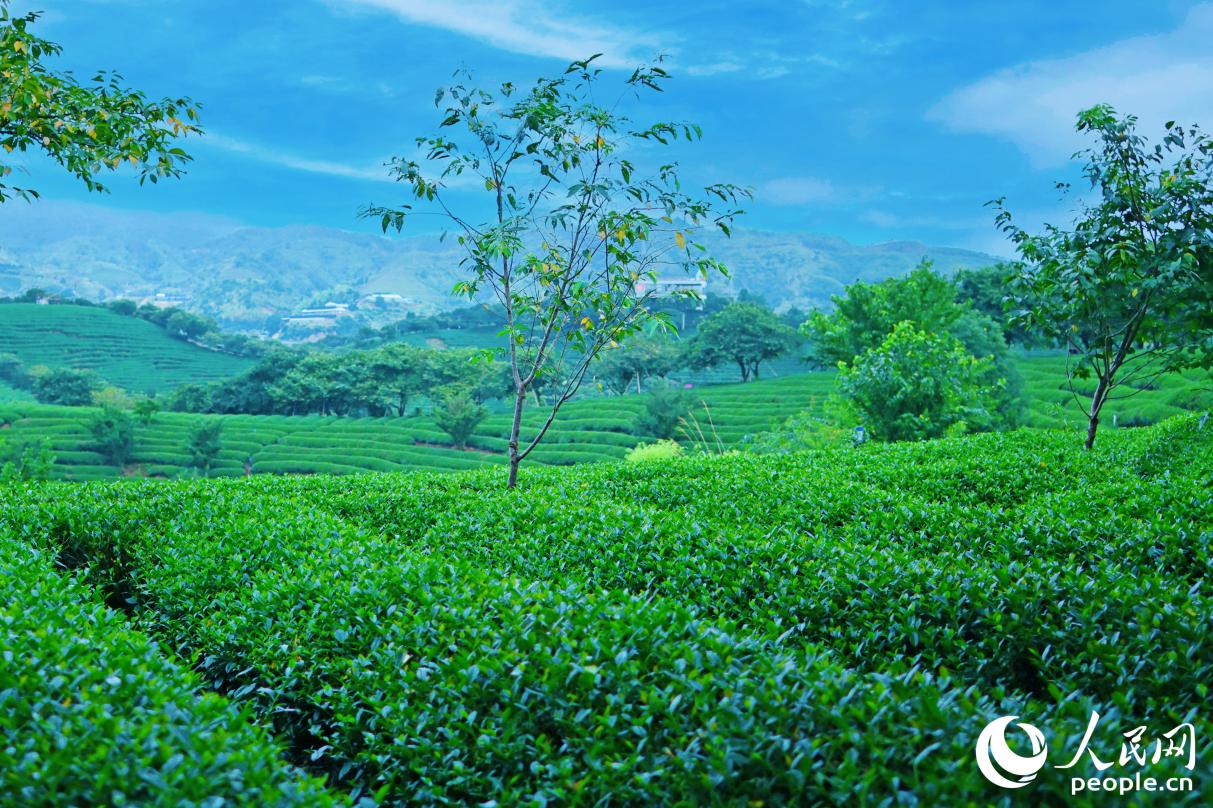
Photo shows an oolong tea garden in Yongfu town, Zhangping, a county-level city in Longyan, southeast China's Fujian Province. (People's Daily Online/Li Changqian)
As Xie's tea plantation expanded, a growing number of Taiwanese tea farmers were drawn to Zhangping to cultivate tea trees in the mountains. Li Zhihong was among them.
"Zhangping's climate closely resembles Taiwan's Ali Mountain, making it ideal for growing high-mountain tea," Li said. "I had long dreamed of developing a tea business on the mainland, so I decided to put down roots here and build a plantation from scratch."
In Yongfu town, Li introduced innovative plantation management techniques and now produces 40 tonnes of premium high-mountain tea annually. His tea has even been selected by the Palace Museum. Today, he has expanded his plantation to 2,500 mu and employed over 500 local farmers in tea picking, processing, and distribution, generating an additional 6 million yuan (about $851,395.8) in income.
To date, Zhangping has established 48 high-mountain tea bases covering more than 50,000 mu, with annual tea production exceeding 5,800 tonnes. Yongfu town has become the most concentrated and largest tea production base for Taiwanese farmers' investment outside the Taiwan island.
Photos
Related Stories
- When Shanxi Fenjiu meets Chengdu tea: A journey of inspired blends
- Tea industry exceeds 15 billion yuan in Wuyishan, SE China's Fujian
- Tea expo in Prague highlights cultural exchanges with China
- Increasingly versatile matcha boosts incomes for 110,000 tea farmers in Tongren, SW China's Guizhou
- China's new-style tea beverages turn daily drinking into cultural expressions
- Tea gardens in C China's Hubei bloom into tourist destinations
- E China's village boosts coordinated development of tea industry and tourist service
- China's bubble tea boom brews rural growth, international presence
- Chinese green pest control technologies benefit overseas tea plantations
- The 3rd Cambridge International Tea Culture Festival in celebration of the UN International Day for Dialogue Among Civilizations
Copyright © 2026 People's Daily Online. All Rights Reserved.
