



Bringing APEC economies closer through connectivity in infrastructure, rules, and people
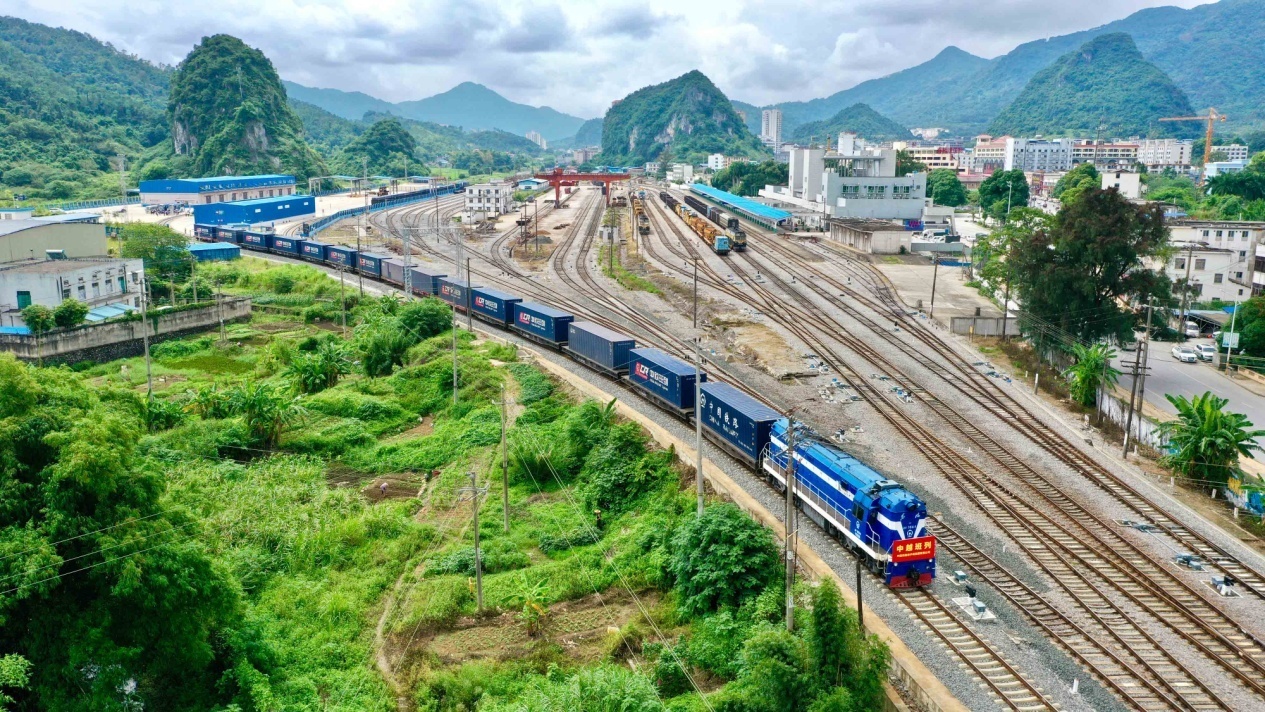
A China-Vietnam cross-border freight train departs the Pingxiang Railway Port in south China's Guangxi Zhuang autonomous region. (Photo/Yang Baosen)
In the Asia-Pacific, giant vessels laden with goods cross the vast oceans, trains speed across the land, and aerial routes weave into an increasingly dense network.
In 2014, the Asia-Pacific Economic Cooperation (APEC) Economic Leaders' Meeting in Beijing adopted the APEC Connectivity Blueprint (2015-2025).
Over the past decade and more, APEC members have worked hand in hand to steadily advance physical, institutional, and people-to-people connectivity, solidifying the foundation for open development across the region. A comprehensive, multi-tiered, and high-level connectivity network continues to take shape.
Connecting infrastructure: Facilitating smooth flow of goods across Asia-Pacific
At the Chancay Port in Peru, an ocean-going cargo vessel loaded with specialty agricultural products such as blueberries and bananas set sail, arriving at the venue of the ninth China International Import Expo (CIIE) in Shanghai in just 22 days.
At Shanghai Port, BYD ZHENGZHOU, the roll-on/roll-off vessel operated by Chinese automaker BYD, embarked on a 14-day voyage to deliver over 4,000 Chinese new energy vehicles to the Port of Melbourne in Australia.
At the Pingxiang Railway Port in south China's Guangxi Zhuang autonomous region, a China-Vietnam cross-border freight train loaded with tropical fresh fruit arrived, enriching the fruit baskets of countless Chinese households.
Intertwined highways, railways, shipping routes, and digital networks are enabling a growing array of commodities to cross oceans and mountains and circulate smoothly across the Asia-Pacific.
Research data published by the APEC Policy Support Unit shows that rail networks in the region grew 9 percent while airport and maritime connectivity increased by 3.8 percent and 12 percent, respectively, between 2015 and 2025.
Infrastructure projects such as the airport cluster in the Guangdong-Hong Kong-Macao Greater Bay Area in China, the Jakarta-Bandung High-Speed Railway in Indonesia, the East Coast Rail Link in Malaysia, and the Independence Boulevard in Papua New Guinea have not only improved domestic transportation networks but also expanded the space for regional connectivity.
Driven by the proactive efforts of APEC members, Asia-Pacific connectivity is upgrading toward a smarter, greener, and more resilient future.
"By advancing connectivity in a greener, more sustainable, and more inclusive manner, the outcomes of cooperation under the APEC framework will benefit even more people," said Anindya Novyan Bakrie, chairman of the APEC Business Advisory Council (ABAC) Indonesia and the Indonesian Chamber of Commerce and Industry.
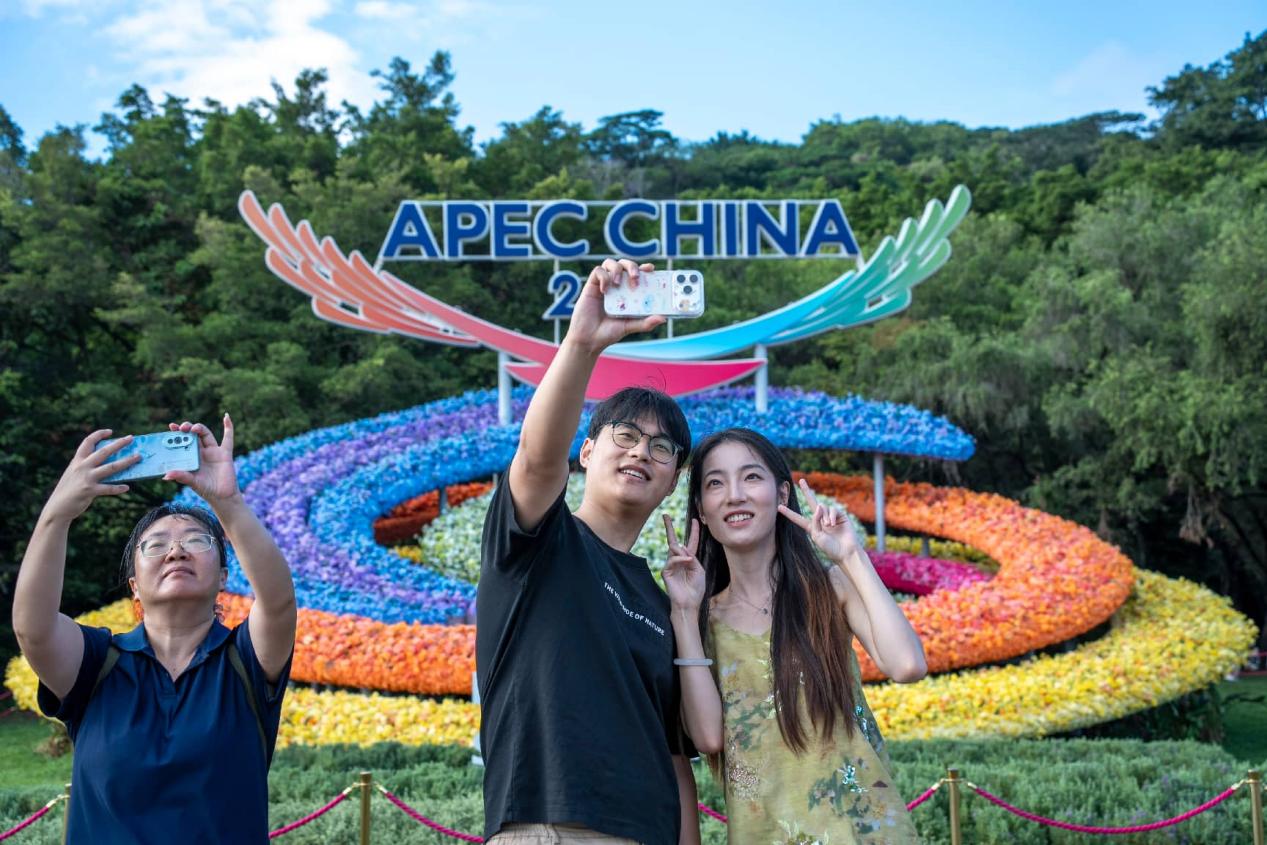
An Asia-Pacific Economic Cooperation (APEC)-themed flower bed attracts citizens and tourists to snap photos at Lianhuashan Park in Shenzhen, south China's Guangdong province. (Photo/Leng Wen)
Connecting rules and regulations: Breaking down barriers and unleashing benefits
From advancing market connectivity to promoting the alignment of rules and regulations, APEC members have continued to dismantle barriers to the flow of trade, investment, technology, and services, making economic circulation smoother than ever.
Among APEC economies, 12 are members of the Regional Comprehensive Economic Partnership (RCEP). Since its inception, the China-ASEAN Free Trade Area (FTA) has operated steadily and achieved fruitful results.
Once taking effect, the China-ASEAN FTA 3.0 Upgrade Protocol will work hand in hand with the RCEP, creating an even more powerful "dual-engine" drive.
As the high-standard free trade area network continues to develop, institutional arrangements such as preferential tariff treatment, and cumulation of origin will translate into tangible convenience for all business entities.
In Jiaxing, east China's Zhejiang province, automotive slide-rail assemblies produced by TF-METAL Zhejiang Co., Ltd., a subsidiary of Japan's TF-METAL Co., Ltd., connect industrial chains across China, Japan, and Thailand.
The components are imported from Japan, processed and assembled in China, and the finished products are exported to automotive factories in Thailand. The most vital document traveling with the product is the RCEP certificate of origin, likened to "paper gold" by foreign trade insiders.
Previously, because the Japanese components accounted for a relatively high value, the product sometimes failed to meet the rules-of-origin requirements of the China-ASEAN FTA, forcing Thai clients to pay extra import tariffs.
After the RCEP entered into force, the principle of accumulation of origin allows raw materials originating in Japan to be considered as materials originating in other RCEP members where processing is taking place, making it easier for products to qualify for preferential tariffs.
According to the general manager of TF-METAL Co., Ltd., since 2022, the company has saved approximately $1.34 million for its clients. With the mass production of new vehicle models, this figure is expected to continue growing.
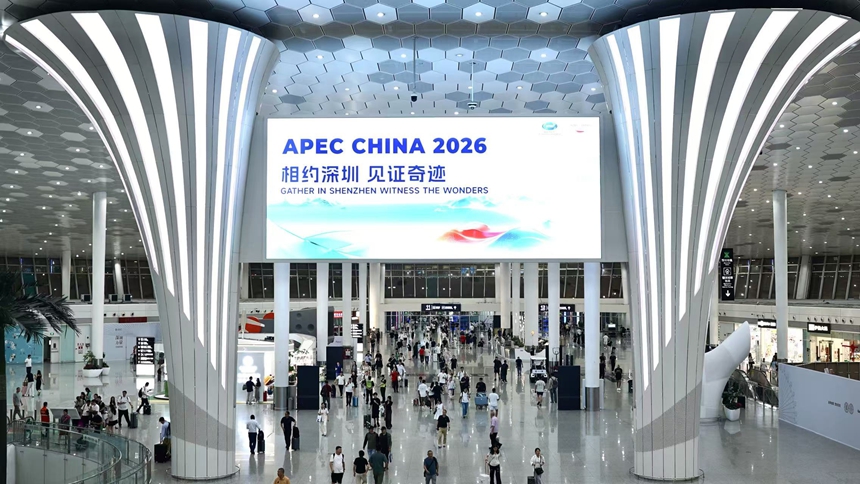
Photo shows an Asia-Pacific Economic Cooperation (APEC)-themed large-screen poster at Shenzhen Bao'an International Airport in Shenzhen, south China's Guangdong province. (Photo/Shenzhen Airport Group)
Connecting people: Fostering close ties and deepening friendship
Data shows that in the first 10 months of this year, more than 1.25 million entries and exits by foreign travelers from APEC economies were recorded at Shenzhen Bao'an International Airport in Shenzhen, south China's Guangdong province.
As the flight touches down, a Mexican merchant holding an APEC Business Travel Card passes through entry inspection quickly and smoothly via a dedicated border inspection channel. The pragmatic facilitation measures implemented by China as the APEC host country left a deep impression on him.
The APEC Business Travel Card is an important instrument for promoting the facilitation of personnel exchanges. A final report on the performance evaluation of the APEC Business Travel Card mechanism, released in 2025, shows that the mechanism covers all 21 APEC economies, with over 460,000 cardholders worldwide. China is the most popular destination for these cardholders.
As business exchanges, scientific research cooperation, and people-to-people ties grow ever more frequent, Shenzhen, a dynamic hub of opening-up, showcases the vitality of exchange.
Exchanges draw people closer while sparking new ideas for cooperation. At the 2026 WISEDEMO Campaign Asia-Pacific Youth Shenzhen Dialogue, held in Shenzhen, young people from across the region expressed their expectations for regional cooperation through diverse proposals.
"As the world meets Shenzhen, new stories begin to bloom. One world, we stand together."
These lines are from the song "One World," composed by South Korean international student Shin Moon-sub to welcome the APEC Economic Leaders' Meeting in Shenzhen.
Performed jointly by young people from across the globe, the song captures a shared aspiration: letting exchanges span mountains and seas, cooperation bridge borders, and people work together to forge a brighter future for the Asia-Pacific community.
Photos



Related Stories
- President Xi: To see 50 years of China, come to Shenzhen
- RWS CEO hails China's open message, leadership at APEC
- The Asia-Pacific is a realm for shared devt, a stage for co-op side by side
- Full text: Remarks by Chinese President Xi Jinping at the 33rd APEC Economic Leaders' Meeting
- Xi announces measures to consistently support Asia-Pacific cooperation
- China is advocate, promoter, forerunner in Asia-Pacific economic cooperation: Xi
- Xi stresses innovation in building Asia-Pacific community
- Xi calls for openness, integration in building Asia-Pacific community
- Xi stresses solidarity, mutual assistance in building Asia-Pacific community
- Xi calls for further efforts to build Asia-Pacific community
Copyright © 2026 People's Daily Online. All Rights Reserved.
