



Jordanian entrepreneur builds thriving business, finds a home in E China's Yiwu
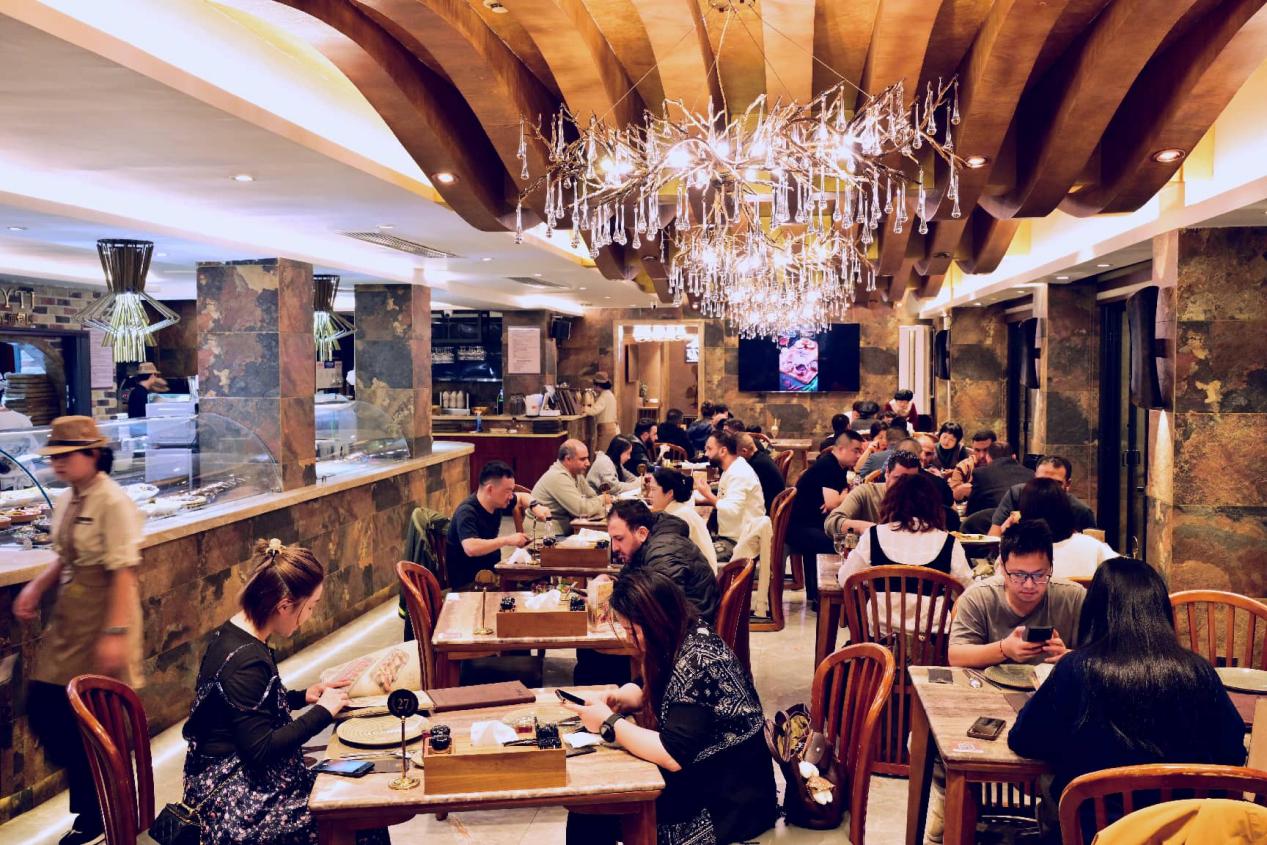
Beyti Restaurant in Yiwu, east China's Zhejiang province, is packed with patrons. (Photo/Lyu Bin)
Beyti Restaurant on Chouzhou North Road in Yiwu, east China's Zhejiang province, draws a lively crowd of patrons as the aroma of grilled meat wafts from the kitchen.
Spotting a regular customer walking in, restaurant owner Mohanad Shalabi steps forward to offer a warm handshake and an embrace, just like welcoming a family member home.
Shalabi has been living in China for 26 years. In 2002, he and his wife moved to Yiwu and opened an Arabic restaurant named "Ward," meaning "Flower" in Arabic. Since then, the restaurant, offering culinary delights and a touch of homesickness, has flourished here. Shalabi has not only achieved his entrepreneurial dream, but also found a true sense of belonging in China.
Originally from Jordan, Shalabi left his hometown at the age of 17 to make a living, traveling to the Netherlands and Thailand along the way. In 2000, he arrived in Guangzhou, south China's Guangdong province, where he worked in an Arabic restaurant run by his uncle, learning how to cook while gaining management experience. "Back then, the seed of entrepreneurship was already planted in my heart," Shalabi recalled.
"China's vast market offered boundless opportunities, and I believed my career would succeed here," he said. Later, he married Liu Fang, a woman from east China's Anhui province who worked as an interpreter at the restaurant, making him even more determined to make China his home.
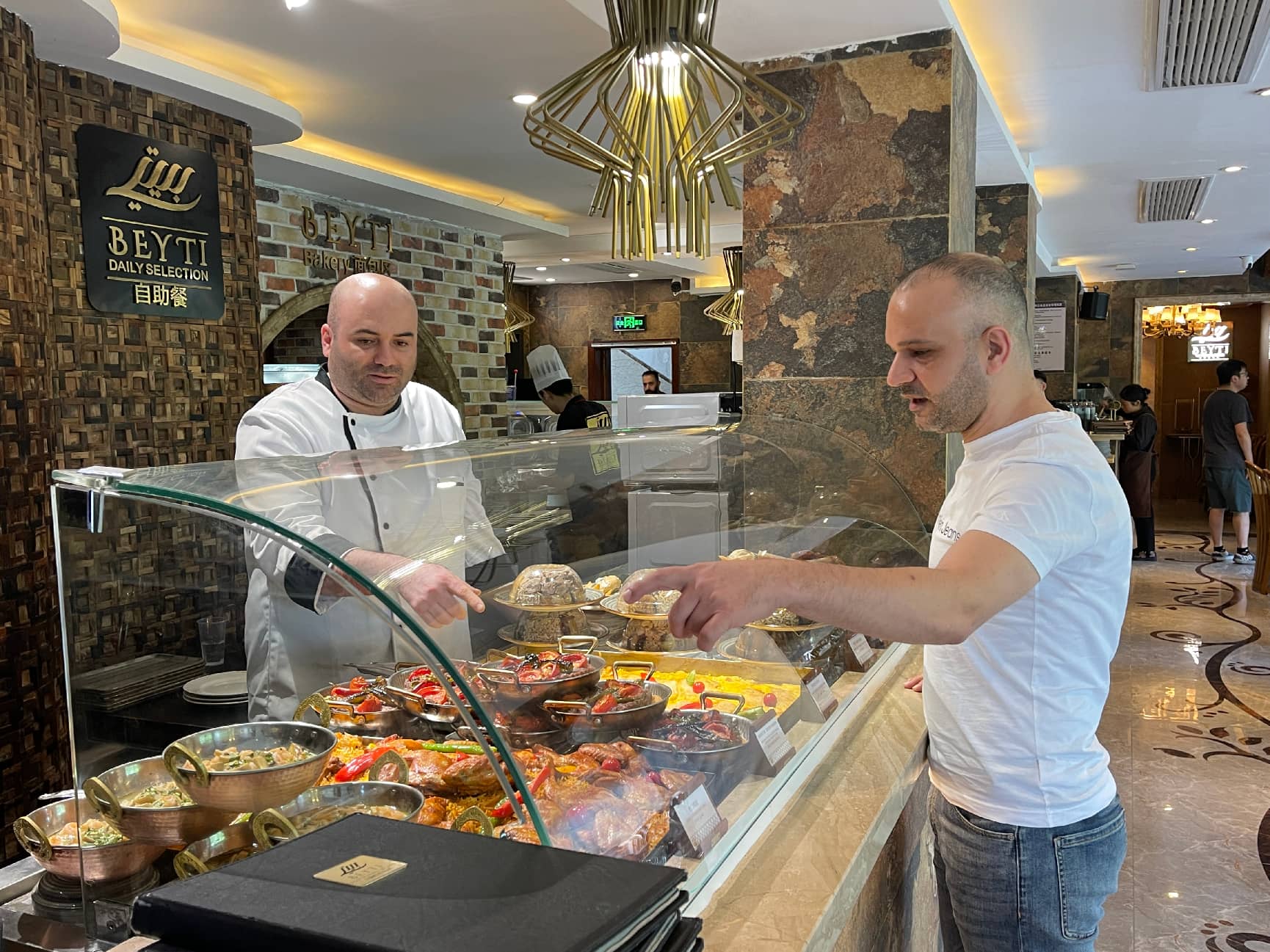
Mohanad Shalabi (right) talks with an employee in his restaurant in Yiwu, east China's Zhejiang province. (People's Daily/Liu Junguo)
In 2002, through a friend originally from the Middle East, Shalabi learned about Yiwu, a vast market for small commodities where many foreign merchants went to source goods.
"My friend told me it was hard to find an authentic Arabic restaurant in Yiwu and suggested I go take a look," Shalabi recalled. He realized the opportunity was right there.
At that time, Yiwu, dubbed "the world's capital of small commodities," was in the middle of a crucial period of transformation and upgrading, looking very different from the bustling hub it is today. Yet, the city's hospitality and inclusiveness quickly convinced Shalabi to stay.
"Not knowing anyone or the area, I worried that the landlord might raise the rent on us when we were looking for a place. Instead, upon hearing that we were a young couple starting a business, the landlord immediately offered a fair price, helped us move our belongings, and introduced us to the neighborhood," Shalabi recalled.
"The good public security also gave us peace of mind. No matter how late we went out, it was completely safe. On top of that, Yiwu's foreign trade was already beginning to gain momentum, offering great market opportunities," said Shalabi.
Riding the tailwind of China's accession to the World Trade Organization (WTO), the people of Yiwu stood at the forefront of the reform and opening-up. Merchants from an increasing number of countries flocked to the city in search of business opportunities. Shalabi's original goal was to make sure foreign merchants in Yiwu could enjoy a taste of home.
Shalabi opened his first restaurant on Chouzhou North Road, an area frequented by foreign merchants. He named it "Ward" to symbolize flowers of happiness and peace. To his surprise, the small restaurant quickly became a favorite among foreign traders in Yiwu.
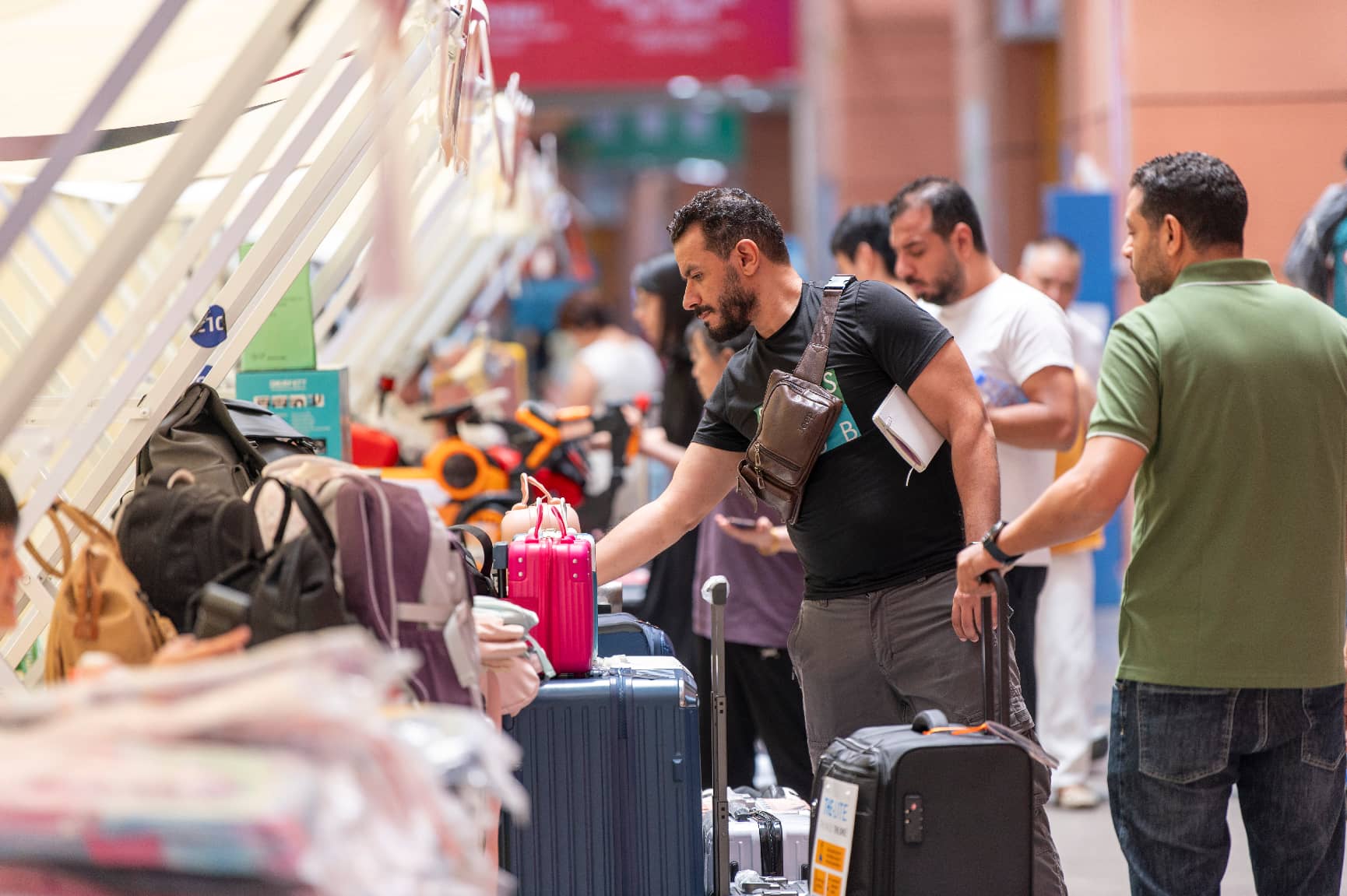
Bag exhibits attract foreign merchants for viewing and procurement in District 2 of the Yiwu International Trade Market in Yiwu, east China's Zhejiang province. (Photo/Hu Xiaofei)
Gradually, foreign merchants began using the restaurant for much more than just dining. Some waited for clients here, while others negotiated deals. Between bowls of chickpea soup and grilled meat, sample catalogs and price sheets often lay spread across the table.
"It was a restaurant, but it was more like an open and accessible venue for business negotiations. Many foreign merchants didn't speak Chinese, so my wife, my staff, and I served as interpreters. Many deals were actually finalized during the ten-odd minutes spent waiting for the food to be served," Shalabi said.
The restaurant became a landmark in the community of foreign merchants in Yiwu, underpinned by the city's supportive and convenient business environment.
Administrative services for foreigners, such as the consultation, appointment booking, and online processing of accommodation registration, visas, and work permits, were quick and smooth. In the business sector, the local government launched online platforms for matters including foreign investment and the opening of personal foreign exchange settlement accounts. Foreign merchants could also look up various public services through smart digital tools and personalized guides.
"No matter how big or small an issue, a single phone call could sort it out. This is the 'Yiwu speed,'" Shalabi said.
With local government support, Shalabi established "Nad's Home," a volunteer organization dedicated to helping foreigners in Yiwu solve problems. It also organizes various volunteer activities on a regular basis.
On June 5, 2014, Chinese President Xi Jinping delivered an important speech at the opening ceremony of the Sixth Ministerial Conference of China-Arab States Cooperation Forum. In the speech, he spoke about the story of Shalabi who put down roots in China and realized his life dreams.
Following that, people came from far and wide in admiration. As the original facilities and space could no longer keep pace with the growing number of patrons, Shalabi leased a nearby three-story venue spanning over 1,000 square meters, renaming the establishment "Beyti."
"'Beyti' means 'my home' in Arabic. I want everyone who comes here to feel like they are returning home," said Shalabi.
The most eye-catching feature of the new restaurant is a prominent display wall featuring high-quality Belt and Road cooperation. Embossed on the wall is a relief map of the Yixin'ou (Yiwu-Xinjiang-Europe) China-Europe freight railway route starting from Yiwu, with countries along the way marked.
"Many foreign merchants didn't know about high-quality Belt and Road cooperation or the China-Europe freight trains at first. After seeing the wall, they realized trains leave Yiwu with Chinese goods for Europe, connecting our hometowns with Yiwu and making us feel that we are one big family. The freight train service is more than a trade route. It is a dialogue between civilizations on mutual benefit and win-win cooperation," Shalabi said.
The convenience of trade and commerce has brought tangible benefits to Shalabi. "Today, 99 percent of the ingredients for the restaurant can be purchased locally, and a single phone call brings them right to our doorstep," he said.
"My story is much more than just an entrepreneurial journey. It is a story of exchange and mutual learning among civilizations," Shalabi said. "I want to tell that young Jordanian stepping off the train over 20 years ago: Don't worry, you will find your career direction here, and you will find a true sense of belonging," he added.
Photos


Related Stories
- Indian entrepreneur carves out life journey in "world's supermarket" Yiwu
- China's lightning-fast manufacturing response reflects resilience of Chinese economy
- Heatwaves drive export surge for creative cooling products from E China's Yiwu
- From 'world supermarket' to global partner hub, Yiwu makes foreign entrepreneurs' dreams into reality
- Yiwu sees orders surge as World Cup draws near
- World Cup-themed merchandise produced in China's Yiwu in high demand
- Yiwu secures strong presence in global markets through bold reforms, openness
- Yiwu: the "world's supermarket" fuels robust foreign trade growth
- Yiwu gears up for upcoming World Cup
- Yiwu's sixth-generation market embraces digital trade
Copyright © 2026 People's Daily Online. All Rights Reserved.
