Stelios Virvidakis: A lifelong dialogue between Greek and Chinese philosophy
The National and Kapodistrian University of Athens is one of the oldest higher education institutions in modern Greece. Stelios Virvidakis is professor emeritus of moral philosophy and epistemology and has long been an advocate for the comparative study of Greek and Chinese philosophy. "Philosophers express the self-consciousness of a culture," Virvidakis said. For him, comparative philosophy offers not only a way for Greece and China to learn from each other, but also an approach through which other cultures can enrich one another.
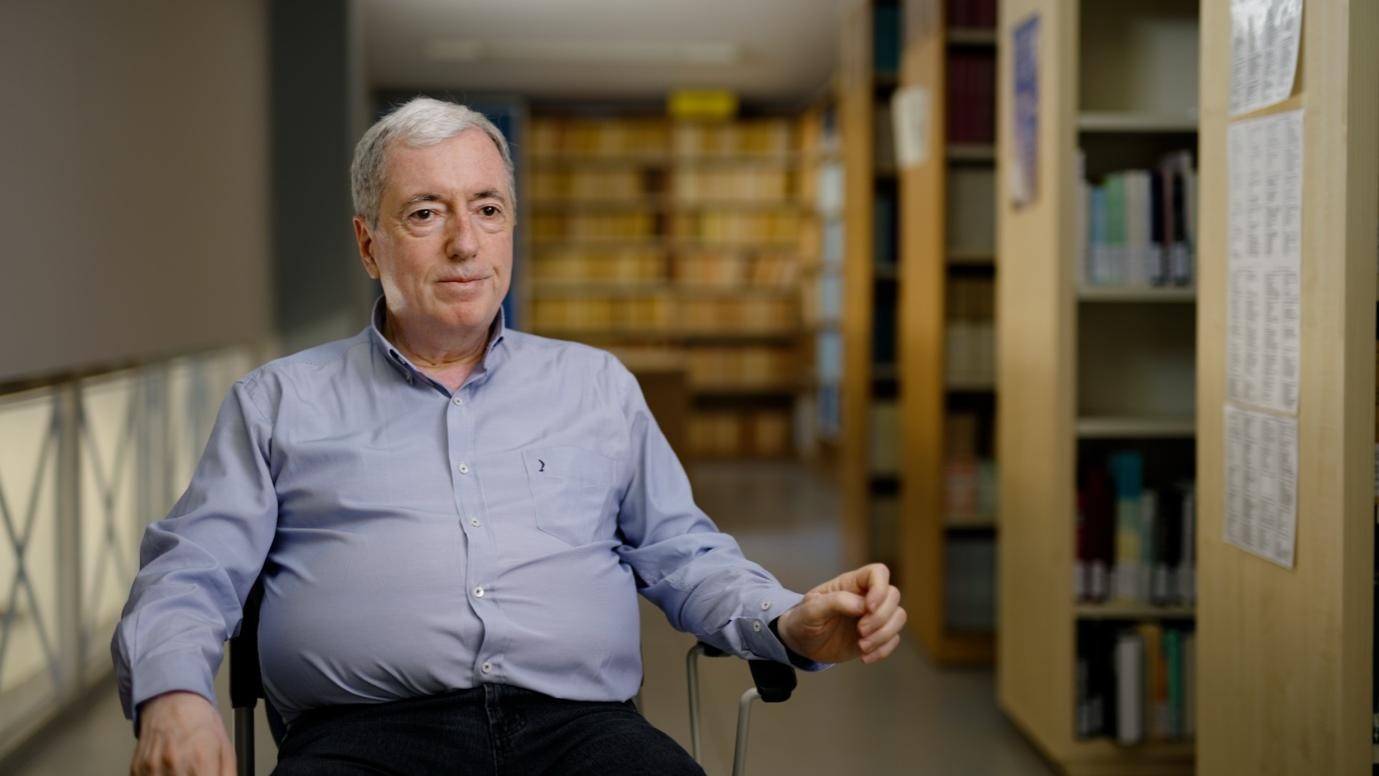
Stelios Virvidakis (Photo/Patrick Shead-Simmonds)
Virvidakis' interest in comparative philosophy dates back to his time as a student. Although specializing in Western philosophy, he always felt that there was something missing if alternative approaches to knowledge were not considered. "Chinese philosophy is one of the greatest traditions," he remarked. "So naturally I was curious and wanted to learn more." Since 2011, Virvidakis has frequently travelled to China to deliver lectures and seminars on topics ranging from Greek philosophy to history and culture. His first trip to China was to attend a conference hosted by the Chinese Academy of Social Sciences in Beijing.
Virvidakis has found many parallels between early Chinese and Greek thought. "There is a parallel between Taoism and the Greek Pre-Socratic philosopher Heraclitus," he shared. Both traditions explore a world in flux and the relationship between opposites. Virvidakis' favorite Taoist thinker is Zhuangzi, whose use of humor and paradox reminds him of the sceptics of the Hellenistic period.
In 2021, the Center of Greek and Chinese Ancient Civilisations was established. It was a joint venture between four Greek universities: the National and Kapodistrian University of Athens, Aristotle University of Thessaloniki, the University of Crete, and the University of Patras. Around the same time, a counterpart was founded in China by Southwest University, Renmin University, Sichuan University, and Shandong University. Virvidakis was the first president of the Greek center and currently serves as its general secretary.
"Although there have been international centers for comparative study, this is the first Sino-Greek collaboration," Virvidakis said. "It is a bilateral effort to establish direct channels of communication through knowledge exchange." Recently, the center organized a talk on the circulation of philosophical texts from Europe to China, focusing particularly on the introduction of Aristotle to China and its subsequent transmission to Japan and Korea. Besides exploring the historical dissemination of Aristotelian philosophy in China in the seventeenth and eighteenth centuries, the talk also examined Aristotle's reception in contemporary China.
In June 2026, Virvidakis took part in the Second World Conference of Classics at the Academy of Athens, which brought together specialists across the arts and human sciences. One of the talks he particularly enjoyed focused on love poetry in ancient China and Greece. "While the Greeks and Romans were more explicit about erotic relations," he shared, "the Chinese were more reserved, and greater emphasis was placed on expressing subtle feelings".
Currently, Virvidakis regularly collaborates with Southwest University in Chongqing, where he returned this summer to give an introductory course on ethics. He particularly enjoyed discussing the works of Immanuel Kant and John Stuart Mill, two of his favorite philosophers, with Chinese colleagues and students. "I am happy to return to China again and again if I can teach students more about Greek philosophy, literature, or history," he said.
For Virvidakis, this continuing dialogue reflects a comparative approach that can extend far beyond philosophy itself. Comparison allows people to better understand different cultures and worldviews. Quoting Confucius, he remarked, "When studying other people, you can select their good qualities and follow them, and their bad qualities and avoid them." He looks forward to continuing his contribution to the field of comparative philosophy and serving as a bridge between Greece and China.
(Web editor: Hongyu, Wu Chengliang)