Prokopios Pavlopoulos: Placing the human being at the center of society
The world should place the human being at the center of society, former President of Greece Prokopios Pavlopoulos said in a recent interview with People's Daily Online UK. Pavlopoulos is also a full member of the Academy of Athens, and professor emeritus at the Law School of the University of Athens.
In May 2019, Pavlopoulos paid a state visit to China as president of Greece. He fondly recalled the reception at Tiananmen Square and his visit to the Forbidden City, which he had first visited in 2005 as Greece's minister of the interior under Prime Minister Kostas Karamanlis. Pavlopoulos' visit to China was followed by President Xi Jinping's three-day state visit to Greece in November 2019.
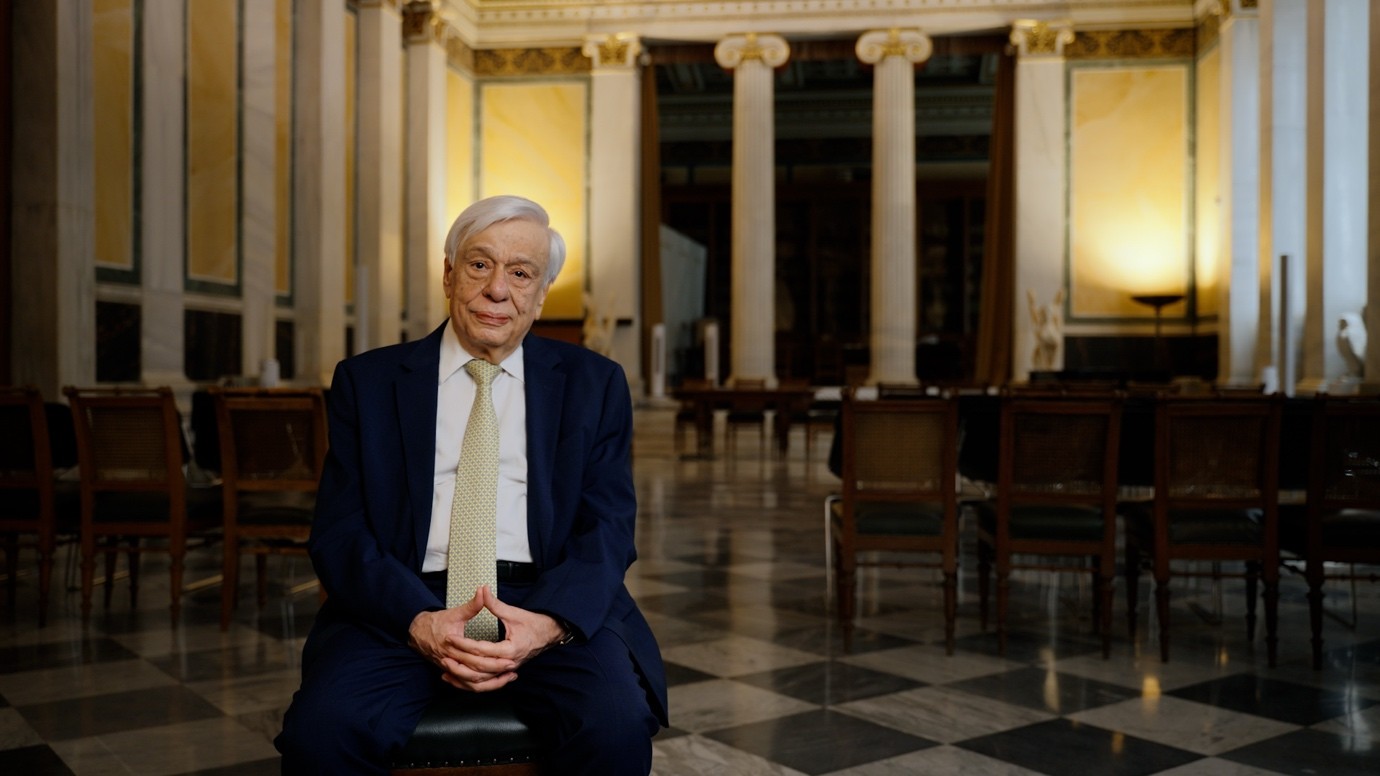
Prokopios Pavlopoulos (Photo/Patrick Shead-Simmonds)
The two state visits consolidated Sino-Greek friendship and strengthened cooperation between the two countries. At the time, China and Greece already shared strong ties based on economic cooperation, including COSCO's majority stake in the Port of Piraeus and Greece joining the Belt and Road Initiative. "Relations between our countries used to mainly focus on economic cooperation," he explained. "Since then, Greece and China have developed a strategic relationship, working together to address challenges facing humanity as a whole." Today, the two state visits in 2019 continue to be regarded as milestones in the bilateral relationship between Greece and China.
From significant improvements in living standards to China's leading role in advancing artificial intelligence (AI), Pavlopoulos praised the unprecedented development China has undergone in recent decades. "We, Europeans, have much to gain from China's experience, and at the same time, China can learn from ours," he remarked.
For Pavlopoulos, "the meetings in 2019 were not just about bilateral relations between Greece and China, but also about the world in general." The two presidents exchanged ideas about upholding principles rooted in their two ancient civilizations, including defending human rights, maintaining peace, and upholding justice. He found these discussions not only personally valuable, but also deeply relevant to the troubled times in which we live.
Pavlopoulos emphasizes the importance of respectful dialogue between civilizations in navigating geopolitical instability. "Through this dialogue we can achieve development on a people-to-people level, economic cooperation, and above all, peace," he shared. "The values we share can help us find solutions to contemporary challenges."
For Pavlopoulos, returning to classical studies is a powerful way of fostering dialogue between civilizations. He found the Second World Conference of Classics, which he took part in at the Academy of Athens in July this year, to be particularly rewarding. The conference highlighted the importance of classical studies and brought scholars from different continents into dialogue with each other. "Even though Confucius and Aristotle never met," Pavlopoulos explained, "their work shares several points of convergence concerning the course of humanity. By upholding universal human values, their work transcends time, peoples, and cultures."
"Everything begins with the human being" is a phrase Pavlopoulos returned to again and again throughout the interview. "In both ancient Chinese philosophy and ancient Greek philosophy," he explained, "the human being is placed at the center of society, and we must defend this principle." Pavlopoulos considers both Greece and China to be civilizations with traditions that prioritize peace, place the human being at the center, and promote dialogue between civilizations. "Perhaps it is romantic," he remarked, "but we can extend this vision of civilization and humanity to other parts of the world."
(Web editor: Hongyu, Wu Chengliang)