



China steps up efforts to combat climate change

Welding robots assemble new energy heavy trucks on the production line of HANMA Technology Group Co., Ltd. in Ma'anshan, east China's Anhui province. (Photo/Wang Wensheng)
China's Ministry of Ecology and Environment recently released an annual report on the country's policies and actions on climate change.
According to the report, in 2025, China's carbon dioxide emissions per unit of GDP were 17.7 percent lower than in 2020.
Meanwhile, non-fossil fuels accounted for 21.7 percent of total energy consumption, up from 16 percent in 2020. Installed wind and solar capacity reached 1.84 billion kilowatts. Forest stock volume stood at 20.988 billion cubic meters. New energy vehicles (NEVs) accounted for 50.8 percent of all new vehicle sales.
Li Gao, vice minister of ecology and environment, noted that China has achieved significant milestones in addressing climate change and is steadily advancing along a green, low-carbon development path tailored to its national circumstances.
"Major progress has been made in decarbonizing the energy and industrial sectors, with several targets outlined in China's 2030 nationally determined contributions (NDCs) already met ahead of schedule," he said.
Renewable energy's share of electricity generation continues to climb. Notably, as of July 2025, installed solar capacity surpassed coal-fired power for the first time, establishing it as China's largest electricity source. Furthermore, all incremental electricity demand nationwide was fully met by renewable generation.
Industrial transformation is yielding measurable results. The green and low-carbon sector is projected to generate approximately 11 trillion yuan ($1.65 trillion) in output value, supported by over two million enterprises. China now operates the world's most comprehensive clean energy supply chain.
From 2021 to 2025, ultra-low-emission retrofits were completed for production capacity totaling 940 million tons of crude steel, 360 million tons of coke, and 470 million tons of cement clinker.
Green and low-carbon initiatives in key sectors are making steady progress. In 2025, freight turnover by rail and waterway increased by 20.8 percent and 41.7 percent, respectively, compared with 2020. Ships calling at ports along the Yangtze River Economic Belt used 230 million kilowatt-hours of shore power, four times the 2020 level.
Besides, China has continued to promote energy-saving retrofits of existing buildings, while all new buildings are required to meet green building standards.
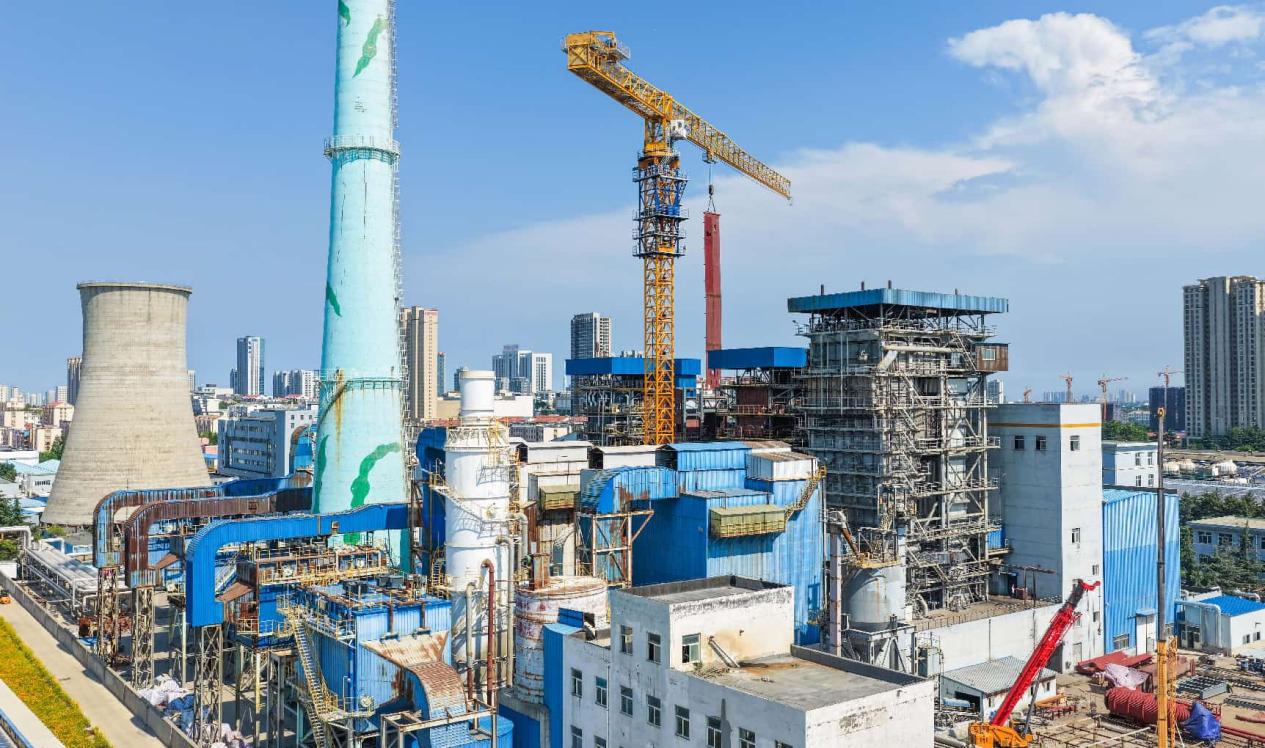
A heating boiler energy-efficiency retrofit is underway at a thermal power plant in Rongcheng, east China's Shandong province, June 11, 2026. (Photo/Li Xinjun)
China is also implementing a National Climate Change Adaptation Strategy 2035. Its capabilities in monitoring, early warning, risk assessment, and disaster prevention and mitigation have improved significantly, while climate change adaptation efforts in key sectors and regions have been steadily advanced.
The report shows that China has established an integrated meteorological observation system comprising 10 Fengyun meteorological satellites, 842 weather radars, 131 upper-air observation stations, and more than 100,000 ground-based meteorological observation stations, among other facilities. The system can comprehensively monitor and identify 83 percent of hazardous weather events. Initial progress has also been made in developing a territorial spatial framework that incorporates climate change adaptation.
To support China's carbon peaking and carbon neutrality goals, the Ministry of Ecology and Environment is accelerating the development of a carbon footprint management system. Li said that as of the end of September this year, China had issued 37 national standards for calculating product carbon footprints, and the national greenhouse gas emission factor database contained 576 emission factors.
According to the report, during the 14th Five-Year Plan period (2021–2025), China's national carbon emissions trading market helped reduce carbon emissions in the thermal power sector by approximately 530 million tons. The market also helped the power generation sector reduce society-wide emissions reduction costs by 56.8 billion yuan.
Li said China had established the world's largest carbon emissions trading market. It currently covers around 8.3 billion tons of carbon dioxide emissions, accounting for more than 65 percent of the national total, and cumulative trading of emission quota has exceeded 1 billion tons. China will continue expanding the market's coverage, with the petrochemical, chemical and other industrial sectors to be included by 2027.
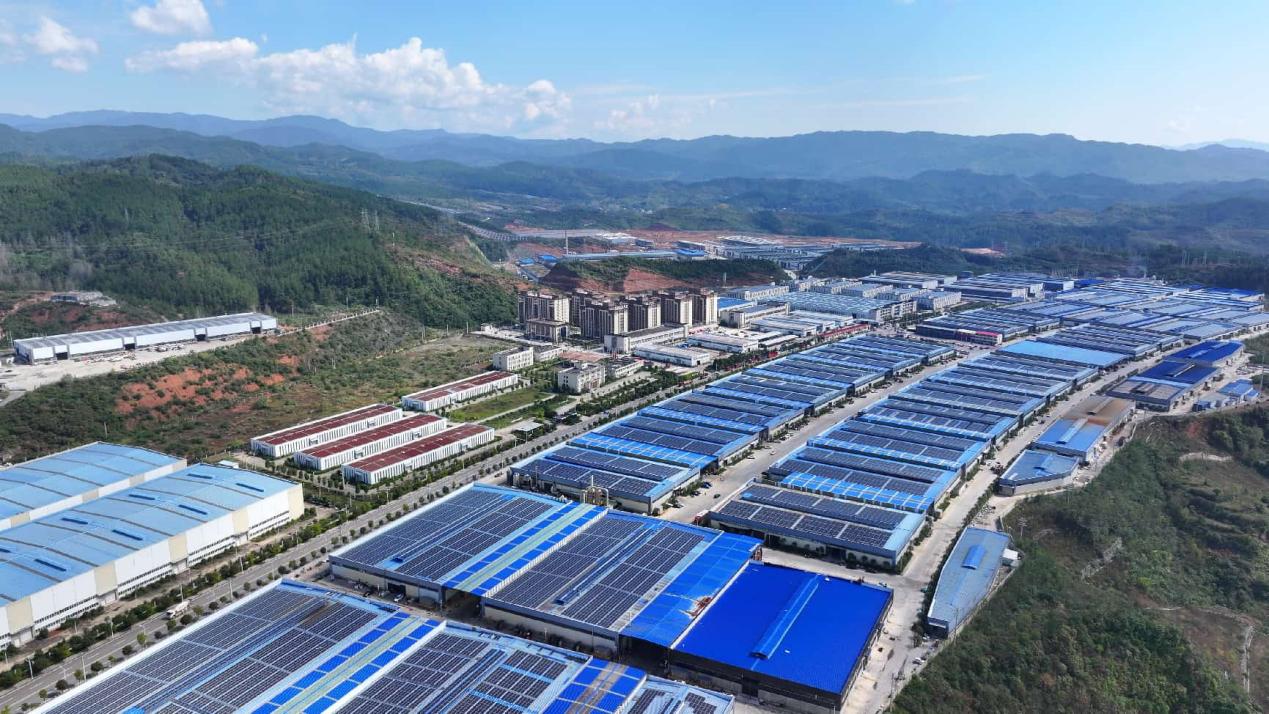
Photo shows solar panels installed on rooftops of factory buildings in an industrial park in Fangxian county, Shiyan, central China's Hubei province. (Photo/Zhang Qilong)
China's voluntary greenhouse gas emissions reduction market is also expanding rapidly. To date, 44 projects have been registered, covering more than 25 million tons of emissions reductions. Trading volume has exceeded 24 million tons, with transaction value approaching 2 billion yuan.
The 31st session of the Conference of the Parties to the United Nations Framework Convention on Climate Change (COP31) will be held in Antalya, Turkiye, in November this year.
Li said China supports making implementation the focus of COP31. It believes the conference should engage in in-depth discussions on longstanding issues, including insufficient emissions reduction efforts and financial support from developed countries, as well as new challenges posed by unilateralism and protectionism, which undermine collective efforts to address climate change.
COP31 should help advance the multilateral process by supporting and creating the conditions for all parties, particularly developing countries, to implement their NDCs, and make tangible progress toward achieving the goals of the Paris Agreement.
Photos




Related Stories
- China urges focus on climate change, cooperation at Arctic Circle Assembly
- China rolls out five-year action plan to boost climate resilience against geological hazards
- Balancing climate action with livelihoods
- Earth sees second-warmest June on record
- China's green century: Strategy, vision and the road to climate leadership
- China’s role in tackling climate change highlighted at UN event in Beijing
- North China set for first heat wave of 2026 in coming days
- China boosts global climate cooperation with AI-supported early warning system
- China's climate envoy warns of energy security risks, urges renewables shift
- Chinese solution provides 'early warnings for all'
Copyright © 2026 People's Daily Online. All Rights Reserved.
