



Chinese solution provides 'early warnings for all'
China is actively sharing its experience and technological achievements in early warning systems with the world, offering technology, capacity building and risk identification systems to contribute to the United Nations' Early Warnings for All initiative, officials and experts said.
From embracing World Meteorological Day in March to launching the homegrown MAZU early warning system in July, and initiating a collaborative action plan for its urban application in October, the country translated the early warning concept into practice in 2025.
Launched in 2022 by United Nations Secretary-General Antonio Guterres, the Early Warnings for All initiative aims to ensure that everyone on Earth is protected from hazardous weather, water, or climate events through life-saving early warning systems by the end of 2027.
In October, a Chinese delegation delivered a presentation on MAZU, an artificial intelligence-powered Chinese solution for early warnings for all, at the special session of the World Meteorological Congress held in Geneva, Switzerland.
The World Meteorological Organization praised China's efforts and contributions in applying AI to strengthen the four pillars of the UN initiative — risk management, monitoring and forecasting, warning dissemination and response capabilities, according to the China Meteorological Administration.
After the session, representatives from several WMO member states approached the Chinese delegation to explore cooperation on co-developing and sharing the MAZU system, it said.
The name Mazu comes from that of a sea goddess, a mythological protector against maritime disasters revered for centuries in China and across Southeast Asia.
In July, the CMA unveiled the Early Warnings for All China Solution, naming it MAZU, the acronym of which stands for multi-hazard, alert, zero-gap and universal.
"MAZU represents a seamless integration of our excellent traditional culture with modern technology," said CMA head Chen Zhenlin. "It is designed to provide customized warning systems and proven disaster prevention wisdom to developing nations," he said.
The solution is a comprehensive package of soft measures and hard technology, including sharing the country's emergency response framework, its disaster prevention system, and the "call-to-action" mechanism that ensures high-level warnings trigger immediate responses.
China has also developed the AI forecasting models Fenglei, Fengqing and Fengshun, covering time scales from minutes to seasons. At MAZU's core is a cloud-based early warning system that offers customized and sustainable technical solutions, the administration said.
The MAZU solution has been implemented across China to protect lives and fuel economic growth, it added.
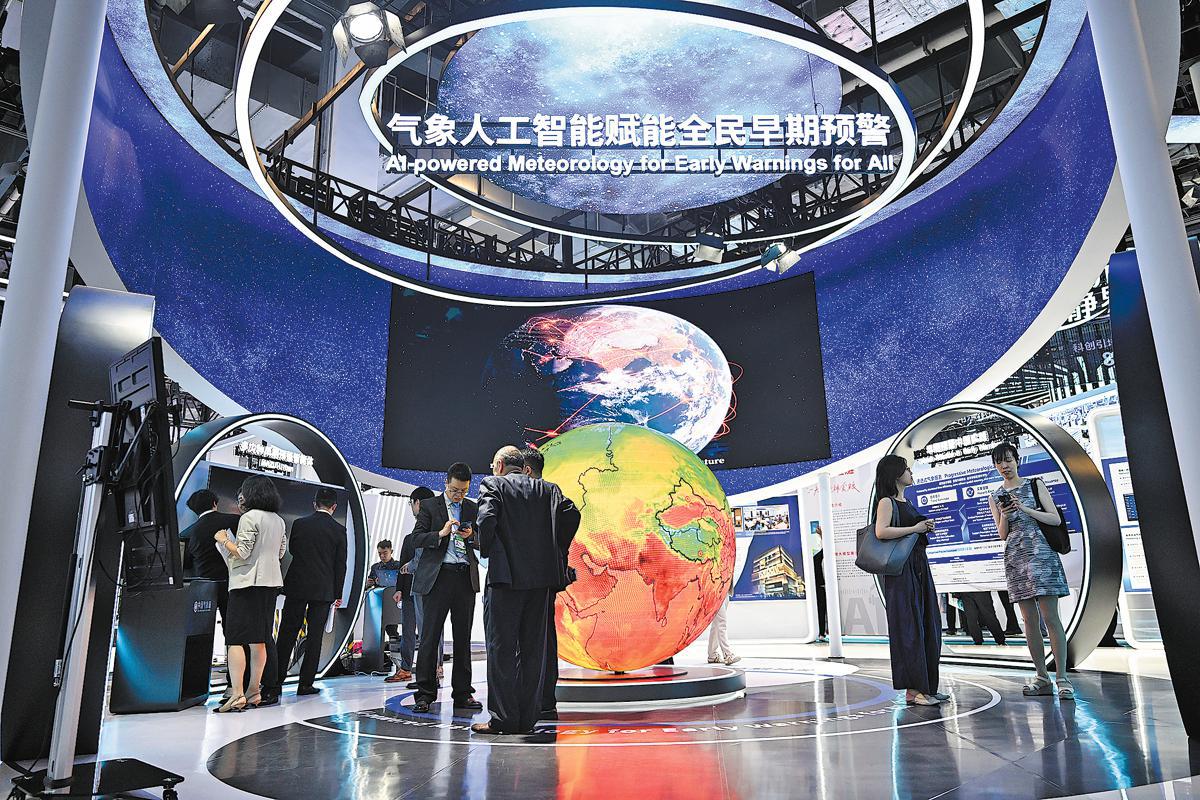
The MAZU system is on display at China Meteorological Administration's booth during the World Artificial Intelligence Conference in Shanghai on July 26, 2025. CHEN HAOMING/XINHUA
Coastal connections
In Fujian, the cradle of Mazu culture, the ancient prayer for safe voyages is now answered by precise, hourly weather warnings. As a coastal province frequently battered by typhoons, Fujian has developed a sophisticated "1262" meteorological disaster prevention model utilizing the MAZU system.
The model works by pinpointing key risk areas 12 hours in advance, pre-positioning rescue forces six hours ahead, and identifying township-level high-risk zones two hours before a forecast weather event.
In July, when Typhoon Danas approached Fuzhou, capital of Fujian province, the urban drainage center, acting on meteorological warnings from the system, emptied 139 inner-city rivers in advance.
"Meteorological early warning is the vanguard for urban drainage," said Xue Yubin, deputy director of the Fuzhou Urban Hydrographic Net Joint Drainage and Dispatch Center. "It transforms our work from passive defense to active fortification," Xue said.
The model has benefited the province's fishery industry, especially the local farmers who make a living by raising abalone or growing seaweed. In the aquaculture hubs of Putian and Ningde, early warnings have played an important role in protecting the livelihood of fishermen and increasing farmers' income.
Yang Jianbin, an agronomist with the Xiuyu district aquatic technology extension station in Putian, said the value of early warnings for aquaculture comes from precise forecasting, advance prevention and loss reduction. Specialized services for seaweed farmers in Xiapu have helped avert losses exceeding 100 million yuan ($13.8 million) in recent years, according to local authorities.
The "1262" model has become a flagship case study of the MAZU solution, with its expertise in marine forecasting being shared with island nations such as the Solomon Islands.

A fisherman checks a precise weather forecast near his aquaculture base in Putian, Fujian province. ZHAO YIMENG/CHINA DAILY
Business benefits
At the Ningbo-Zhoushan Port, the world's busiest port by cargo throughput for the past 16 years, weather can disrupt a multi-million-dollar business. Located in a region in Zhejiang province prone to gales and sea fog, the port faces up to 1,000 hours of operational downtime annually.
The local meteorological bureau has developed an early-warning and control platform that integrates real-time meteorological, maritime and port data, delivering minute-by-minute alerts directly to dispatchers and operators.
During Typhoon Co-May in late July, chief forecasters updated wind forecasts in real time, enabling port managers to adjust work schedules and recover 10 hours of operating time.
In November, based on European forecasts of severe offshore winds, the safety team at Mediterranean Shipping Company in Geneva ordered several vessels to skip scheduled calls at Ningbo.
According to Lian Sheng, deputy director of the port's dispatch center, daily charter costs can run to $100,000 per vessel, so such a decision might result in massive losses.
Port officials communicated that their localized forecasting showed winds inside the harbor were milder, shielded by the Zhoushan Islands. The clarification built immediate trust. During the next cold air event a week later, MSC relied fully on the port's guidance, and its vessels operated on schedule. "It shows how precise weather services and a smart early warning system can empower port operations," Lian said.
According to port statistics, the early-warning system added an estimated 98 hours of workable time in 2024 and generated 370 million yuan ($51 million) in direct economic benefits.
Meanwhile, MAZU-Urban, an urban multi-hazard early warning agent developed in Shanghai, has benefited other developing countries in realizing early warnings for all and reducing losses.
The agent integrates Shanghai's self-developed AI models, which have pushed the average lead time for severe convective weather forecasts to over four hours, said Cao Yuan, head of the Shanghai AI meteorological application innovation center.
The agent was used to successfully forecast rainfall over Kampala, capital of Uganda, and winds at Lake Victoria in Africa in March. The Uganda National Meteorological Authority sent a letter to the Shanghai Meteorological Service, expressing gratitude for the support provided by MAZU-Urban.
"The agent allows for targeted policy for each country and region," said Liu Haobo, a senior engineer from the information center at the Shanghai Meteorological Service.
The team developed guidance based on specific disaster data for Mongolia, fine-tuning the system with the help of a visiting Mongolian forecaster. When Typhoon Wipha threatened the Macao Special Administrative Region in July, MAZU-Urban was integrated with local disaster standards and rescue frameworks to provide tailored impact forecasts, Liu said.
Zhao Yang, director of the information center at the Shanghai Meteorological Service, said the model can be accessed from computers, tablets and phones, to serve professional departments, key industries and the public.
Access to the AI early warning system was handed over to representatives from Djibouti and Mongolia in July, marking the official start of MAZU-Urban's application overseas. It is now on trial in 35 countries and regions across Asia, Africa and Oceania, Zhao said.
The CMA said it plans to focus on building an open and inclusive global cooperation network for early warnings, prioritizing the needs of the least developed countries and small island developing states. Over the next three years, it will provide training for 2,000 people, 100 scholarships and 50 visiting scholar positions, said Chen Zhenlin, head of the administration.
"The introduction of the MAZU solution marks China's shift from an active participant in global meteorological governance to a contributor to major international agendas and a provider of global public goods," Chen said at a news conference in October.
He added that China will continue exploring the use of AI and other new technologies to further enhance the role of MAZU in global climate governance and disaster risk reduction.
Photos




Related Stories
- Temperatures for 2025 indicate global warming acceleration
- China continues to advance global sustainable development with other countries: FM spokesperson
- Warmer, wetter climate brings changes, concerns in NW China
- Working together for steady, long-term progress in global climate governance
- Chinese young people join climate action on World Children's Day
Copyright © 2026 People's Daily Online. All Rights Reserved.
