



How ASEAN fruits reach tables across China
Early in the morning, workers harvest fragrant coconuts on a plantation south of Bangkok, Thailand. The plantation's owner, Qin Shaoyu, fell in love with the coconuts' sweet, milky flavor a decade ago and has made his home in Thailand ever since. Today, his coconuts are sold in supermarkets across China.
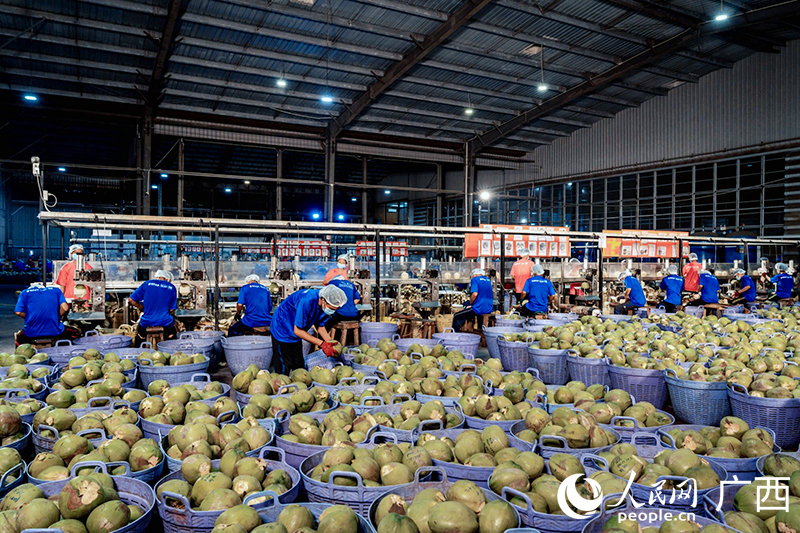
Workers process coconuts at Qin Shaoyu's coconut processing plant in Thailand. (People's Daily Online/Yan Lizheng)
Getting fresh fragrant coconuts to dining tables in China depends on a logistics network timed down to the hour. Sea transport from Thailand to Qinzhou Port in south China's Guangxi Zhuang Autonomous Region takes just three days, followed by a little over a day by road to Nanning, well within the optimal window for fresh-cut processing.
Early in the morning, refrigerated trucks loaded with fresh fruit stream into Youyiguan Port in Pingxiang, Guangxi. A truck carrying 17 tonnes of durians from Vietnam clears an intelligent inspection gate in less than 15 seconds. Driver Li Hainan, who makes several trips a day, said, "We could never have imagined this speed in the past."
Youyiguan Port is one of China's largest land ports for fruit imports and exports, handling one in every three durians imported into the country. From January to July this year, Guangxi's ports imported 1.73 million tonnes of fruit from ASEAN countries, valued at 26.03 billion yuan ($3.9 billion), up 6.83 percent and 19.19 percent year on year, respectively.
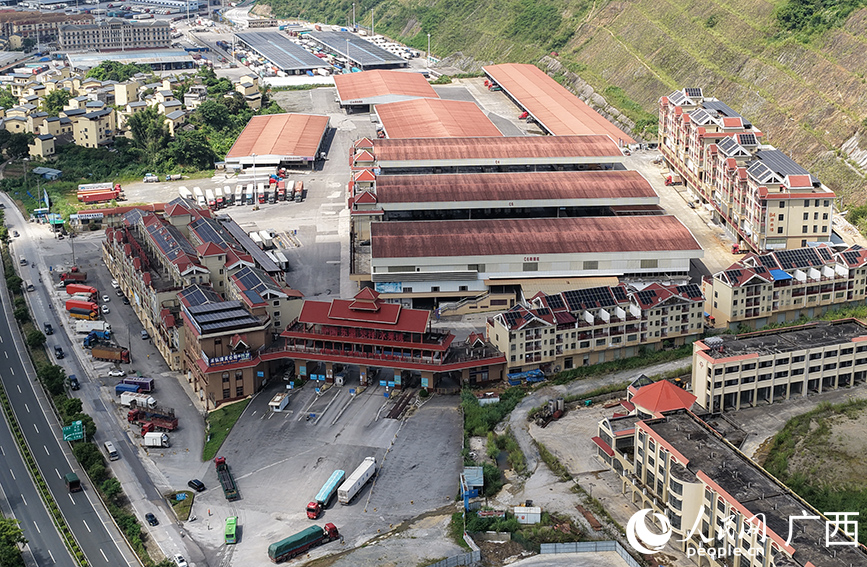
Photo shows a China-ASEAN fruit trading center in Chongzuo, south China's Guangxi Zhuang Autonomous Region. (People's Daily Online/Fu Huazhou)
At Jiangnan International Fruit Trade Market in Nanning, the air is rich with the aroma of tropical fruit. Since durians entered their peak season, fruit wholesaler Guo Huizhen has been busy. High quality and affordable prices have drawn a steady stream of buyers.
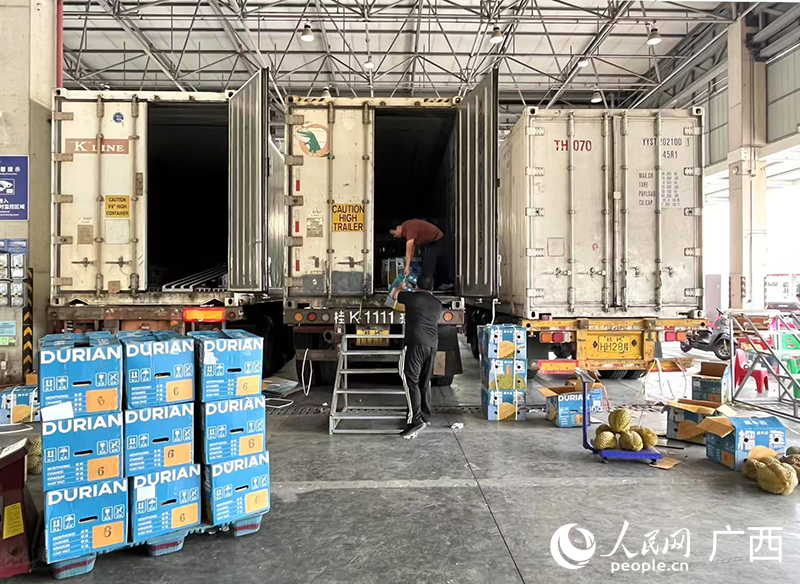
Photo shows a durian wholesale stall at Jiangnan International Fruit Trade Market in Nanning, south China's Guangxi Zhuang Autonomous Region. (People's Daily Online/Wei Huan)
Today, ASEAN fruits entering China through Pingxiang can reach Jiangnan Fruit and Vegetable Wholesale Market in Guangzhou, south China's Guangdong Province, in seven hours, or Beijing's Xinfadi wholesale market in 30 hours.
The China-Laos Railway, which connects southwest China's Yunnan Province with Southeast Asia, has also joined this race to deliver fresh produce.
Early in the morning, a Lancang-Mekong Express freight train loaded with Thai durians arrives at Wangjiaying West Station in Kunming, capital of Yunnan Province, after a 26-hour journey on the China-Laos Railway. Some of the durians will supply the local market, while most will be transferred seamlessly from rail to road for delivery to more than 30 cities across China within 48 hours.
A key part of the New International Land-Sea Trade Corridor and a vital cross-border route, the China-Laos Railway has brought tropical fruits from Southeast Asia to households across China since opening in December 2021. As of Aug. 12 this year, cross-border fruit imports transported via the railway had exceeded 200,000 tonnes.
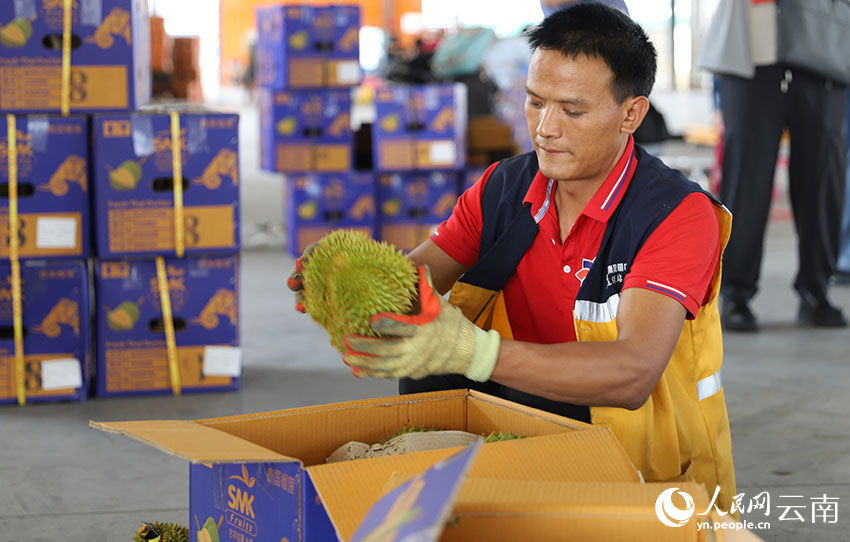
A worker unloads and sorts Thai durians at Wangjiaying West Station in Kunming, southwest China's Yunnan Province. (People's Daily Online/Li Faxing)
The New International Land-Sea Trade Corridor is helping ASEAN fruits reach markets across China.
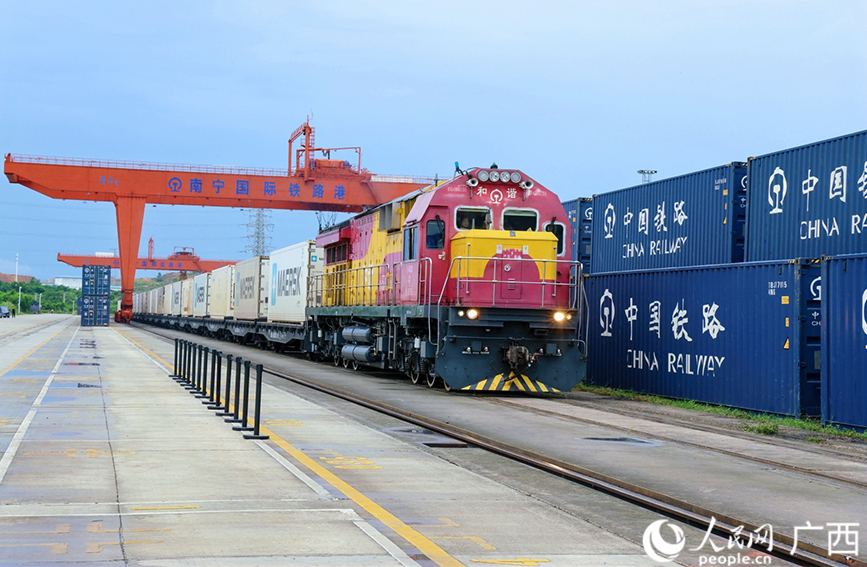
A refrigerated train loaded with fruit from ASEAN arrives in Nanning, south China's Guangxi Zhuang Autonomous Region. (People's Daily Online/Feng Xiaohui)
Every year, millions of tonnes of tropical fruit reach Chongqing via the New International Land-Sea Trade Corridor before being distributed to Sichuan, Guizhou, Hubei, Hunan, Gansu and other central and western provinces.
Wang Hao, general manager of Sichuan Langhao Import and Export Group Co., Ltd., has nearly a decade of experience importing durians.
"In the past, transporting Thai durians to China by road took seven to nine days, with each container costing about 50,000 yuan to ship and losses running at about 10 percent," he said. "Switching to the China-Laos Railway cut the journey to Chengdu to as little as 72 hours, halved transport costs and brought losses close to zero."
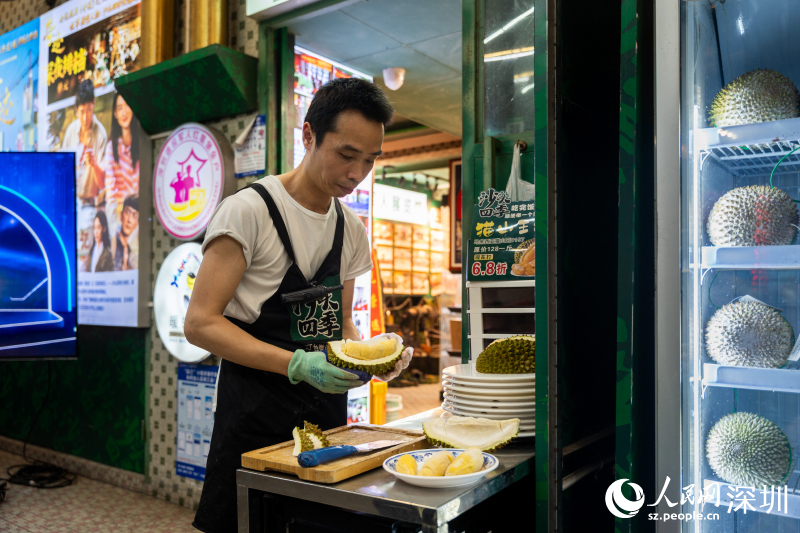
A staff member opens a fresh durian. (People's Daily Online/Wang Xing)
The Pinglu Canal, stretching 134.2 kilometers and accommodating vessels of up to 5,000 tonnes, runs from the mouth of the Pingtang River in Hengzhou, Nanning, directly to the Beibu Gulf.
"Once the Pinglu Canal is operational, the cost of shipping ASEAN fruits to China is expected to fall by another 30 percent," said Cao Derong, president of the China Chamber of Commerce of Import & Export of Foodstuffs, Native Produce & Animal By-Products (CFNA).
Fruits are on display at the 23rd China-ASEAN Expo in Nanning, south China's Guangxi Zhuang Autonomous Region. (People's Daily Online/Liu Luyao)
Photos


Related Stories
- China-ASEAN FTA 3.0 targets digital, green and supply chain ties
- Hong Kong, ASEAN sign protocol to amend investment agreement
- China-ASEAN Initiative on Strengthening E-Commerce Cooperation Implementation Plan released in Nanning
- Guangxi launches multilingual tax refund guide, e-map for overseas visitors
- China-ASEAN fruit distribution hub takes shape at accelerated pace
- 2026 China-ASEAN Silk Road E-Commerce Promotion Event held in Nanning
- China-ASEAN Forestry Artificial Intelligence Innovation Application Competition concludes in Guigang, S China's Guangxi
- Journalists, social media influencers from ASEAN countries visit China's Shenzhen
- ASEAN journalists visit China's Guangdong as bilateral ties mark 5th anniversary
- Diplomatic envoys from ASEAN member states promote specialty fruits from China and ASEAN
Copyright © 2026 People's Daily Online. All Rights Reserved.
