



China-ASEAN FTA 3.0 targets digital, green and supply chain ties
The China-ASEAN Free Trade Area 3.0 (CAFTA 3.0) is creating new openings for businesses, as China and ASEAN deepen cooperation in the digital economy, green development and supply chain connectivity.
Signed in October 2025, the CAFTA 3.0 Upgrade Protocol added three areas to the agreement's institutional framework for the first time: the digital economy, green development and supply chain connectivity.
Both sides are now moving to ratify the agreement.
The upgrade was a central topic at the 23rd China-ASEAN Expo and China-ASEAN Business and Investment Summit in Nanning, south China's Guangxi Zhuang Autonomous Region.
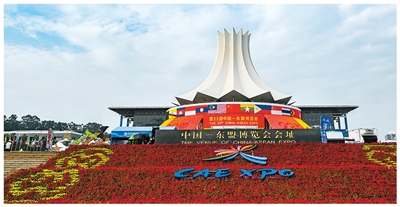
Photo shows Nanning International Convention and Exhibition Center in Nanning, south China's Guangxi Zhuang Autonomous Region. (Photo by Cao Yiming/Xinhua)
Two-way trade between China and ASEAN passed $1 trillion in 2025 — the first time it has crossed that mark. China has remained ASEAN's largest trading partner for 17 consecutive years, and ASEAN has been China's largest trading partner for six.
The CAFTA has widened its scope from tariff reductions to the rules that govern trade.
The first version applied zero tariffs to more than 90 percent of products. The second focused on market access for services and investment. The 3.0 upgrade goes further, extending the framework to the digital economy, green development and supply chain connectivity.
Zhou Yamin, director of the Department of Regional Cooperation Studies at the National Institute of International Strategy, Chinese Academy of Social Sciences, said the main opportunity in the 3.0 upgrade is greater certainty in the rules.
Rules that align across countries cut the cost of doing business abroad, Zhou said, making it easier for companies to plug into regional value chains.
The upgrade also complements the Regional Comprehensive Economic Partnership (RCEP), ASEAN Secretary-General Kao Kim Hourn said.
CAFTA 3.0, he added, is a step toward deeper regional integration.
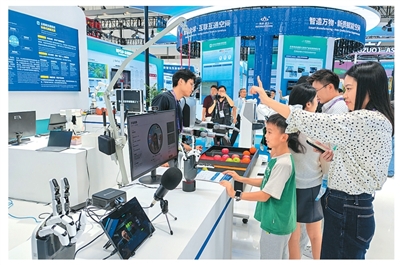
A visitor tries out a robotic arm at the 23rd China-ASEAN Expo, held in Nanning, south China's Guangxi Zhuang Autonomous Region. (Photo by Wang Huiqiong/People's Daily Overseas Edition)
Ge Hongliang, deputy dean of the College of ASEAN Studies at Guangxi Minzu University, said the CAFTA 3.0 upgrade brings mutual recognition of rules into the agreement's framework.
He said proposed measures such as unified standards for electronic invoices in digital trade and a carbon footprint tracking system for the green transition would help bring industries in China and ASEAN closer together.
A report released during the 23rd China-ASEAN Expo found that the companies it surveyed generally viewed RCEP as having a positive effect on their business, particularly through expanded markets, smoother customs procedures and lower trade costs.
The rules are also expected to deepen supply chain links between the two sides.
At the expo, SAIC-GM-Wuling (SGMW), one of China's largest automakers, showcased the Air EV — its first new energy vehicle designed for the global market, built at the company's Indonesian plant since August 2022.
A year later, its sales in the Indonesian market surpassed 10,000 units.
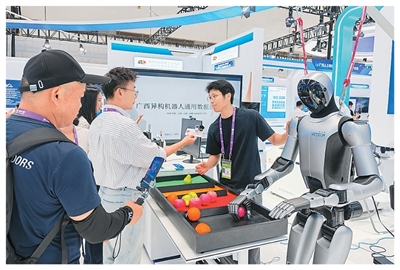
A robot demonstrates picking up fruit at the 23rd China-ASEAN Expo, held in Nanning, south China's Guangxi Zhuang Autonomous Region. (Photo by Wang Huiqiong/People's Daily Overseas Edition)
A representative of SGMW's overseas operations said the company initially faced two difficulties: qualifying components from multiple countries under RCEP rules of origin, and getting local partners to meet environmental standards.
The company responded by setting up production in Indonesia and bringing more than 17 Chinese supply chain partners into the country. It has also worked with more than 40 local suppliers, coordinating manufacturing, supply, sales, finance and human resources.
SGMW currently holds more than 50 percent of the new-energy vehicle market in Indonesia, according to the representative.
Xu Yingming, head of the international market research institute at the Chinese Academy of International Trade and Economic Cooperation under China's Ministry of Commerce, said China-ASEAN industrial division of labor and collaboration have become increasingly close, shifting from simple trade in goods toward deeper integration in upstream and downstream production and supply chains.
"Companies are increasingly turning to the development of integrated regional industrial networks, placing greater emphasis on the efficiency of cross-border flows of intermediate goods, and optimizing the allocation of components under CAFTA rules, thus promoting coordinated production capacity between China and ASEAN and deepening the division of labor across upstream and downstream sectors," Xu said.
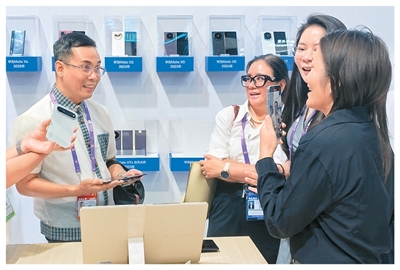
Businesspeople and visitors learn about Chinese mobile phones at the 23rd China-ASEAN Expo, held in Nanning, south China's Guangxi Zhuang Autonomous Region. (Photo by Wang Huiqiong/People's Daily Overseas Edition)
According to the report, more than half of the companies surveyed were already part of RCEP regional supply chains. Among those planning to adjust their supply chain arrangements, 73.3 percent said they would maintain or expand investment in China — a figure that climbs to 79.8 percent among foreign-invested enterprises.
The benefits are not limited to large corporations. A Vietnamese cross-border e-commerce entrepreneur said studying e-commerce in China changed her view that cross-border online trade was mainly the domain of big companies.
One of her main products, Vietnamese durians, now has daily sales of around 10,000 on a single cross-border e-commerce platform, she said.
Digital economy and green transition are emerging as new areas of cooperation.
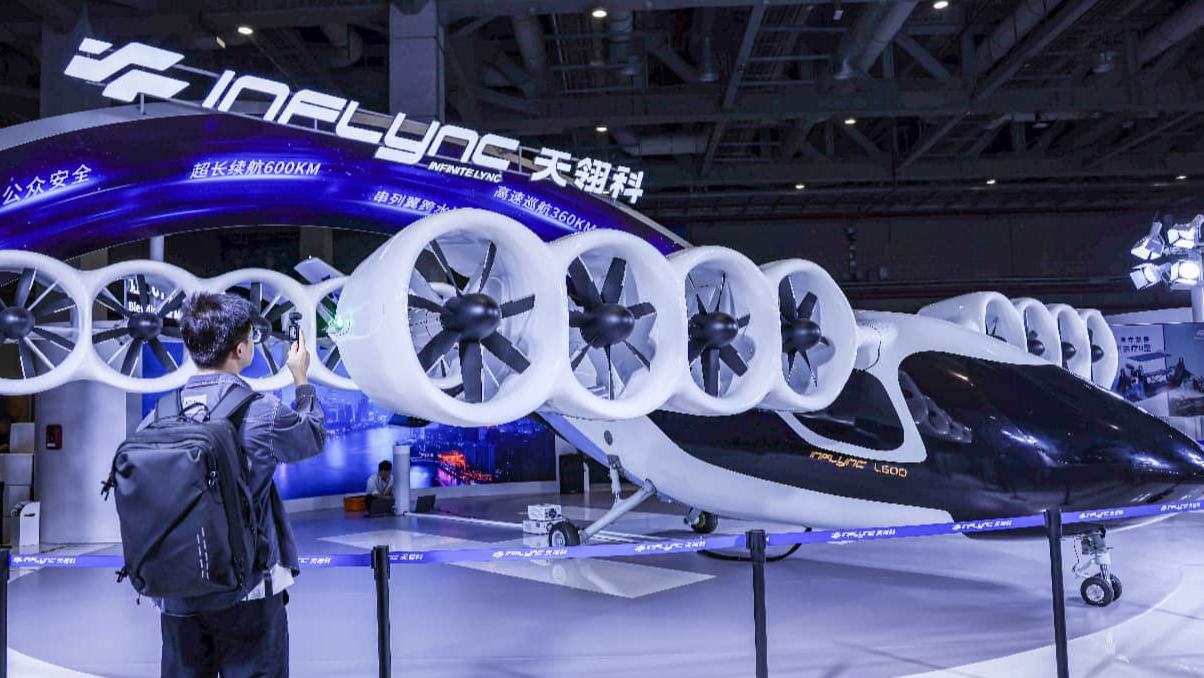
At the expo, exhibits on green and low-carbon development included products made from discarded railway tracks, while digital economy showcases featured lightweight quadruped robots.

Visitors pose for photos at the exhibition area for China-ASEAN cooperation achievements in emerging industries at the 23rd China-ASEAN Expo, held in Nanning, south China's Guangxi Zhuang Autonomous Region. (Photo by Wang Huiqiong/People's Daily Overseas Edition)
Such exhibits, along with activities in the new areas covered by CAFTA 3.0, highlighted new opportunities for China-ASEAN cooperation.
The report found that 37.6 percent of companies surveyed had already engaged in cross-border e-commerce or other digital economy activities in the RCEP region — up 13.2 percentage points from 2025.
By adding new areas of cooperation and smoothing regional industrial and supply chains, the CAFTA 3.0 upgrade gives leading companies institutional backing to deepen their presence in both the Chinese and ASEAN markets and build new businesses in digital and green industries, Xu said. For micro, small and medium-sized enterprises, he added, the same changes significantly reduce the cost of operating across borders.
"This will help China-ASEAN economic and trade cooperation enter a new stage driven by innovation and featuring mutual benefit and win-win outcomes," Xu said.
"The 3.0 upgrade expands cooperation from traditional trade in goods to trade in services, and from traditional industries to emerging economic fields such as the digital economy and green and low-carbon development. This will help companies in China and ASEAN countries further deepen cooperation in these new areas," Ge said.
Companies are the ones who put two-way cooperation into practice, Ge said. They are central to strengthening ties between China and ASEAN, and to benefit from the new rules, they need to turn the arrangements into concrete projects.
Photos



Copyright © 2026 People's Daily Online. All Rights Reserved.
