



Chinese teacher-turned-entrepreneur builds win-win Thai coconut business
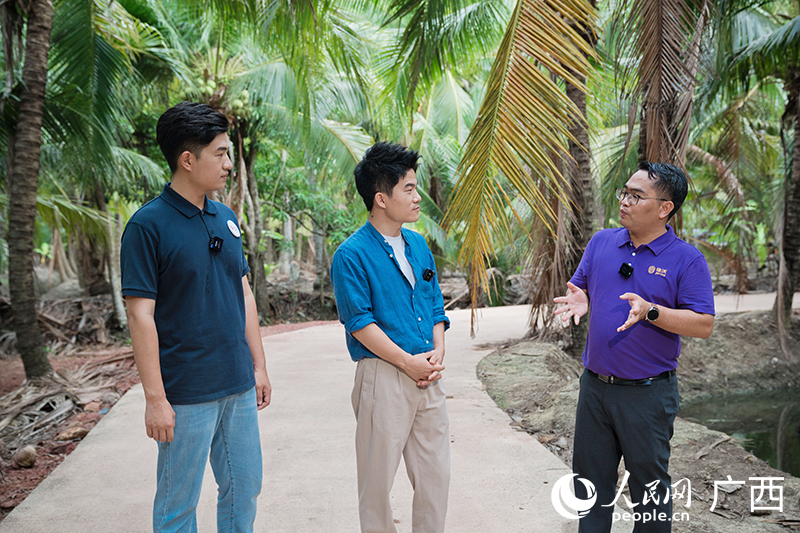
Qin Shaoyu (first from right), a Chinese teacher-turned-entrepreneur, talks with livestreamers during a traceability event for ASEAN fruits at a coconut plantation owned by ICOCO (Thailand) Co., Ltd. (People's Daily Online/Shen Quanchi)
"That's it! It will definitely conquer the Chinese market."
Qin Shaoyu said this the first time he tried the water from Thai fragrant (Nam Hom) coconuts — and a decade later, he has been proven right.
Qin's first encounter with Thai fragrant coconuts on April 1, 2015 has since evolved into a successful cross-border agribusiness, bringing premium Thai coconuts into millions of Chinese households while helping transform Thailand's coconut industry.
Qin first arrived in Thailand in 2006 as a volunteer Mandarin teacher. After several years engaging with local communities, he left his stable job to pursue business opportunities, eventually settling on Thailand's coconut industry in 2015.
Chinese consumers generally preferred light, naturally sweet flavors, and the coconut's delicate tropical aroma fit this preference well. At the same time, an increasing number of consumers were willing and able to pay for healthier, higher-quality products, Qin said, recalling his early assessment of the business's prospects.
More importantly, Thai fragrant coconuts offer a unique flavor profile that is difficult to replicate elsewhere, according to Qin, who explained that the fruit's core producing area, Damnoen Saduak, has an exceptional natural environment.
Located in a delta region formed by sediment deposits, with rich black alluvial soil containing minerals accumulated over centuries, Damnoen Saduak features a naturally balanced soil salinity resulting from the mix of freshwater from rain and rivers, along with periodic seawater intrusion, Qin said.
Combined with abundant sunshine and an average annual temperature of around 28 degrees Celsius, the area allows coconuts to bear fruit year-round, resulting in a rich aroma and high sweetness, he added.
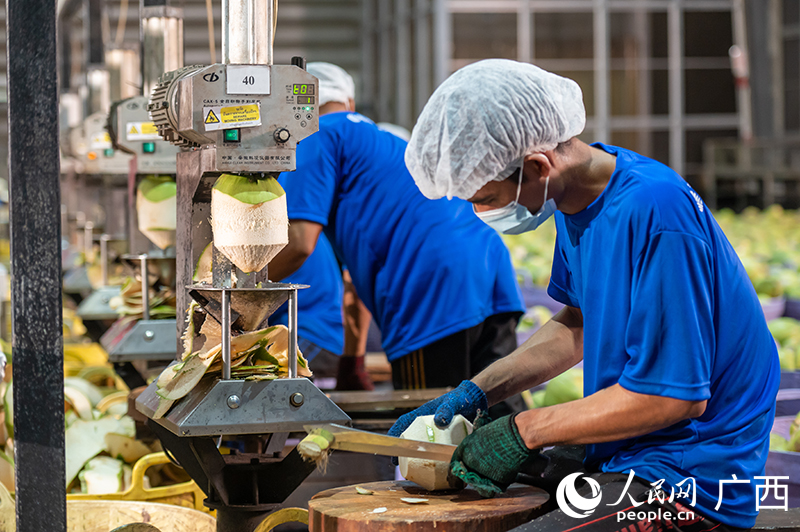
Workers dehusk coconuts using equipment imported from China at a processing plant run by ICOCO (Thailand) Co., Ltd. (People's Daily Online/Yan Lizheng)
Recognizing the fruit's potential for great success in the Chinese market, Qin started to introduce Thai fragrant coconuts to wholesale markets in major Chinese cities, including Guangzhou, Beijing and Shanghai.
Despite initial doubts about the fruit's higher price than domestic alternatives, Qin achieved instant sales success online through cooperation with leading e-commerce companies in Shanghai.
Thanks to the rapid rise of China's e-commerce sector and a surge in tourism to Thailand, which helped create early consumer awareness and demand, Qin's Thai fragrant coconut business experienced booming growth in the Chinese market through integrated online and offline promotion.
Qin co-founded ICOCO (Thailand) Co., Ltd. on Sept. 9, 2015, making it the first enterprise to introduce Thai fragrant coconuts into the Chinese market on a large scale and later establishing a leading position in the industry.
In 2014, Thailand's exports of fragrant coconuts to China were still limited to only a few shipping containers. By 2015, that figure had surged to 1,000 containers, with Qin's team accounting for nearly 40 percent.
Beyond trade, Qin's operations introduced mechanized processing technology into Thailand's coconut industry that had long relied on manual labor.
When Qin first entered the industry, there were only eight coconut processing factories across Thailand. All coconuts were manually dehusked by workers, resulting in low production efficiency and output that could not meet surging demand from the Chinese market.
Qin's team redesigned and optimized the processing workflow based on the shape of Thai fragrant coconuts and introduced a full set of automated coconut dehusking equipment from China, effectively doubling efficiency, reducing labor costs, and ensuring more stable product quality.
This innovative approach not only earned him an innovation award for coconut processing equipment from Thailand's Ministry of Industry, but also helped drive an upgrade across the country's coconut industry.
Industry peers began visiting to learn from his experience, and the sector gradually moved toward automated production.
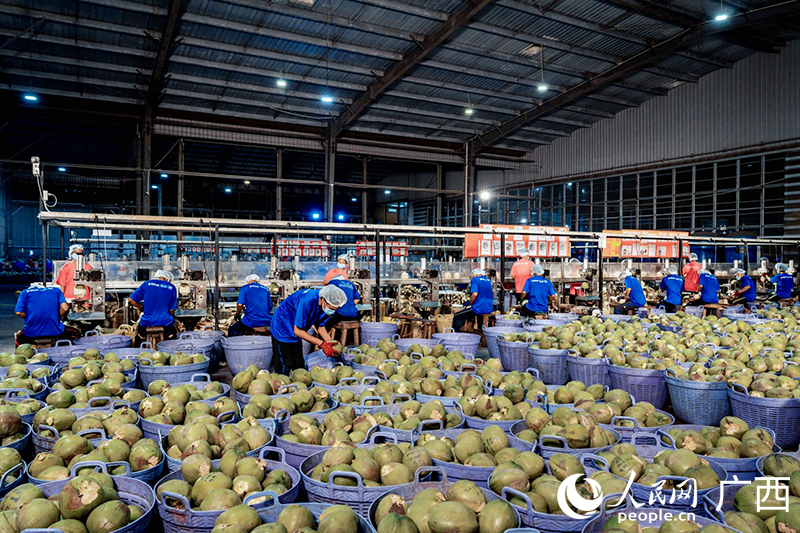
Workers process coconuts inside a plant run by ICOCO (Thailand) Co., Ltd. (People's Daily Online/Yan Lizheng)
Logistical challenges in the early stage also motivated Qin to rethink export standards.
Initial shipments of young coconuts suffered damage during cold-chain transport, leading to financial losses and product spoilage.
In response, Qin's company shifted toward higher-maturity coconuts better suited for long-distance shipping and established a grading system based on weight and use cases — ranging from premium food-service coconuts to retail and community distribution tiers.
To ensure product traceability and authenticity, the company strictly followed Thailand's Good Agricultural Practices (GAP) system, making sure each shipment could be traced back to verified plantations.
As demand expanded, Qin strategically relocated his main deep-processing operations to south China's Guangxi Zhuang Autonomous Region.
The short sea crossing from Thailand to Guangxi — roughly three days — made the region ideal for processing fresh coconut products, including coconut water, coconut meat, and ready-to-eat items.
In 2022, the company invested over 15 million yuan ($2.2 million) to build a processing facility in an industrial park in Nanning, the capital of Guangxi. The plant now supplies major food and beverage brands in China.
Qin also plans to establish a transparent production system in Nanning, allowing customers to observe real-time coconut processing from raw import to finished product.
Qin's coconut business has also generated significant economic benefits for Thailand. Over the past decade, coconut plantation areas in Thailand expanded from under 100,000 rai (16,000 hectares) to around 400,000 rai, while farmgate prices rose roughly fivefold, substantially increasing rural incomes.
Today, the company is working to create a diversified coconut product portfolio covering fresh coconuts, processed coconut water, coconut meat and byproducts.
Its exports now reach markets including China, Singapore, Indonesia, Australia, New Zealand, Japan, South Korea, the United States, and Spain.
Plans are underway to fully tap the value of coconuts.
Qin plans to build a fully integrated coconut super factory in Thailand, creating a complete circular value chain.
Coconut shells will be carbonized to generate electricity for high-energy equipment such as cold storage facilities, while coconut husks will be processed into organic fertilizer and returned to coconut plantations, according to Qin.
Photos


Related Stories
Copyright © 2026 People's Daily Online. All Rights Reserved.
