



China's sci-fi industry gains new momentum
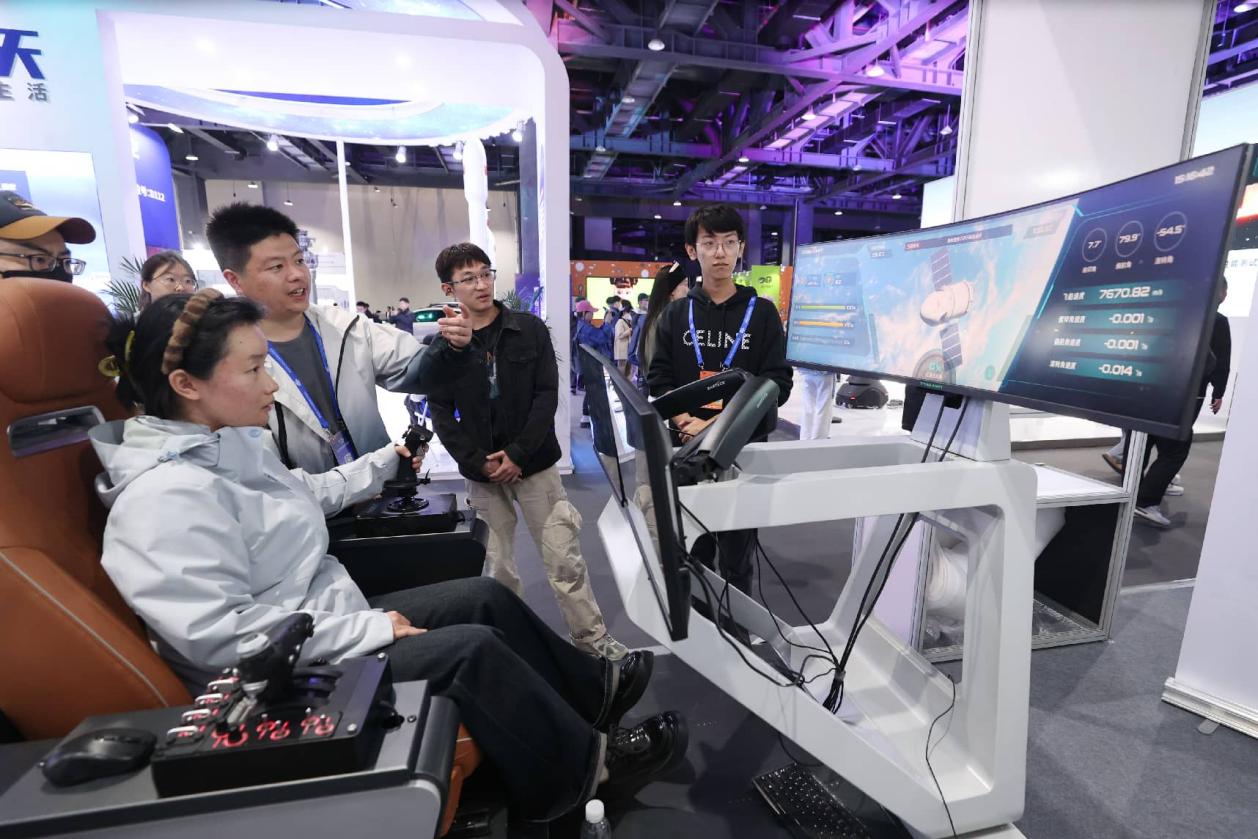
On March 27, a visitor experiences an immersive space flight simulation device at the 2026 China Science Fiction Convention in Beijing. (Photo/Chen Xiaogen)
According to a 2026 report on China's science fiction industry released by the China Research Institute for Science Popularization, China's science fiction industry generated 126.1 billion yuan ($18.61 billion) in revenue in 2025, up 15.7 percent year on year. The industry has exceeded the 100-billion-yuan mark for three consecutive years.
Driven by stronger original intellectual property (IP) development, advances in digital technologies, and innovative consumer experiences, China's science fiction industry is becoming deeply integrated with a wide range of sectors, including literature, film and television, cultural tourism, manufacturing and education. An increasingly complete industrial ecosystem is taking shape.
At Guangming Science City, an innovation hub in Shenzhen, south China's Guangdong province, Wu Yan, a professor at the Southern University of Science and Technology and celebrated sci-fi writer, was working with Chen Yuehong, cultural consultant of Shenzhen's Guangming district, and Yin Di, associate professor at the College of Theatre, Film and Television, Shenzhen University, to polish the plot for the final chapter of their jointly created science fiction trilogy.
Their in-depth discussion covered topics from the societal impacts of artificial intelligence to the ethical dilemmas of human immortality. "It was an incredibly fulfilling and refreshing dialogue," said Wu, still feeling inspired by the wide-ranging exchange.
As a pilot zone for building the comprehensive national science center within the Guangdong-Hong Kong-Macao Greater Bay Area, Guangming Science City is home to a cluster of major scientific facilities, where researchers work alongside cutting-edge laboratories and research platforms.
At the end of last year, the science fiction division of the Pengcheng Academy of Literature was established there, focusing on the creation and incubation of sci-fi works and jointly promoting the development of Shenzhen's homegrown science fiction literature and film projects.
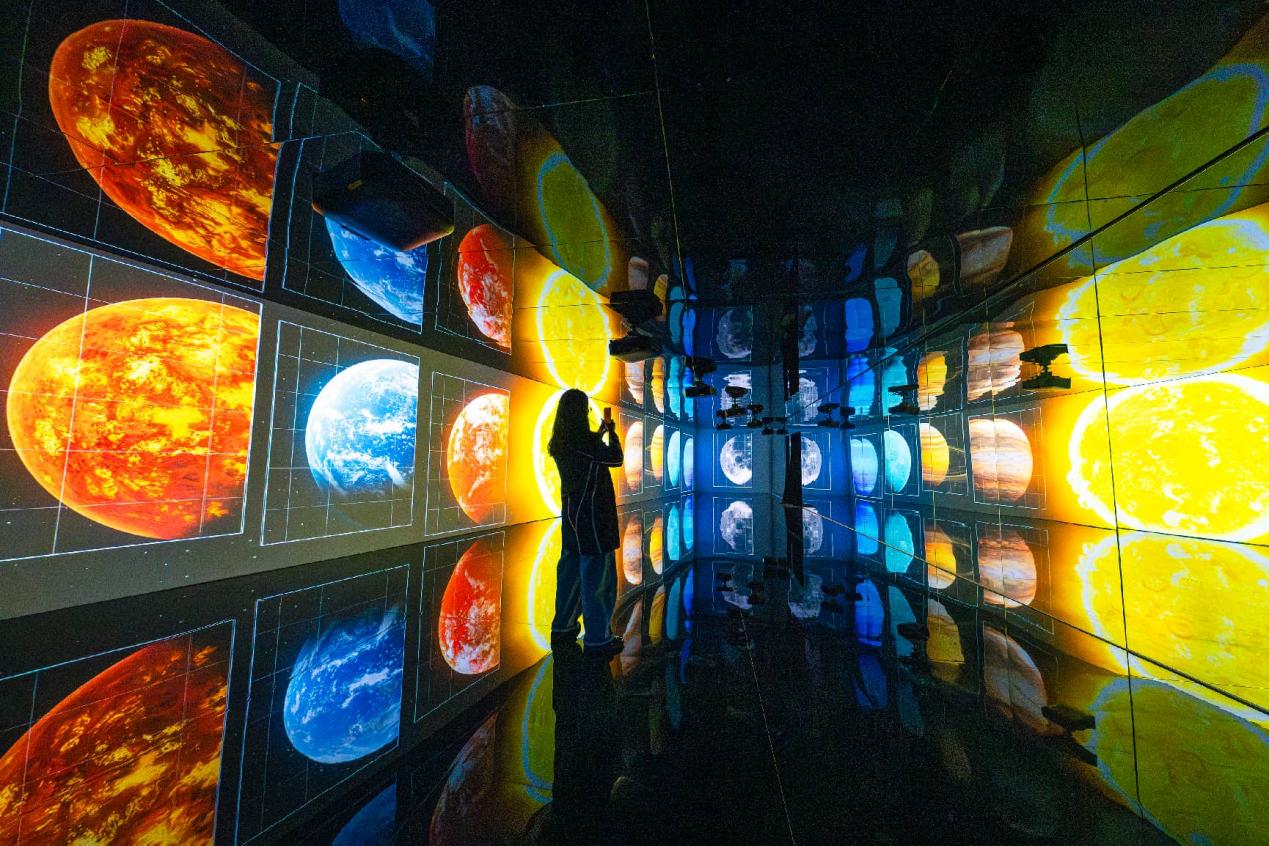
A woman takes photos at a science fiction exhibition in Suzhou, east China's Jiangsu province. (Photo/Zhang Feng)
The science city offers a bespoke creative venue for creators. They gain first-hand access to major scientific infrastructures while leveraging open exchange zones to spark and refine creative ideas.
"Direct, on-site exposure to facilities like quantum computers fosters scientifically grounded imagination. The science city has cultivated fertile ground for sci-fi innovation and creation," noted Chen.
Events including the Pengcheng Science Fiction Week, sci-fi literature forums and science drama festivals have been held one after another in Guangming Science City, attracting growing public interest.
"Science fiction endures long-term social development with the wings of imagination, while continuously inspiring scientific exploration with new ideas," said Wang Lingyu, director of the Guangming District Library.
Supported by top-tier research facilities such as the National Supercomputing Center in Shenzhen and the Shenzhen Bay Laboratory, more and more seeds of science fiction creativity are taking root and growing in Guangming district.
In the film and television sector, emerging technologies are constantly expanding the boundaries of science fiction storytelling.
On a huge curved LED screen, a city skyline came alive with dense buildings and bustling streets. At the center of the stage, actors interacted with digital humans appearing above the city. On the monitor, computer-generated imagery was rendered in real time, bringing the scenes to life. At a virtual production studio of Chengdu Film and Television City's digital production base in Sichuan province, southwest China, a science fiction TV drama was undergoing pre-production testing.
Since its launch, the virtual studio has used virtual 3D environments and extended reality technologies to recreate various filming scenarios and enable virtual production.
"The studio has already developed more than 10 ready-to-use digital scene assets, including deserts and urban landscapes, making it especially suitable for shooting science fiction films," said Zhong Ziming, a representative of the digital production base at Chengdu Film and Television City.
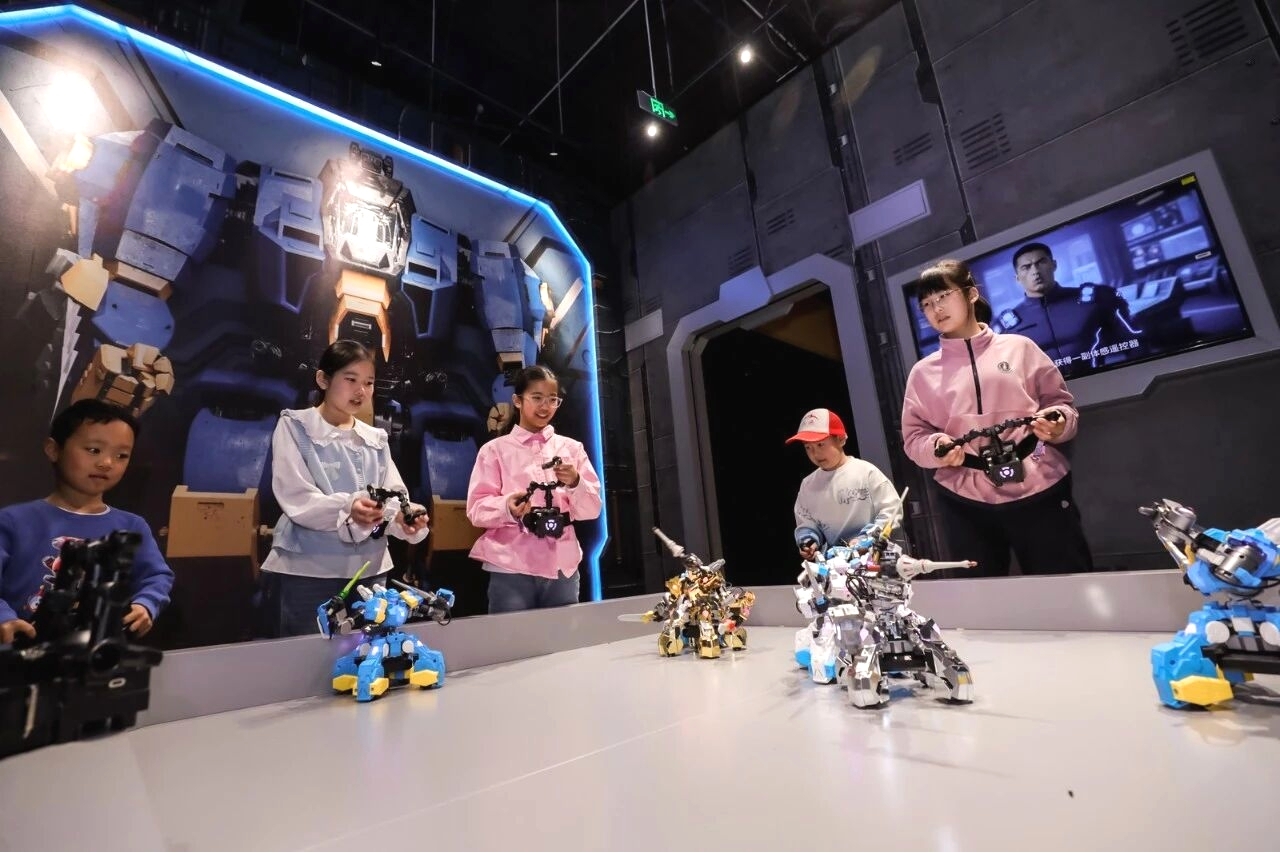
Children play a robot game at a science fiction exploration center featuring the works of Chinese science fiction writer Liu Cixin. (Photo from the official account of the publicity department of Beijing's Tongzhou district on WeChat)
Unlike traditional green-screen filming, virtual production allows visual effects to be rendered in real time, bringing post-production work forward and shortening shooting schedules.
Bai Yicong, vice president of the China Television Drama Production Industry Association, said that combining science fiction productions with cutting-edge virtual production technologies not only reduces the need for re-shoot and lowers the cost of building physical sets, but also solves challenges such as camera movement in complex scenes.
The integration of artificial intelligence has further enriched the digital assets available in virtual studios. "Creators can use artificial intelligence to generate key frames and incorporate them into digital environments, creating a wider range of science fiction scenarios," Bai said.
Meanwhile, the integration of science fiction and cultural tourism is also gaining momentum.
"The sense of participation and interaction was amazing. It felt like stepping straight inside a science fiction movie myself. It was both fun and rewarding." Xu Shuyu, a resident of Beijing's Tongzhou district, had just completed a space exploration experience with her child at a science fiction exploration center featuring the works of Chinese science fiction writer Liu Cixin.
Ye Shengwei, planning director of the culture and tourism company under Beijing Investment Group, said the exploration center was transformed from a former industrial site and features five major immersive experience zones as well as a panoramic interactive theater.
Drawing inspiration from six of Liu's classic works, including The Wandering Earth, The Sea of Dreams and The Time Migration, the center transforms literary imagination into immersive spatial experiences through cinematic settings, interactive lighting effects and digital installations.
Visitors can put on virtual reality headsets to explore the evolution of the universe or join a mission as members of the "earth defense force" and work with others to protect the planet.
"Our goal is to shift visitors from spectators into participants, letting them fully experience the world of science fiction firsthand," Ye said. Since officially opening in March this year, the center has welcomed nearly 10,000 visitors.
In recent years, more and more science fiction-themed cultural tourism projects have emerged. Many of them are exploring immersive settings, high-quality content and diversified experiences. They are becoming not only cultural tourism destinations, but also important platforms for science education.
Photos



Related Stories
- China remains world's top contributor to high-quality research: Nature Index
- Interview: China-Europe SMILE project benefits global scientific community: ESA head
- Immune-boosting therapy shows promise against superbugs: study
- China achieves successful batch cloning of super high-yield dairy goats
- Chinese scientists identify wood-based material option for future green intelligent sensors
- Chinese scientists discover new extreme particle accelerator in cosmos
- Profile: A young scientist daring the deep
- China launches immersive aerospace science center for kids, teenagers in Beijing
- Chinese scientists discover factor that slows aging in immune cells
- China activates its largest scientific intelligent computing cluster
Copyright © 2026 People's Daily Online. All Rights Reserved.
