



China steps up efforts to build integrated nationwide computing power network
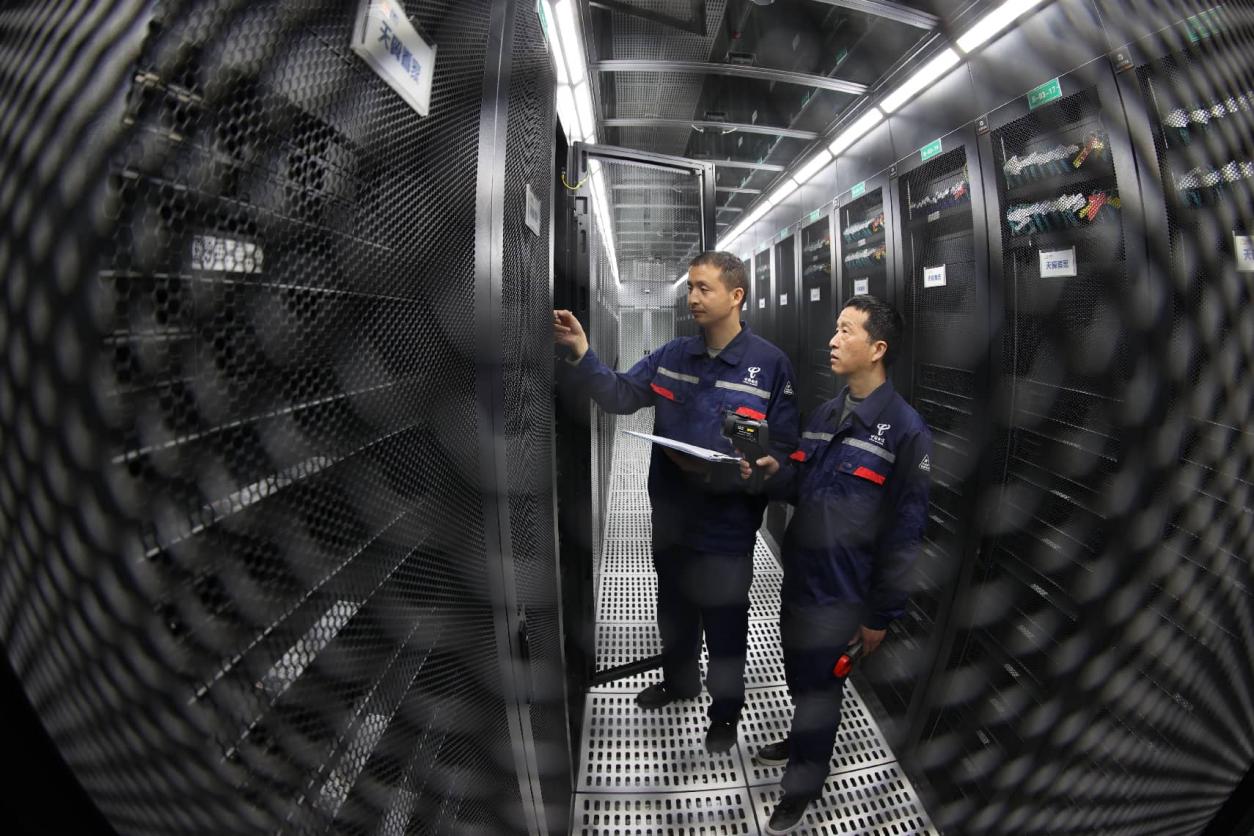
Technicians check cabinets at a central cloud computing big data center of Chinese wireless carrier China Telecom in Xiangyang, central China's Hubei province. (Photo/Wang Hu)
Advancements in artificial intelligence have pushed computing power to the forefront as an essential core digital resource worldwide. One pressing challenge is how to enable computing resources across different regions to work together efficiently and be accessed on demand.
China's 15th Five-Year Plan (2026-2030) outlines the need to further advance the East Data, West Computing initiative, build a multi-tier computing infrastructure system, and establish an integrated nationwide computing power network.
What exactly is a computing power network? And how is China turning this blueprint into tangible infrastructure network? Real-world applications across the country are already offering concrete answers.
At the First People's Hospital of Jingzhou in central China's Hubei province, radiologist Zhang Liren uploaded computed tomography images into an AI-assisted diagnostic system. In less than 10 seconds, a preliminary assessment of a patient's condition was generated.
Such remarkable speed gains rely on robust network support. China Mobile Hubei, the Hubei branch of wireless carrier China Mobile, recently unveiled its Lingban Computing Network platform, engineered to build a multi-level latency coverage system.
It delivers a 1-millisecond latency for intra-city access, 5 milliseconds across the province, 7 milliseconds between provincial capital Wuhan and key cities along the Yangtze River Economic Belt, and 10 milliseconds linking Wuhan to the nation's eight core computing hubs.
Previously, computing tasks were sometimes processed locally and sometimes dispatched hundreds of kilometers away, resulting in delays that users simply had to endure.
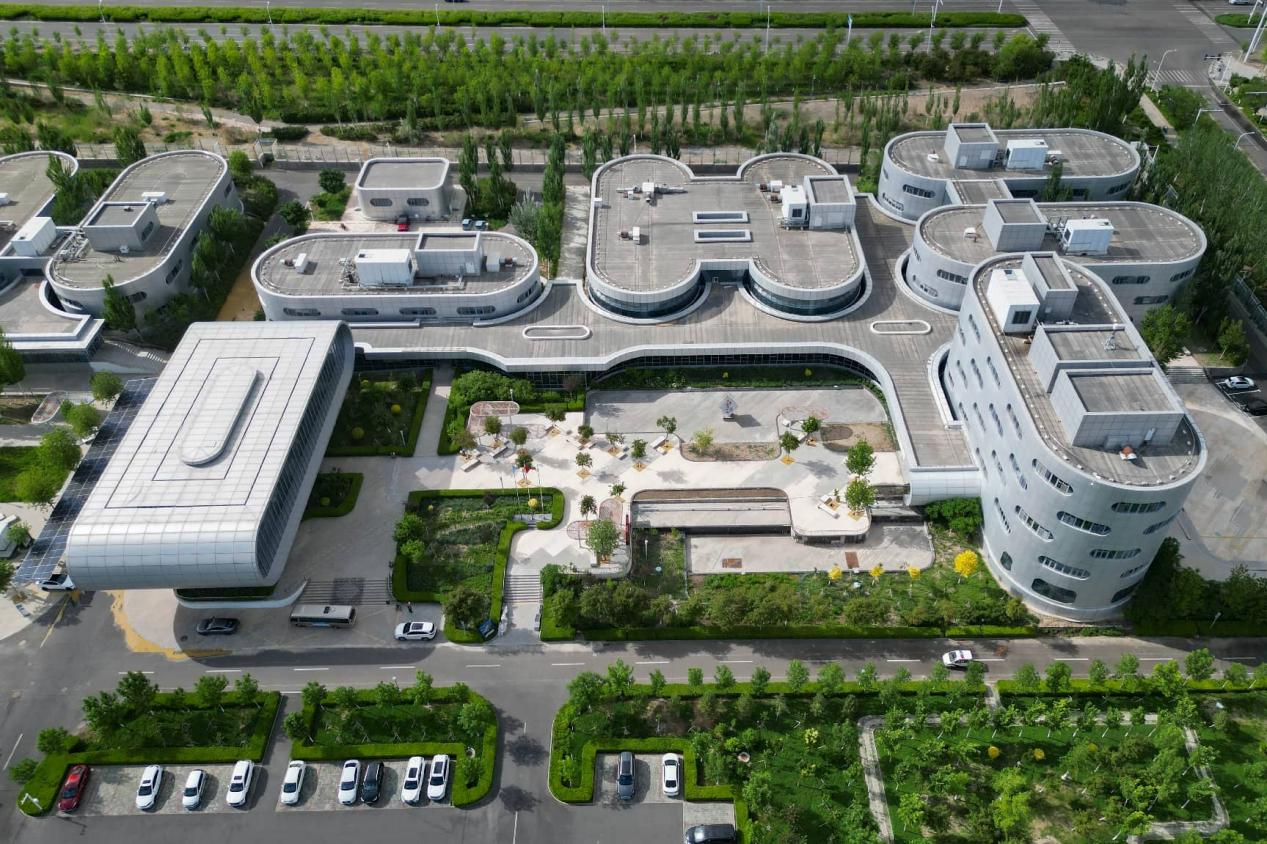
Photo shows a cloud computing industrial park in Karamay, northwest China's Xinjiang Uygur autonomous region. (Photo/Cai Zengle)
China Mobile Hubei has deployed 27 municipal-level data centers and 42 operational or under-construction computing nodes across Hubei province.
According to Gong Jian, head of a research institute under China Mobile Hubei, the company integrates edge computing resources from cities across the province while incorporating idle social computing resources under unified management.
Paired with an intelligent task-scheduling platform, this enables AI startups to access fast computing services without massive upfront investment, Gong added.
The spatial distribution of China's computing resources suffer from inherent geographic imbalance: eastern provinces host concentrated market demand yet face steep costs for new data center construction, while western regions boast abundant land and energy for server facilities but have far weaker local computing consumption. Meanwhile, computing demand fluctuates significantly across industries and time periods.
"Therefore, computing tasks need to be proactively assigned according to urgency, budgets, and chip requirements to determine where they should be executed," said Zhang Huawei, product manager for China Mobile's computing network scheduling platform.
Different tasks require different types of computing resources.
"To use a highway analogy, ambulances use emergency lanes while delivery trucks stay in regular lanes," said Zhang Xianghong, head of the data infrastructure standards working group under the National Technical Committee 609 on Data Standardization Administration of China.
"In practice, applications such as remote surgery occupy the equivalent of emergency lanes, whereas large-model training and film rendering can wait in line and utilize resources with less stringent latency requirements."
According to Zhang, the integrated nationwide computing power network is essentially a form of digital infrastructure. Built on information network technologies, it enables highly integrated, large-scale scheduling and operation of computing resources nationwide.
"Put simply, it ensures that every computing task finds the most suitable lane," Zhang added.
Beyond technological upgrades, building a unified national computing network also drives sweeping structural reform across China's digital economy by reorganizing how computing power, raw data, communication networks and power supply resources are integrated and distributed.
The integrated nationwide computing power network represents not only technological innovation, but also a fundamental restructuring of how computing power, data, networks, electricity, and other resources are integrated and allocated.
Inside the monitoring system of a national integrated computing power network monitoring and scheduling test platform at the Pengcheng Laboratory in Shenzhen, south China's Guangdong province, real-time data on computing resources nationwide is displayed clearly on screen.
Deng Qing, director of the computing network ecosystem at Pengcheng Laboratory, said the monitoring system provides a clear picture of intelligent computing capacity and resource distribution across regions.
Currently, the system covers the 10 major clusters within the eight computing hubs established under the East Data, West Computing initiative, as well as computing resources from certain non-hub regions.
At present, 1.37 million PFLOPS of intelligent computing capacity has been incorporated into the monitoring system, accounting for approximately 72 percent of China's total intelligent computing capacity.
"The monitoring system serves as the eyes of the computing power network," Deng explained. "It is the prerequisite for efficient scheduling, resource optimization, and informed decision-making. Since computing resources built on different architectures vary substantially, the first requirement is visibility. Only when integrated real-time monitoring provides data on distribution, workload, and utilization can resources be effectively scheduled and efficiently used."
According to Guo Mingjun, director of the computing economy division at the State Information Center under China's National Development and Reform Commission, one defining feature of the integrated nationwide computing power network is intensive development.
The objective is to promote large-scale and concentrated development of diverse computing resources, including general-purpose computing, intelligent computing, and supercomputing within national computing hubs.
By the end of March this year, intelligent computing capacity built within the eight national computing hubs of the East Data, West Computing initiative accounted for more than 80 percent of the national total, highlighting a trend of increasingly concentrated development.
For computing resources built on different architectures, operated by different institutions, and located in different regions to be recognized, managed, and utilized under a unified scheduling framework, standardized rules are essential.
Zhang noted that the National Technical Committee 609 on Data Standardization Administration of China has already released nine technical documents, largely establishing the standard framework for computing networks. Moving forward, these standards will continue to be refined based on practical experience to strengthen their authority and guiding value.
Photos




Related Stories
- China's installed power capacity registers steady growth
- China Dynamics: China's power consumption up 6% in April
- China's power use up 6 pct in April
- China's power consumption rises steadily amid accelerating green shift
- China's installed power generation capacity climbs 15.5 pct by end March
- China's deepest offshore wind farm starts full-capacity grid operation
- China pioneers green computing in hydropower mountain tunnel
- China's power use up 6.1 pct in Jan-Feb period
- Power grid at full throttle reflects strong momentum of China's economy
- China to improve cross-regional power allocation
Copyright © 2026 People's Daily Online. All Rights Reserved.
