



Wuhan names Yangtze finless porpoise its city mascot as species recovery signals biodiversity conservation
On May 22, Wuhan, Central China's Hubei Province, hosted its primary event for the 2026 International Day for Biological Diversity. The area’s famous Yangtze finless porpoises were celebrated as a symbol of public science education and officially debuted as Wuhan's city mascot, becoming an emblem of the city's commitment to biodiversity conservation.
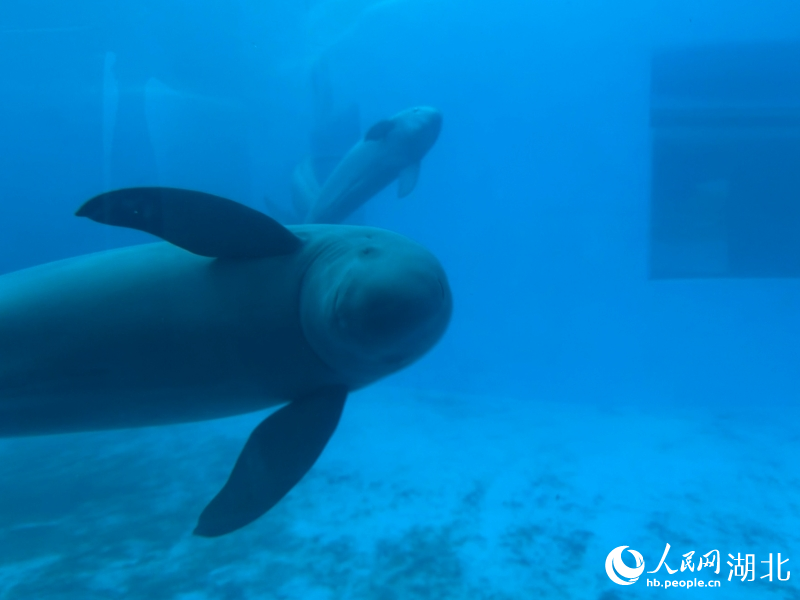
Photo shows a Yangtze finless porpoise at the Baiji Dolphinarium of the Institute of Hydrobiology, the Chinese Academy of Sciences, Wuhan, central China's Hubei Province. (People's Daily Online/Zhang Pei)
In April, Wuhan formally designated the Yangtze finless porpoise as its city mascot. This marked a new phase in the species' protection, shifting from administrative and scientific support to legal protection and broader public recognition.
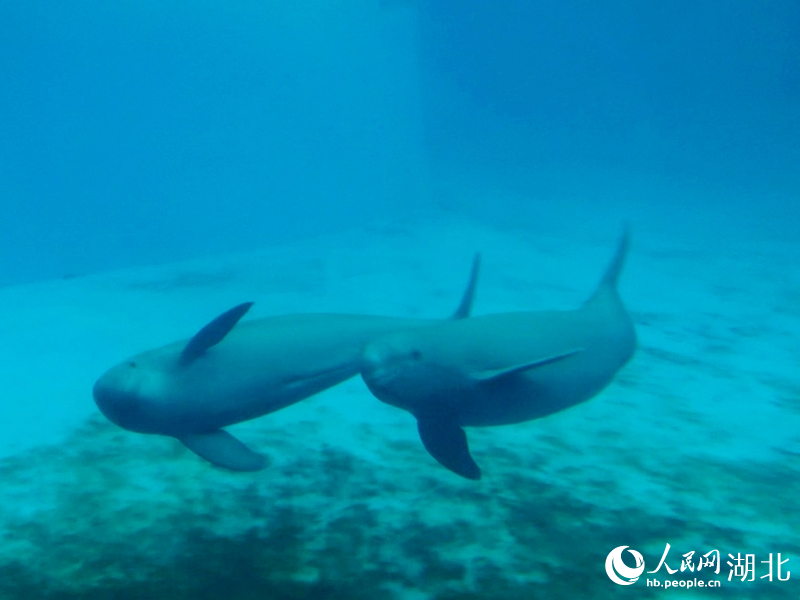
Yangtze finless porpoises swim underwater at the Baiji Dolphinarium of the Institute of Hydrobiology, the Chinese Academy of Sciences, Wuhan, central China's Hubei Province. (People's Daily Online/Zhang Pei)
Amid China's decade-long fishing ban on the Yangtze River, the Yangtze finless porpoise population has rebounded to 1,426. Sightings in the Wuhan section of the river have also risen significantly.
The Yangtze finless porpoise is a barometer of the river's ecological health. The steady recovery of the species provides strong evidence of a broader revival of the Yangtze River ecosystem and its growing abundance of aquatic life.
Xu Jun, deputy director of the Institute of Hydrobiology at the Chinese Academy of Sciences, said the institute has established a captive breeding population of Yangtze finless porpoises, making it one of China's leading conservation bases for the species. The institute has also continued to share biodiversity conservation methods for the Yangtze finless porpoise with other countries.
Researcher Mei Zhigang demonstrated a smart monitoring platform for Yangtze finless porpoises and biodiversity. By combining underwater acoustic arrays, surface and aerial imaging, and AI-powered identification, the system enables round-the-clock monitoring. It also overcomes known challenges in tracking the Yangtze finless porpoise, including poor visibility and inaccurate detection.
In 2025, relevant institutions jointly launched the International Small Cetacean Conservation Research Program. 19 officials and cetacean experts from Cambodia, Laos, Myanmar, Thailand, and Indonesia visited Wuhan to learn about conservation practices for the Yangtze finless porpoise and to explore protection plans for Irrawaddy dolphins in the Mekong River.
Wuhan's Agriculture and Rural Affairs Bureau launched a global campaign to gather visual designs for the Yangtze finless porpoise. In the future, the Yangtze finless porpoise IP will be deeply integrated into the city's public spaces and international exchanges.
Photos


Related Stories
- Wuhan makes remarkable achievements in protecting Yangtze finless porpoise
- Finless porpoises in Poyang Lake relocated for better protection
- Endangered "smiling angel" spyhopping Asia's longest river
- From extinct Yangtze River dolphin to artificially bred finless porpoise
- 2 finless porpoises relocated, 'married' to optimize population diversity
- Trapped finless porpoise rescued in E China's Jiangxi
- Reviving the 'river pig'
- Long run to be held in central China to save finless porpoise
- Extinction of Yangtze porpoises accelerating: report
- NGO set up to protect endangered finless porpoise
Copyright © 2026 People's Daily Online. All Rights Reserved.
