



China's coastal regions forge new paths for prosperity from the sea
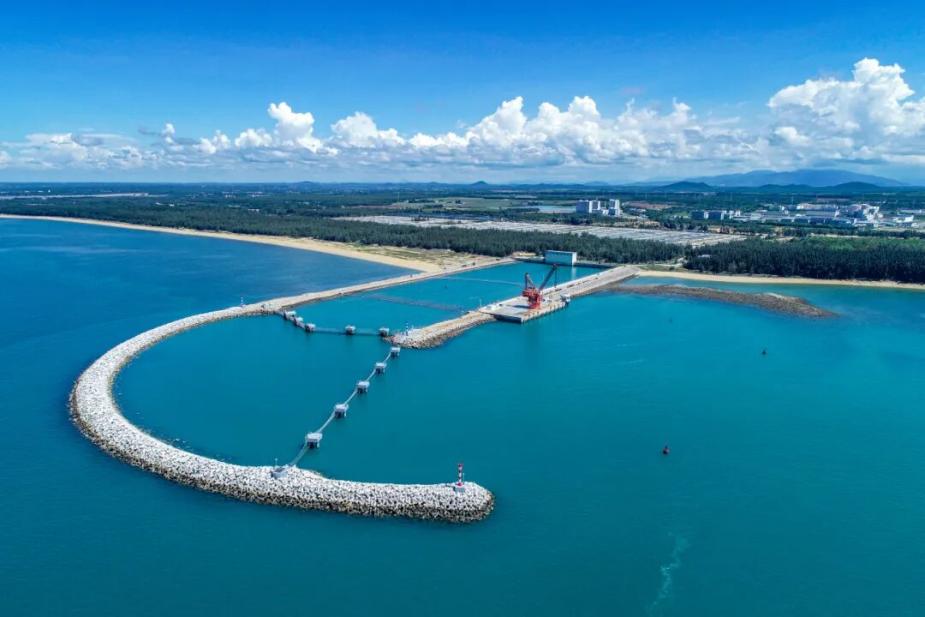
Photo shows the Pinctada maxima oyster farm beside the Changjiang nuclear power plant in south China's Hainan province. (Photo provided by Hainan Nuclear Power Co., Ltd.)
From the breakwater of the Changjiang nuclear power plant in south China's Hainan province, one can look out over rows of aquaculture cages swaying gently on the blue sea. A closer look reveals young shellfish, each no bigger than a palm, attached to the nets.
Few people know these waters have become a breeding ground for Pinctada maxima, a species under second-class national protection, producing precious South Sea pearls.
The striking scene showcases harmonious coexistence between large-scale nuclear facilities and delicate marine creatures. It embodies a locally adaptive development model that strikes a fine balance between industrial progress and ecological conservation.
For nuclear power plants, handling industrial waste heat is an unavoidable challenge. Transferring excess heat to nearby industrial parks often leads to energy loss during transmission, while releasing overly warm water back into the sea can trigger eutrophication, threatening marine ecosystems and even affecting the safe operation of power units.
The shift to Pinctada maxima farming demonstrates a strategic understanding of natural systems. As filter feeders, these oysters require no manual feeding and actively mitigate seawater eutrophication, yielding both ecological and commercial value.
Earlier attempts to raise the species in the waters off Sansha in Hainan, in pursuit of exceptionally clean seawater, proved disappointing — the lack of algae and natural nutrients there slowed oyster growth and compromised quality.
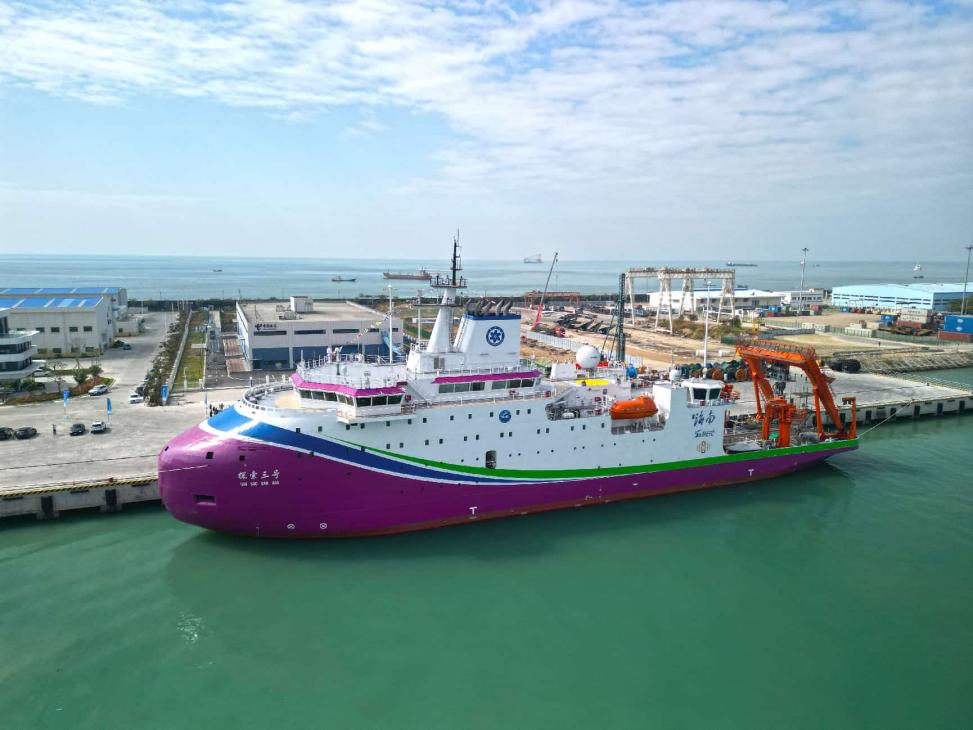
Chinese multi-purpose deep-sea scientific exploration and archaeological vessel Tan Suo San Hao (Exploration No. 3) docks at the Nanshan Port in Sanya, south China's Hainan province. (Photo/Li Xueshi)
In contrast, waters around the Changjiang nuclear power plant maintain a steady year-round temperature of around 25 degrees Celsius. Clean water, gentle currents and abundant plankton create an optimal growing environment that fully meets the species' strict survival needs.
Today, the thriving oysters have transformed industrial byproducts into economic assets. This synergy between nuclear power and pearl cultivation underscores a vital lesson: whether resources become limitations or advantages hinges on vision and strategy. By transcending conventional thinking, regions can harness unique conditions to drive high-quality development.
Across Hainan, similar efforts to rethink traditional marine industries are already taking shape. "Living off the sea" no longer refers only to fishing, shipping or tourism. The value of marine resources is being continually redefined and expanded.
Qingshui Bay in Lingshui Li autonomous county, for example, sets a perfect example. This popular seaside tourism destination has become home to China's first commercial underwater data center.
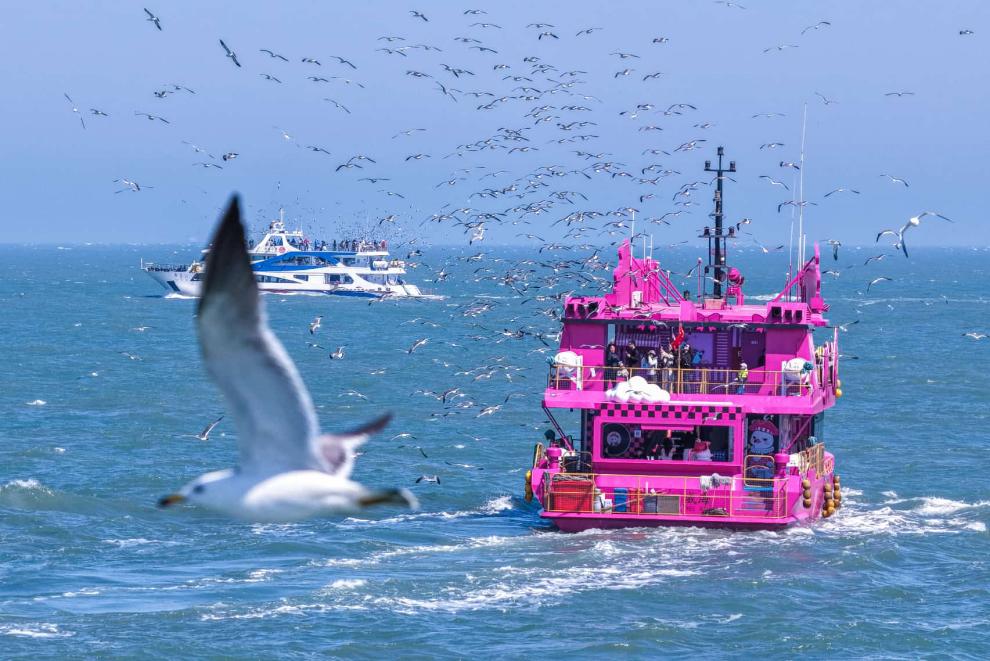
Tourists take a boat ride to get close to black-tailed gulls off Hailyu Island in Rongcheng, east China's Shandong province. (Photo/Li Xinjun)
By using naturally cold deep-sea water for cooling, the facility consumes significantly less energy than traditional land-based data centers, providing support for the development of digital economy for the Hainan Free Trade Port.
Elsewhere in Hainan province, the Nanshan Port in Sanya has transformed itself from the province's smallest cargo port into one of the world's busiest home ports for scientific research vessels. By opening its resources to research institutes, universities and expedition fleets nationwide, the port accommodated more than 2,100 scientific expeditions in 2025, seeing rapid business growth.
Over the past three years, Hainan's marine economy has consistently ranked among the fastest-growing in China. Behind this momentum lies a simple but important principle: marine development cannot rely on one-size-fits-all models. Only by building on local resource endowments and pursuing innovation suited to local realities can regions continuously cultivate new growth drivers and spur new industries.
Beyond Hainan, this broader shift toward transformation and upgrading has become a shared path for many of China's coastal regions as they foster new quality productive forces.
In Rongcheng, east China's Shandong province, local industries have moved away from densely packed nearshore aquaculture toward a three-dimensional marine farming model featuring algae in upper waters, shellfish and abalone in mid-level zones, and artificial reefs and fish habitats near the seabed. The approach has boosted output while helping restore marine ecosystems.
In Yancheng, east China's Jiangsu province, leftover cold energy generated during liquefied natural gas (LNG) gasification at coastal ports has been turned into a graded cold-energy supply system. It supports cold-chain storage, cold-water aquaculture and freeze-drying industries, allowing previously wasted energy to create new economic value.
Tech-driven innovation, ecological priorities and resource utilization tailored to local conditions are opening up new avenues for value creation and providing fresh pathways for developing new quality productive forces.
Ultimately, "living off the sea" is no longer about extracting resources from the ocean without restraint. It now focuses on building sustainable, harmonious coexistence between humans and marine ecosystems.
By understanding local coastlines, marine conditions and ecological foundations, and by planning carefully, innovating boldly and developing thoughtfully, China's coastal regions are discovering that the ocean can offer an even more abundant future.
Photos

Related Stories
- China completes 537-day deep-sea material corrosion test
- China's 3 deep-sea manned submersibles have made over 1,700 dives to date
- Various firsts achieved in deep-sea expedition
- China launches a deep-sea cold seeps research megaproject, including a manned deep-sea lab
- Chinese scientists advance development of High-energy Underwater Neutrino Telescope
- China's submersible and research vessels fine-tuned for future deep-sea missions
- CCG departments handle over 250 cases of illegal sea sand mining and unlawful use of marine resources in 2024
- China's independently-developed deep-sea scientific research, archaeological vessel officially commissioned in Sanya
- China delivers independently-developed deep-sea scientific research, archaeological vessel
- Diver pieces back together smashed marine ecosystem
Copyright © 2026 People's Daily Online. All Rights Reserved.
