



China's commercial space sector advances modular rocket manufacturing
China's commercial space industry has taken another step forward with the successful maiden flight of the Lijian-2 Y1 carrier rocket, developed by CAS Space.
The rocket was recently launched from the Dongfeng commercial space innovation pilot zone in northwest China, successfully deploying multiple payloads -- including the Qingzhou Cargo Spacecraft Test Vehicle, and other two satellites -- into their designated orbits.
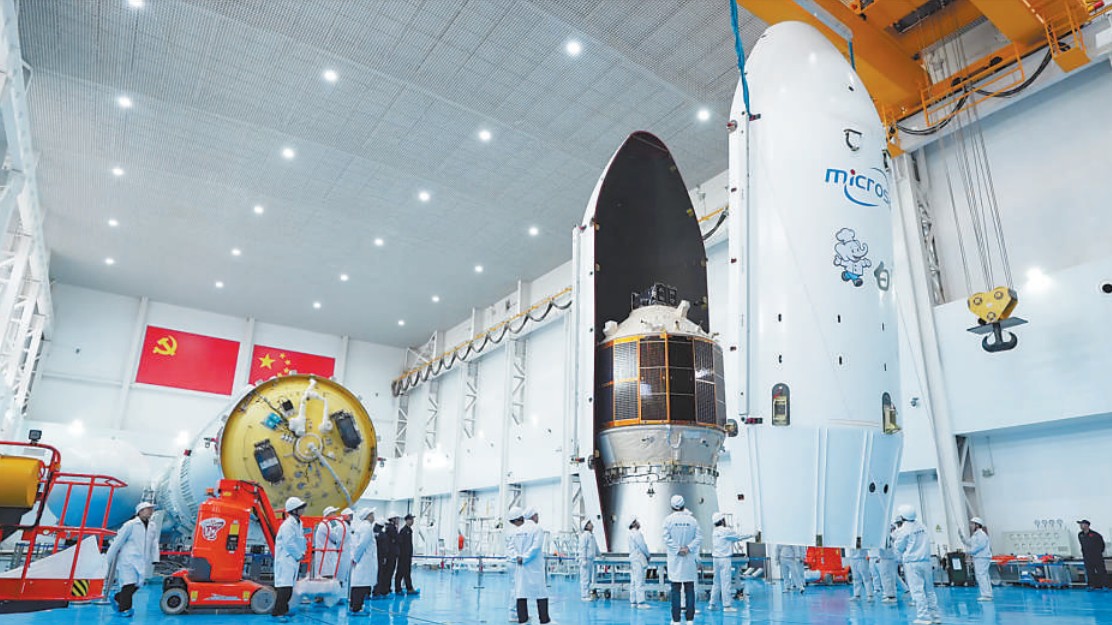
Photo shows fairing assembly of the Lijian-2 carrier rocket. (Photo provided by the interviewee)
This inaugural flight of the Lijian-2 rocket highlights a series of technological innovations, notably its modular design and planned recoverability. Experts suggest these features could fundamentally reshape rocket manufacturing and operations.
A key innovation is the standardized design of the rocket's core stage and boosters, which appear nearly identical. This deliberate uniformity allows for batch production of major components, enabling assembly similar to "building blocks." This approach significantly streamlines manufacturing.
Lian Jie, deputy chief designer of the Lijian-2 rocket, explained that key components conform to uniform specifications. If a component malfunctions before launch, it can be swiftly replaced like a standard part, minimizing delays and enabling high-frequency launch capability.
The same philosophy applies to the rocket's engines. Departing from tradition where core stages and boosters use different engines, the Lijian-2 employs a unified engine model.
The first stage utilizes nine fully interchangeable liquid rocket engines. The second stage features a modified version of the same engine with a larger nozzle for enhanced high-altitude efficiency. Essentially, all ten engines share the same core design, simplifying maintenance and replacement.
Lian further detailed that the modular core stage and boosters allow the Lijian-2 to be configured flexibly with zero, two, or four boosters. This flexible booster arrangement gives the rocket a maximum thrust of up to 1,000 tonnes, with a low Earth orbit payload capacity ranging from 2 to 20 tonnes.
The rocket is designed to support diverse missions, including cost-effective cargo transport, low-orbit satellite constellation deployment, and launches of scientific experimental satellites.
Beyond modular manufacturing, the Lijian-2 series is pioneering a novel recovery approach. Moving away from traditional stage-by-stage retrieval, it plans to implement an integrated recovery scheme where the boosters and core stage remain connected and return to Earth as a single unit.
According to Lian, this approach offers improved aerodynamic control, reduced landing impact, stronger propulsion redundancy, and less loss of payload capacity. It also increases the proportion of recoverable components within the rocket while simplifying recovery systems, helping to further reduce launch costs.
At present, cargo missions to China's space station are primarily carried out by the Tianzhou series spacecraft. To further lower transportation costs and improve flexibility, China is exploring a new space logistics model driven by national demand and supported by commercial capabilities.
Within this framework, the Qingzhou cargo spacecraft has been developed as a lighter, more adaptable option. Weighing just 4.2 tonnes, it features a single-module integrated design and can be launched by multiple types of rockets.
The Qingzhou Cargo Spacecraft Test Vehicle carried on this mission housed 27 projects, including technology validation experiments, in-orbit testing, scientific research, and science outreach projects, with a total payload weight of 1.02 tonnes. It will conduct a series of in-orbit experiments at altitudes between 200 and 600 kilometers.
An expert with the Innovation Academy for Microsatellites of the Chinese Academy of Sciences noted that the test vehicle will focus on verifying key in-orbit technologies. Once operational, the Qingzhou cargo spacecraft is planned to dock with China's space station and provide regular cargo delivery services.
Yang Haoliang, commander of the Lijian-2 rocket, stated that the successful maiden flight, carrying the Qingzhou prototype, demonstrated China's evolving space cargo transport capability. He noted a shift from the accumulation of individual capabilities to a more integrated, system-level approach.
"Commercial rockets will not only serve market needs but also take part in major national space missions to formal engineering standards in the future. We aim to provide more cost-effective and reliable flight-like launch services," Yang added.
Photos



Related Stories
- China starts feasibility study for space-based intelligent computing constellation
- China pushes forward space computing industry development: official
- China launches in-orbit experiment projects in space hospital quest
- China planning human research program at space station
- Chinese startup tests flexible arm for orbital refueling in space
Copyright © 2026 People's Daily Online. All Rights Reserved.
