



Underwater robots boost marine resource development in Dalian
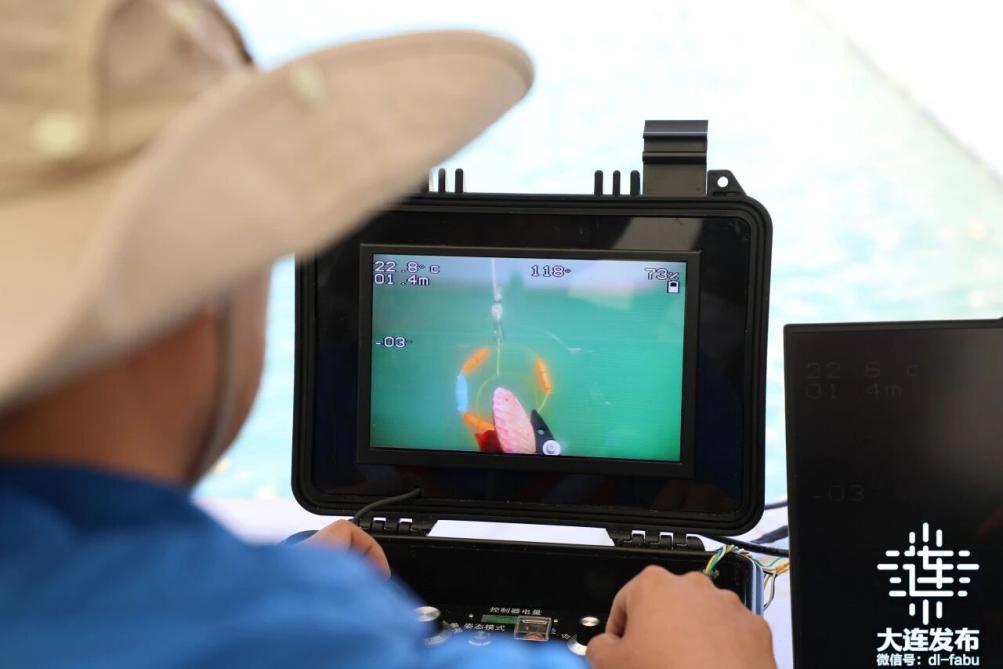
An engineer controls an underwater robot. (Photo from the official account of the information office of the Dalian municipal government on WeChat)
In the waters north of the Manhua terminal in Suoyu Bay, Dalian, northeast China's Liaoning province, gentle waves lapped against the quay.
Not far offshore, researcher Yuan Guoliang from the Liaoning Underwater Robot Engineering Research Center was fine-tuning a piece of equipment. With a light tap, an orange underwater robot slipped quietly into the sea. On a nearby screen, underwater piles and seawall details came into sharp view, while real-time data on water quality and sediment flowed back to shore.
This scene contrasts starkly with past practices. "Years ago, we had to wear heavy diving suits and work in cold water. At best, we could operate for four or five hours a day, and it took a whole team to assist," said Ma Yongxiang, head of a local seafood company.
Harvesting abalone and sea cucumbers once relied on perilous manual dives amid strong currents, high pressure, and poor visibility. "Few youth want such grueling work today," Ma noted.
"Necessity drives innovation," said Fu Xianping, dean of the Information Science and Technology College at Dalian Maritime University and director of the Liaoning Underwater Robot Engineering Research Center.
After years of development, the center has created the Haiying (Sea Eagle) series of underwater harvesting robots. Equipped with customized grippers, the robot can accurately identify and pick up sea cucumbers and abalone, and store them automatically. Operators control the system from a shore-based station, watching live video feeds of the seabed. Once the task is complete, the robot returns to the surface on its own -- no divers required.
At a Dalian aquaculture farm, a Sea Eagle robot collected samples with unprecedented efficiency. "We now cover more than 40 sites daily versus just 3-4 manually," Ma observed from shore. Such progress overcame daunting challenges: murky waters, unpredictable currents, and unreliable data transmission long hindered underwater robotics.
Working underwater is never easy. Coastal waters are often murky, with strong currents and very low visibility. Data transmission is also difficult, making real-time control a challenge. These factors have long constrained the development of intelligent underwater systems.
To tackle these challenges, the research center brought together more than 80 experts from different fields. After two years of work, the team developed an optical imaging model for turbid water and introduced a new imaging method based on light polarization, significantly improving underwater visibility.
For communication, the team designed a high-speed data transmission system using visible light arrays, enabling multiple robots to operate in coordination. They also built an integrated system linking underwater, surface, and low-altitude equipment, improving overall sensing and coordination in complex marine environments.
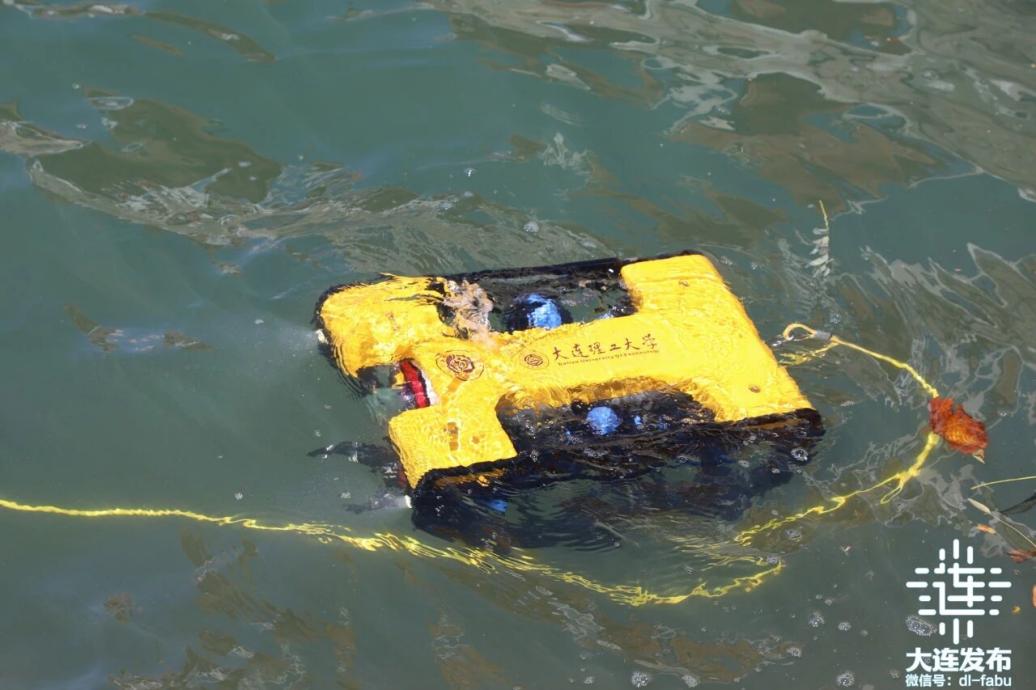
Photo shows a Haiying underwater robot. (Photo from the official account of the information office of the Dalian municipal government on WeChat)
Today, the Haiying and Hai'ou (Sea Gull) robot series developed by Fu's team are widely used in Dalian's marine industry. Their sensors monitor parameters such as temperature and salinity at different depths, while onboard cameras track the growth of marine life and help assess health conditions. Equipped with robotic arms and harvesting tools, they can carry out precise and efficient operations.
Bridging cutting-edge technology and practical applications, a public innovation platform for smart ocean information technology was launched in 2025. Led by Dalian Maritime University and Zoneco Group, and supported by the Liaoning Underwater Robot Engineering Research Center, the public innovation platform for smart ocean information technology aims to speed up the application of new technologies.
Its innovations are already being widely applied. The Hai'ou I robot has been deployed at the construction site of northeast China's first submarine cable with a 630-square-millimeter cross-section, carrying out real-time underwater supervision to ensure safety. The Hai'ou II robot assists in offshore drilling platform installation and pipeline inspections, supporting oil and gas development at sea.
Besides, an underwater robot for Arctic research independently developed by the platform has joined scientific expeditions to the Arctic, supporting the collection of underwater environmental data. Another robot, designed to inspect underwater dam structures, has been delivered to a research institute under China Shipbuilding Industry Corporation, where it plays an important role in water conservancy projects.
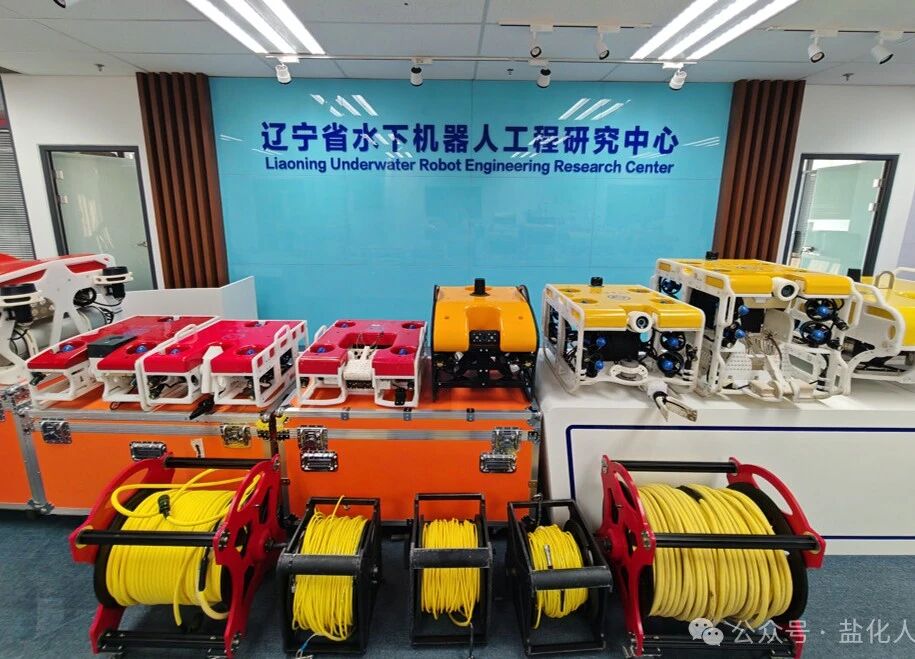
Photo shows the Liaoning Underwater Robot Engineering Research Center. (Photo from official account Yanhuaren on WeChat)
Photos




Related Stories
- Robot 'interns' hit the factory floor in S China's Guangxi
- More smart devices used in China's household service sector
- Designers craft traditional Chinese-style outfits for robots at Zhongguancun Forum
- China's surgical robots serve patients worldwide
- From mind to machine: How thought makes robot dog walk
- China's emerging robot rental market gains momentum
- In pics: International Sci-Fi and Future Tech Expo Beijing 2026
- Intelligent robots empower BFA Annual Conference 2026 in Hainan
- In pics: Qingdao Humanoid Robot Data Training Center in China's Shandong
- Robot "teachers" preparing China's humanoids for real-world jobs
Copyright © 2026 People's Daily Online. All Rights Reserved.
