



'AI milk tea' a taste of new smart economy
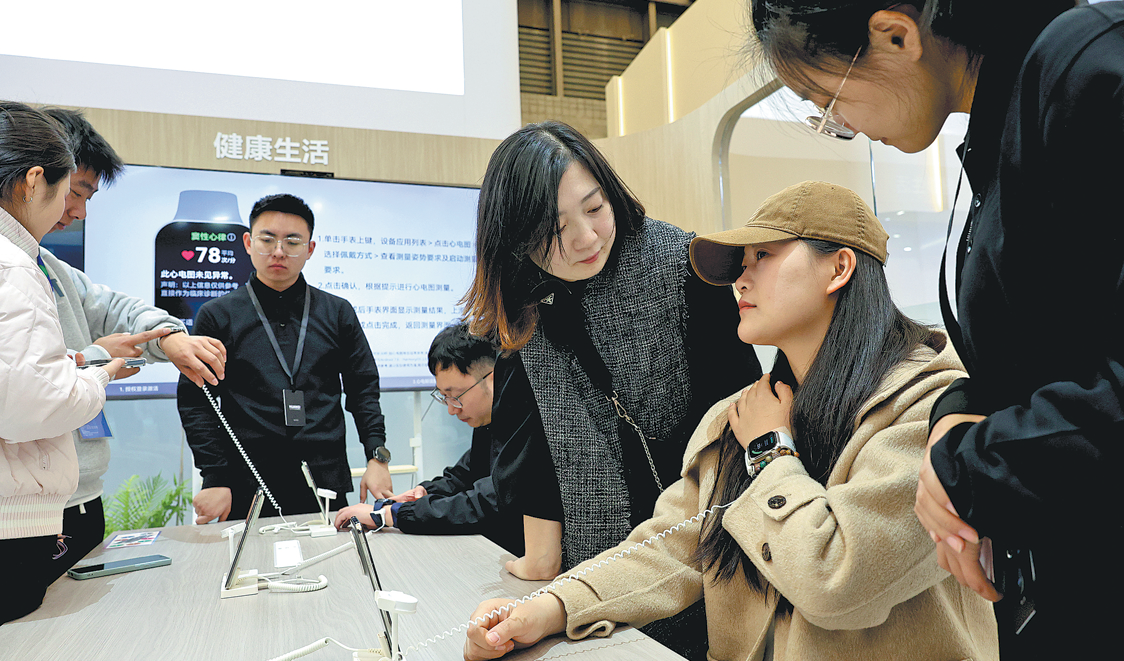
Visitors try smart watches that actively monitor blood pressure at the Appliance &Electronics World Expo in Shanghai on March 20, 2025. FANG ZHE/XINHUA
On a brisk winter day in Hangzhou, Zhejiang province, a winding line of customers braved the cold outside a bustling milk tea shop. Yet, instead of the usual glow of smartphone menus and the repetitive tapping of QR code scanners, a different kind of interaction was taking place: they were ordering directly through artificial intelligence.
One by one, patrons verbally instructed a digital assistant to curate a drink, pinpoint the nearest storefront and process the order. Within seconds, a ping on their phones confirmed the purchase.
"It was my first 'AI milk tea'. I've used food delivery apps for years, but this was the first time that AI picked my drink," said Qin Xiaomeng, a 25-year-old internet product manager from Hangzhou.
China's biggest technology companies — including the Alibaba Group, Tencent Holdings and Baidu Inc — have spent tens of billions of yuan subsidizing AI-powered services, offering everything from ultracheap drinks to discounted travel bookings.
Qin's experience was a small but revealing moment in the global race to shape AI. While Silicon Valley in the United States pours hundreds of billions into building ever-larger models, China has quietly begun pushing AI into people's everyday life on a massive scale.
For policymakers, companies and industry experts, the humble cup of AI milk tea is a vivid indication of how China hopes to scale the technology across a population of more than 1.4 billion people.
A year ago, in the weeks before China's annual two sessions began, a relatively unknown Chinese startup called DeepSeek jolted Silicon Valley. The reaction was immediate. Users downloaded it by the millions. Venture capitalists began asking whether China might catch up faster than expected.
According to the 2026 Government Work Report delivered at this year's two sessions, China will "advance and expand the AI Plus Initiative", and for the first time the country will "create new forms of smart economy".
The country will also promote faster application of new-generation intelligent terminals and AI agents and encourage large-scale commercial application of AI in key sectors and fields, so as to foster new forms and models of AI-native business, the report said.
Chen Changsheng, a member of the report's drafting team, said: "AI Plus has been included in the Government Work Report for three consecutive years, but it is an entirely new concept of creating new forms of smart economy."
"In essence, it is about seizing the opportunities of AI development, and expanding the breadth and depth of AI's empowerment across all industries, so as to rapidly open up new spaces for economic growth, cultivate new business models, and gear up new drivers of growth," he said.
Bai Chong-En, a member of the 14th National Committee of the Chinese People's Political Consultative Conference, China's top political advisory body, and dean of the School of Economics and Management at Tsinghua University, said that it is important to continue investing in foundation models. However, more importantly, China must find strong application scenarios for these breakthroughs.
"Creating a new form of intelligent economy is ultimately about closely integrating AI technology with industrial and broader societal development, enabling AI to be deployed in a wider variety of scenarios to generate greater value," he said.
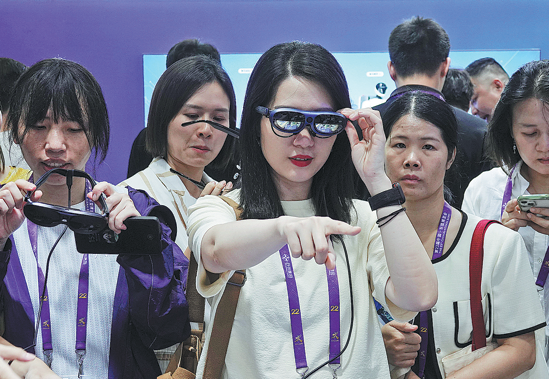
Visitors put on Rokid smart glasses during the China-ASEAN Expo in Nanning, Guangxi Zhuang autonomous region, on Sept 18. YU XIANGQUAN/FOR CHINA DAILY
Physical application
Beyond apps and digital assistants, AI technology is rapidly moving into physical devices — from smartphones and home appliances to vehicles and wearable devices.
Chinese companies are experimenting with ways to embed AI agents directly into everyday hardware, allowing users not only to ask questions but to complete real-world tasks without opening a single app.
When German Chancellor Friedrich Merz slipped on a pair of AI-powered glasses during a visit to Hangzhou last month he began speaking with Chinese staff as German subtitles appeared in real time before his eyes.
"Accurate, fast," Merz said after testing the device's translation feature, according to people present at the demonstration.
The glasses, developed by Hangzhou-based startup Rokid, drew immediate interest from German business executives traveling with the delegation. Several of them placed orders on the spot, highlighting the growing appeal of Chinese-made AI hardware among overseas users.
What caught global attention is that just days later, the device received a major software upgrade that underscored a broader shift in its AI ecosystem.
The overseas version of the company's Rokid glasses pushed an over-the-air update that integrated four major large language models simultaneously — Google's Gemini, ChatGPT, DeepSeek and Alibaba's Qwen.
Industry experts said that the multi-model architecture is unusual in the still-nascent AI glasses sector, where most devices rely on a single AI system.
Rather than switching from one model to another through separate services, users can toggle between the four systems depending on the task — from translation and navigation to messaging and purchasing — under a cloud-and-device collaborative architecture.
Latest data from market research company Omdia said that worldwide shipments of AI glasses reached about 8.7 million units in 2025, a 322 percent jump from a year earlier and the second consecutive year of growth above 300 percent.
Chinese companies are playing an increasingly prominent role. Rokid and smartphone maker Xiaomi ranked second and third globally in shipments, the research firm said.
In China, industry experts see the technology as part of a broader transformation in AI application and consumption.
Lu Ming, an economist and member of the 14th CPPCC National Committee, said AI-powered products and services are lowering the cost of making purchasing decisions by simplifying interactions between users and digital platforms in China.
"AI is breaking the traditional boundaries of consumer groups and geographic regions. It is evolving from a chat tool into an assistant that can actually complete tasks," Lu told China Daily on the sidelines of the annual two sessions in Beijing. "To some extent, AI is also driving consumption by expanding user groups."
Data from Alibaba Group showed that during this year's Spring Festival holiday, over 4 million Chinese users aged over 60 placed orders through AI systems. Natural-language interaction helped many elderly users who previously struggled with smartphone apps to place orders online.
Orders from smaller Chinese cities also surged compared with previous periods, as AI services expanded into lower-tier markets.
Lu said policymakers should encourage technology companies to leverage LLMs to build full-scenario digital assistants while also easing regulatory barriers and improving accessibility for elderly users.
"Only when institutional reform and technological innovation move forward together can new consumption momentum be fully unleashed," he added.
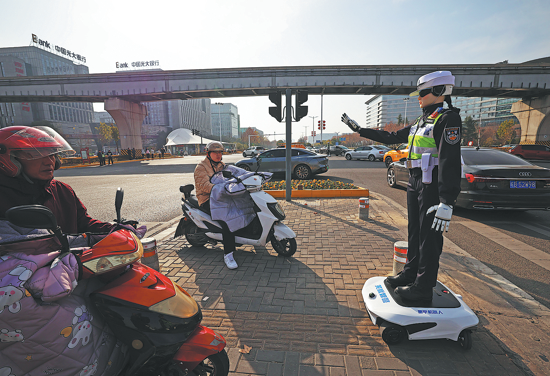
A robot officer with a badge that reads "Intelligent Police Unit R001" is seen on a road in Wuhu, Anhui province, on Jan 10. WANG YUSHI/FOR CHINA DAILY
Personal assistants
Outside consumer apps, another symbol of this transformation that has taken the country by storm is OpenClaw, nicknamed the "AI lobster" for its red lobster logo.
The AI-powered digital personal assistant was developed by an Austria-born millennial inventor and acquired by the US-based company OpenAI.
China's State-backed national supercomputing network announced on Monday that OpenClaw services have been connected to its major interactive workplace platforms, including ByteDance's Feishu and Tencent's WeCom. The network is known for its cost-effective use of large and high-performance digital models.
On the same day, tech giant Tencent Holdings rolled out WorkBuddy, an AI agent designed to integrate with Chinese workplace and messaging tools and compatible with OpenClaw's core skills.
Zhou Hongyi, a member of the 14th CPPCC National Committee and founder of 360 Security Group, said the AI lobster has transformed cloud software into a digital personal assistant on a user's computer and is incredibly easy to operate.
Historically, high-end AI models were restricted to tech giants and came with high operating costs, he said on the sidelines of the two sessions.
Zhou Di, a professor at Hangzhou Dianzi University in Zhejiang province and a deputy to the 14th National People's Congress, China's top legislature, said China develops AI differently from the US.
Zhou said China doesn't rely only on building bigger models that require huge computing power, but instead develops efficient and lightweight models like AI lobster. This allows real-world problems to be solved in areas such as industrial inspection and medical diagnostics.
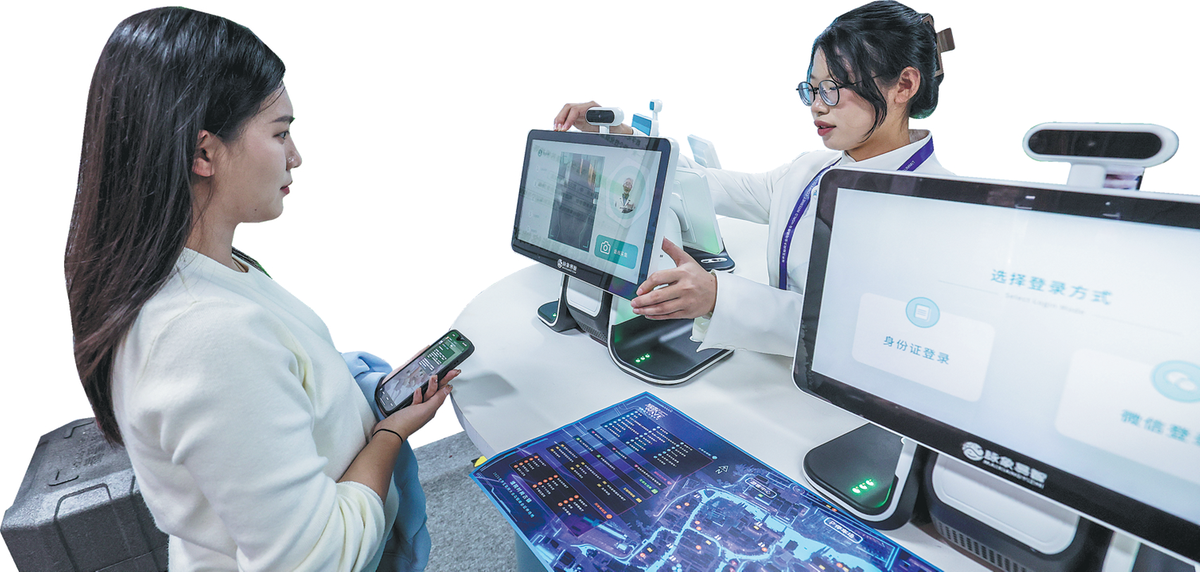
A woman receives an AI-powered traditional Chinese medicine diagnosis during an internet life carnival in Jiaxing, Zhejiang province, on Nov 5. XU YU/XINHUA
Global push
Chinese-developed open-source LLMs accounted for 17.1 percent of global downloads over the past year, surpassing the US, at 15.8 percent, for the first time, according to a joint report by the Massachusetts Institute of Technology and Hugging Face.
Models such as DeepSeek's V3 and Moonshot AI's Kimi K2 have driven a surge in adoption, together representing nearly 30 percent of global usage of open-source LLMs this year, the report said.
Wei Kai, head of the AI research institute at the China Academy of Information and Communications Technology, said the data reflected "a systemic upgrade in China's overall AI capabilities".
"This is not a single breakthrough," Wei said. "It is the result of sustained investment, open ecosystems and the ability to integrate models with real-world scenarios at scale."
Consultancy PwC estimates that AI could contribute $7 trillion to China's GDP by 2030. Market consultancy CCID Consulting projects China's AI industry will grow from 398.5 billion yuan in 2025 to more than 1.7 trillion yuan by 2035.
"China's AI companies are also going global. They have moved beyond the simple export of products or services. Instead, they are enabling the intelligent upgrading of local industrial chains through technology empowerment," Wei said.
Chinese companies such as Alibaba and Huawei have been promoting open-source AI models across Africa, targeting startups and innovation hubs. Freely available and modifiable, these models allow developers to build products without paying high licensing fees.
That approach contrasts sharply with that of OpenAI and most US companies, whose AI ecosystems are largely proprietary — with software, training data and algorithms tightly controlled by parent firms and monetized through paid access.
While global attention has focused on Western technology companies competing for lucrative enterprise contracts in the US and the Middle East, a different strategy has been adopted by their Chinese counterparts.
In Africa, the digital economy is estimated to be about $180 billion — a fraction of OpenAI's roughly $500 billion valuation in recent equity deals.
In such an emerging market, Huawei and ZTE have supplied much of Africa's data centers, 5G and fiber-optic network equipment. Further down the technology stack, Transsion Holdings accounts for much of Africa's smartphone market, with Xiaomi and Honor gaining ground, while TikTok ranks among the continent's most downloaded apps.
In the Middle East, Chinese companies are integrating AI with the internet of things in national projects such as the UAE's Smart Dubai initiative, helping build efficient resource management and urban security systems in desert environments.
In Southeast Asia, industrial vision inspection and predictive maintenance solutions provided by Chinese AI firms are already being deployed in electronics and auto-parts factories in Vietnam and Thailand.
"These practices create commercial value, but more importantly, they improve quality of life, enhance social resilience and push inclusive technology adoption on a global scale," Wei said.
Photos



Related Stories
- "Claw-powered" one-person companies become hot topic at China's "two sessions"
- Chinese high-tech zone rolls out OpenClaw support policies; experts warn potential risks with AI agents
- China's AI push shaping a burgeoning "smart economy"
- China to strengthen research on AI legislation
- China becomes world's largest holder of AI patents
- The end of AI is electricity: What fuels the power advantage? : People’s Daily
- China to harness AI in creating new jobs: minister
- China's AI-related industries to top 10 trln yuan by 2030: official
- China's AI ecosystem leads global adoption, powers innovation drive
- China's core AI industry scale tops 1.2 trln yuan in 2025: official
Copyright © 2026 People's Daily Online. All Rights Reserved.
