



NPC deputy: China's Science and Technology Backyard program drives global green agriculture transformation
"We hope to bring China's Science and Technology Backyard (STB) program to more Belt and Road partner countries and Global South nations, helping local people secure adequate food and clothing while advancing agricultural modernization," said Zhang Fusuo, a deputy to the National People's Congress (NPC), China's top legislature.
Zhang, also an academician of the Chinese Academy of Engineering and a professor at China Agricultural University, is the founder of the STB program.
Since its 2009 launch in Quzhou county, north China's Hebei Province, the STB model has effectively addressed the "last mile" challenge in agricultural technology adoption.
China has launched more than 1,800 STBs nationwide and incorporated the program into the "No. 1 central document" — the first policy statement issued by China's central authorities each year — in both 2024 and 2025.
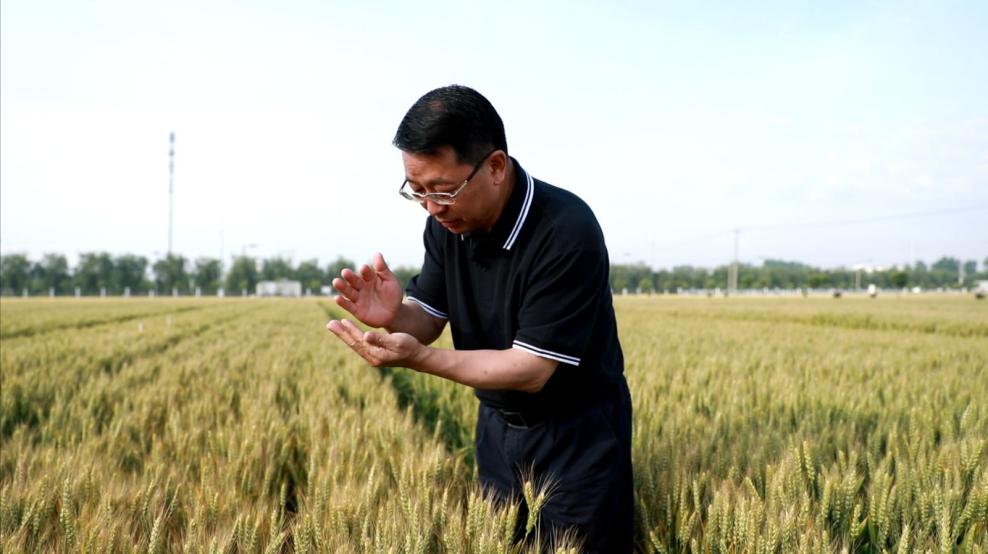
Zhang Fushuo checks on the growth of wheat in a field in Quzhou county, north China's Hebei Province. (Photo courtesy of the interviewee)
The STB model has expanded internationally, now operating in 11 countries and contributing to the global green transformation of agriculture.
Zhang pioneered a "1+1+1" training model to drive the program's global expansion: one year in China for foundational knowledge, one year applying the STB model in the participant's home country, and a final year back in China for refinement — bridging learning and real-world implementation.
In Zhang's view, nurturing local talent is the single most important lever for taking the model global. By training home-grown professionals in partner countries, the program aims to provide systematic solutions to agricultural development challenges in Belt and Road partner countries and Global South nations.
The STB model, which began as a local Chinese innovation, first took root abroad in Africa before expanding to Brazil, Malaysia and beyond, with cooperation models growing increasingly diverse.
The model's success abroad has demonstrated the viability and effectiveness of China's path toward green agricultural development, and the program has been recognized by the Food and Agriculture Organization of the United Nations as a leading case study for worldwide promotion.
Plans are underway to establish an STB global center to systematically summarize and disseminate successful practices, support countries in cultivating local talent, and empower agricultural development and transformation, according to Zhang.
Photos



Related Stories
Copyright © 2026 People's Daily Online. All Rights Reserved.
