



New Year on the Frontlines: Shanghai: one bed, room, home; Xiong'an: one land, map, city
Editor's Note:
This year marks the 105th anniversary of the founding of the Communist Party of China (CPC) and the opening year of the 15th Five-Year Plan (2026-30). A new year begins with new resolve and new momentum. The call to "fight for our dreams and our happiness, and turn our great vision into beautiful realities" continues to inspire action across China.
In the column "New Year on the Frontlines," reporters from the People's Daily traveled to the grass roots to witness the vitality of a vast nation, see its mountains and rivers in motion and its fields in abundance, and listen to the stories of people finding fulfillment in both life and work.
Through these stories, the column seeks to present a vivid portrait of Chinese modernization.
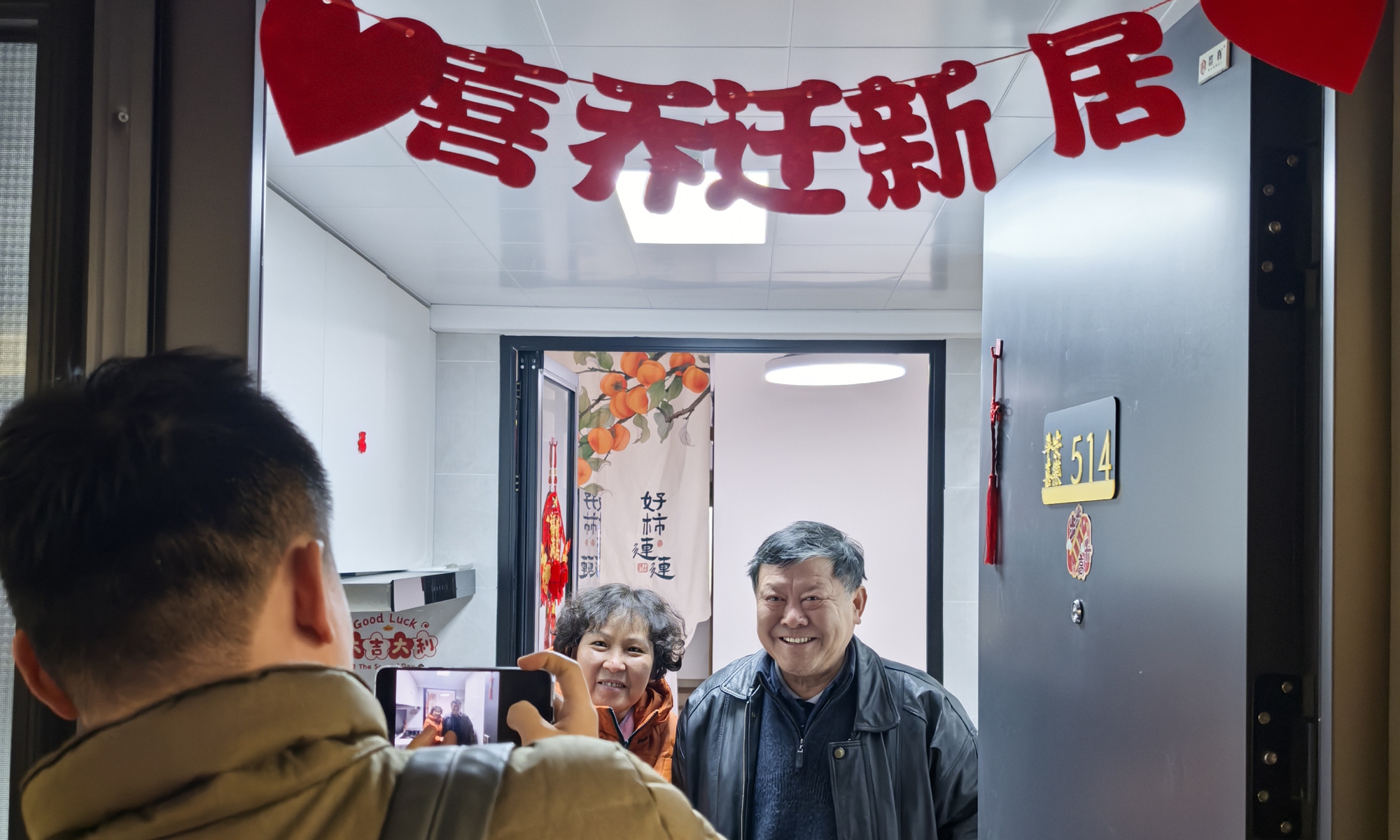
A People's Daily reporter takes photos of Yan Weiming and his wife, residents of Caoxi Third Village in Xuhui district, in Shanghai. Photo: Yin Xinyu/People's Daily
On February 8, in a residential building in Jing'an in downtown Shanghai, delivery rider Shen Zhuangqi - a native of Heze, East China's Shandong Province who has been working in the city for three years - greeted the reporters with a simple sentence: "I've found that big-family feeling here."
That sense of home comes from the apartment block itself. Four people share each room; all appliances and furnishings are provided, bathrooms have hot water 24 hours a day, and the ground floor offers a billiards table, a small cinema, and a fitness room.
"How much is the rent?" A reporter asked.
"Nine hundred yuan ($130.4) a month," Shen replied. "In Jing'an, every inch of land is extremely valuable, I wouldn't get this price if it weren't a government-run apartment."
The building where Shen lives contains 196 rooms and 1,310 beds, and is home to delivery riders, courier staff, hotel workers, and others. Across Shanghai, such buildings are collectively known as "new era homes for urban builders and managers."
"Migrant workers who come to Shanghai to contribute are just as much masters of the city."
Having a place to live creates a sense of belonging. As a global megacity, Shanghai has, in recent years, been actively building a multi-tiered, guaranteed rental housing system summed up as "one bed, one room, one home." To date, the city has supplied 610,000 units (rooms), helping more new settlers and young people realize the dream of stable housing.
In Caoxi Third Village of Shanghai's Xuhui district, the reporters met 70-year-old Yan Weiming, who moved into his new flat in 2025.
The flat is not large, but has a kitchen and a bathroom. "We'll spend the Spring Festival in our new home," he said. "My wife and I can live here comfortably, and the important thing is, now there's a toilet!"
For many older Shanghai residents, the phrase "carrying the chamber pot" was a lived misery for decades - hauling chamber pots or making do with shared facilities because there were no private indoor toilets.
"You can't march toward modernity with a chamber pot in your hand," goes a refrain that spans more than 30 years of urban renewal. In September 2025, after a relay of projects stretching over three decades, the city finished the final renovation tasks for more than 14,000 households ahead of schedule. Shanghai residents finally said goodbye to the era of "carrying the chamber pot."
Yan is one of them. His old three-story home in Caoxi Third Village was torn down and rebuilt as an eight-story elevator building. "I didn't pay a thing for the new flat - only our country could do something like this!" the senior remarked.
A plane from Shanghai and then a quick transfer to the high speed train - in under half a day, the reporters had arrived in Xiong'an New Area in North China's Hebei Province.
There, the reporters saw how Xiong'an has been transformed: From a stretch of raw land to a mapped plan, and then to a city - a modern new town springing up from the earth.
The "golden reed" building, or Sinochem Tower, stands as one of Xiong'an's landmarks. From the office window Xiong'an spreads out in full view. "What a new city! Can you imagine? A few years ago, this was just a big piece of land," said Lin Chengang.
Lin, who works at Sinochem Energy, bought a home in Xiong'an in 2025. "My whole family will be spending Chinese New Year here," Lin said.
Building a millennial city on such "a big piece of land" began with a single map. "Every inch of land should be clearly planned before construction," President Xi Jinping noted.
Inside the planning exhibition center of the new area, a towering master plan hangs above a full-scale sand model of the entire region. Guide Wang Qian walks visitors along the display, tracing with practiced care the planning logic behind every parcel of soil.
What began as a paper blueprint is fast becoming reality. The new city of Xiong'an is unfolding with a sequence of eye-catching revelations.
First, Xiong'an has efficient urban spaces above ground. "Plant green first, build the city later," is a guiding maxim here, and it shows. Stroll through Xiong'an and greenery is everywhere - a park within 300 meters, an urban greenbelt within one kilometer, a forest within three. At its Yuerong Park, manicured gardens and open vistas invite lingering.
"Across nearly 215 square kilometers, 5,338 buildings have already been completed," said Feng Xiaohu of China Xiong'an Group Co, Ltd. "Malls, schools, homes, and office towers - the whole urban ecosystem is taking shape."
Second, Xiong'an has an underground network of utility corridors and logistics. Power lines are invisible across the urban core; even the suburbs lack the lattice of high-voltage towers. Electricity, communications, heating, gas, and water have all been routed into subterranean utility corridors - over 1,000 kilometers of conduits in total.
In Rongxi area of Xiong'an, in a utility tunnel control room, operations staff keep a constant eye on the system via a wall of monitoring screens. "Built on the digital-city foundation, we created an intelligent management platform for the tunnels," said Ma Yongjun of China Xiong'an Group Co, Ltd. "It delivers full video coverage, comprehensive IoT (Internet of Things) sensing, and remote, centralized dispatch."
Third, Xiong'an has a cloud-based digital twin that monitors the "above ground city" in real time. For the first time, Xiong'an is constructing its digital twin in lockstep with the physical city: In every building, every streetlight has a one to one counterpart in the virtual model. The twin city has already aggregated more than 30 billion pieces of public data.
At the Xiong'an Urban Computing Center, engineer Zhao Song taps a building on a digital display and, in an instant, two and three dimensional models of each floor and every workstation pop up on the screen - a layered, data rich mirror of the city beneath his fingertip.
Xiong'an is known as "a city of the future," and also a city for its people. In the resettlement area of Rongxi, the Bailongxiting residential compound sits amid a full complement of neighborhood services.
Resident An Yan praises its 15 minute life circle. Her younger daughter goes to elementary school right by our front gate, which is "worry free and comforting," and "life just keeps getting sweeter." Across Xiong'an, there are more than 300 resettlement neighborhoods like Bailongxiting, and some 169,000 people have been relocated into them.
Carry the blueprint through to the end. Lin noted after the phrase that "promote the innovative development of tourism in Hebei Xiong'an New Area," was written into the 14th Five Year Plan (2021-25), the idea of building "Xiong'an New Area into a modern city through high-standard, high-quality development" has also been proposed for the 15th Five Year Plan (2026-30).
"A millennial undertaking demands planning first, persistent effort, and everything done for the people. Viewed from anywhere in the world, Xiong'an's experiment is truly unprecedented," Lin said.
The breath of spring is already in the air. As China steps into the 15th Five-Year period (2026-30), Shanghai and Xiong'an - one seasoned, one emerging - are both living out the creed "the cities are built by the people and are for the people," writing the scenes that, "when the happy hum of daily life fills every home, the big family of our nation will go from strength to strength."
Photos

Related Stories
- Campus buildings of 4 universities under construction in Xiong'an New Area
- A glimpse of smart, considerate public services in China's Xiong'an New Area
- Xiong'an accelerates smart-city buildout
- Middle span of continuous beam for Baoding East super major bridge of Xiong'an-Xinzhou high-speed railway closed
- In pics: construction site of Xiong'an-Xinzhou high-speed railway in China's Hebei
Copyright © 2026 People's Daily Online. All Rights Reserved.
