



African journalists share insights on China's development and China-Africa's joint pursuit of modernization
Recently, three journalists from Guinea-Bissau, Rwanda, and Tunisia shared their insights into China's development and the prospects for China-Africa cooperation in jointly pursuing modernization during interviews with People's Daily.
All of them have traveled to multiple regions across China for in-depth research and visits, gaining a firsthand understanding of China's development practices and achievements.
While marveling at China's rapid development and achievements, they noted that the country's successful experiences can serve as a rich source of inspiration for other Global South countries, and that China and Africa enjoy vast prospects for cooperation.
Aliu Balde from Guinea-Bissau: Consistent top-level planning translates China's development blueprint steadily into reality
"Only by setting foot on Chinese soil can one truly feel the warmth and rhythm of its development," said Aliu Balde, a jouirnalist from Jornal Nô Pintcha, a newspaper in Guinea-Bissau.
Balde spent August to December 2025 traveling across multiple Chinese provinces alongside nearly 100 international journalists.
During the journey, he saw firsthand that green and innovation-driven development is not an empty slogan in China, but a set of concrete efforts that have been reshaping its development path, according to Balde.
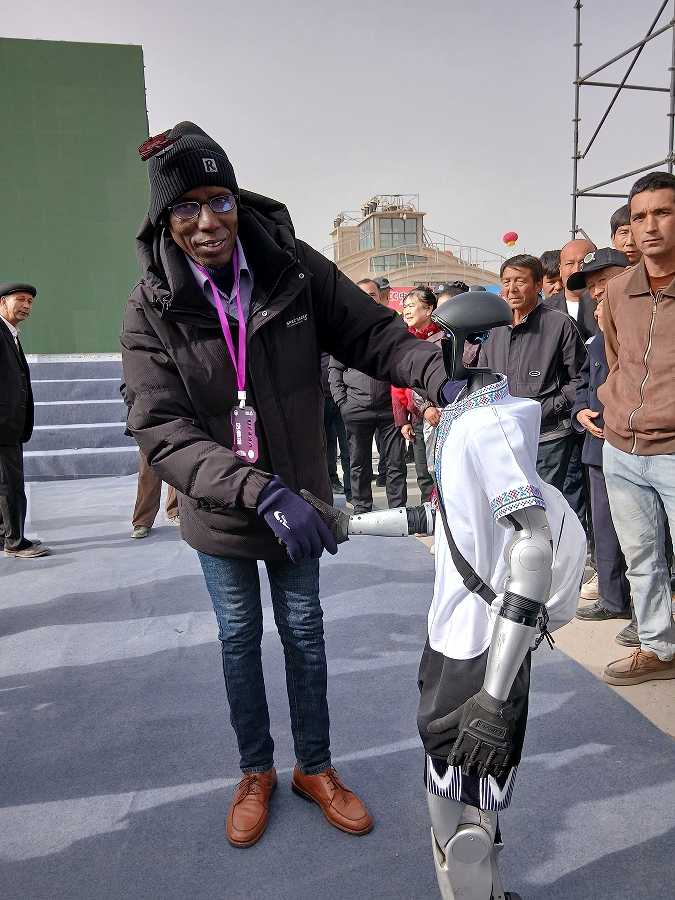
Aliu Balde, a jouirnalist from Guinea-Bissau, interacts with a humanoid robot at the opening ceremony of the 11th Xinjiang Characteristic Fruit (Aksu) Trade Fair in Aksu prefecture, northwest China's Xinjiang Uygur Autonomous Region. (Photo courtesy of Aliu Balde)
In Aksu prefecture of northwest China's Xinjiang Uygur Autonomous Region, Balde saw how local communities transformed vast deserts into fertile orchards through precision drip irrigation and science-based management, producing high-quality apples widely sought after both at home and abroad.
"China's practice of green development is first and foremost reflected in the reshaping of the relationship between humans and nature. I still remember that a local agricultural technician told me, 'Only when the ecology is healthy can industries thrive and people's lives have real prospects,'" Balde said, noting that this is the most vivid embodiment of the idea that "lucid waters and lush mountains are invaluable assets."
Balde was also impressed by the power of technology evident in the streets of Chinese cities.
Riding a driverless electric bus fully controlled by artificial intelligence (AI) for more than 30 kilometers in Beijing, he experienced what he called a glimpse of the future of green mobility.
"From the popularization of electric vehicles to the promotion of intelligent connected vehicle technologies, China is systematically optimizing its transport system to reduce carbon emissions," Balde said.
"Scientific and technological (sci-tech) innovation and the people-centered development philosophy are the most powerful driving forces behind China's green transformation," he noted.
Reflecting on his four-month tour around China, Balde highlighted the country's top-level planning, pointing out that practices unfolding across China are not isolated attempts, but components of a coherent, pragmatic and forward-looking strategy pursued over the long term.
He learned at symposiums that China had secured the world's largest installed capacity for renewable energy during its 14th Five-Year Plan period (2021-2025), and is expected to further speed up a comprehensive green transformation during the 15th Five-Year Plan period (2026-2030), aiming to build a "Beautiful China."
"In Beijing, an expert explained to us that every step of China's development must be guided by a careful accounting of its ecological costs—not as a matter of choice, but as an imperative that will shape the future," Balde recalled.
"In my view, it is precisely this consistent, top-level planning that has translated China's development blueprint steadily into reality, ensuring that green innovations, from desertification control to intelligent transportation, receive sustained and well-coordinated policy support," he said.
Balde believes China's model of embedding green development in innovation serves as valuable inspiration for Africa.
"African countries including Guinea-Bissau can totally carry out deep cooperation with China in such fields as clean energy, smart agriculture, and green infrastructure construction for mutual benefit and win-win results," he said.
African countries can translate China's experience in green technologies and systems-based governance into development solutions suited to their own national conditions, according to Balde.
"China has provided practical and hopeful examples from which other Global South countries can draw inspiration as they chart their future paths," Balde pointed out.
Gerald Mbanda from Rwanda: Chinese government places great emphasis on sci-tech innovation, ensuring that people benefit from the fruits of innovation
Gerald Mbanda, a veteran Rwandan media professional and founder of Africa-China Review, has been closely following China's development and visited the country many times.
"The sheer amazement I felt upon my first visit to China remains vivid in my memory," he said.
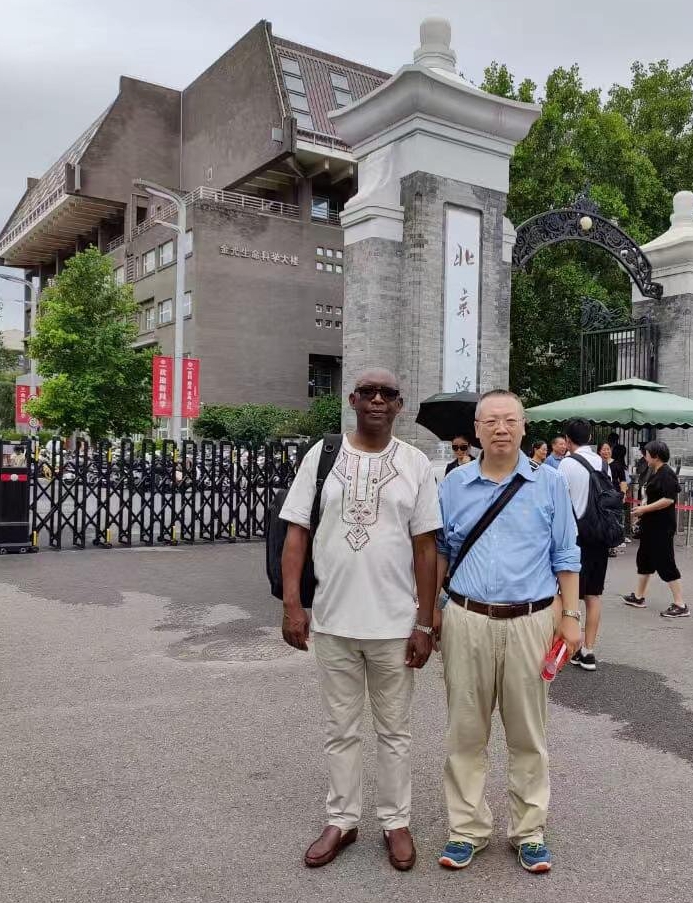
Gerald Mbanda (left) at the Peking University in Beijing. (Photo courtesy of Gerald Mbanda)
"When I first stepped onto Chinese soil and walked along the clean, wide streets, I saw people living and working in peace and contentment. The biased portrayals of China in Western media were immediately proven false—China appeared before my eyes in all its vivid and authentic reality," Mbanda recalled.
Mbanda is particularly impressed by China's practical applications of sci-tech innovations.
In August 2024, Mbanda visited north China's Tianjin Municipality. During a tour of the China-Singapore Tianjin Eco-City, the world's first eco-city co-developed by China and Singapore, he observed that fully automated production lines had become widespread, with industrial robots performing a series of precise operations under computer control.
"From 'robot colleagues' in factories and autonomous vehicles on the roads to 'robot doctors' in hospitals, I was fascinated by these results of innovation," he said, amazed by how digital technologies and clean energy empower urban governance and development.
"China has not only continued to increase its investment in research and development and made progress in technology and innovation, but also applied these advancements in industrial production, transportation and logistics, healthcare, and other sectors to empower economic and social development," Mbanda pointed out.
"The Chinese government places great emphasis on sci-tech innovation, ensuring that people benefit from the fruits of innovation," he noted.
Under the leadership of the Communist Party of China (CPC), China has formulated well-defined development plans and adhered to a people-centered approach, achieving the dual miracles of rapid economic growth and long-term social stability, according to Mbanda.
"China has successfully charted its own path to modernization and earned broad recognition and positive appraisal from the international community. Its experience provides valuable lessons for African countries seeking to pursue modernization," Mbanda said.
Last August, Mbanda authorized the Confucius Institute at the University of Rwanda to produce the Chinese edition of his book on Rwanda-China relations.
The book, titled "China and Rwanda: Effective Leadership is Key to Transformational Governance," reviews the achievements of cooperation between Rwanda and China since the establishment of diplomatic relations, with a focus on the experience both countries have gained in exploring development paths suited to their own national conditions.
"I hope the Chinese edition will help more Chinese readers understand the deep friendship between our two countries," Mbanda said.
Leila Ben Atitallah from Tunisia: China offers new blueprint for international cooperation
Leila Ben Atitallah, founder of Tunisia's radio station The Voice of Africa, described her 2025 tour of China as a profound dialogue with a sustainable future.
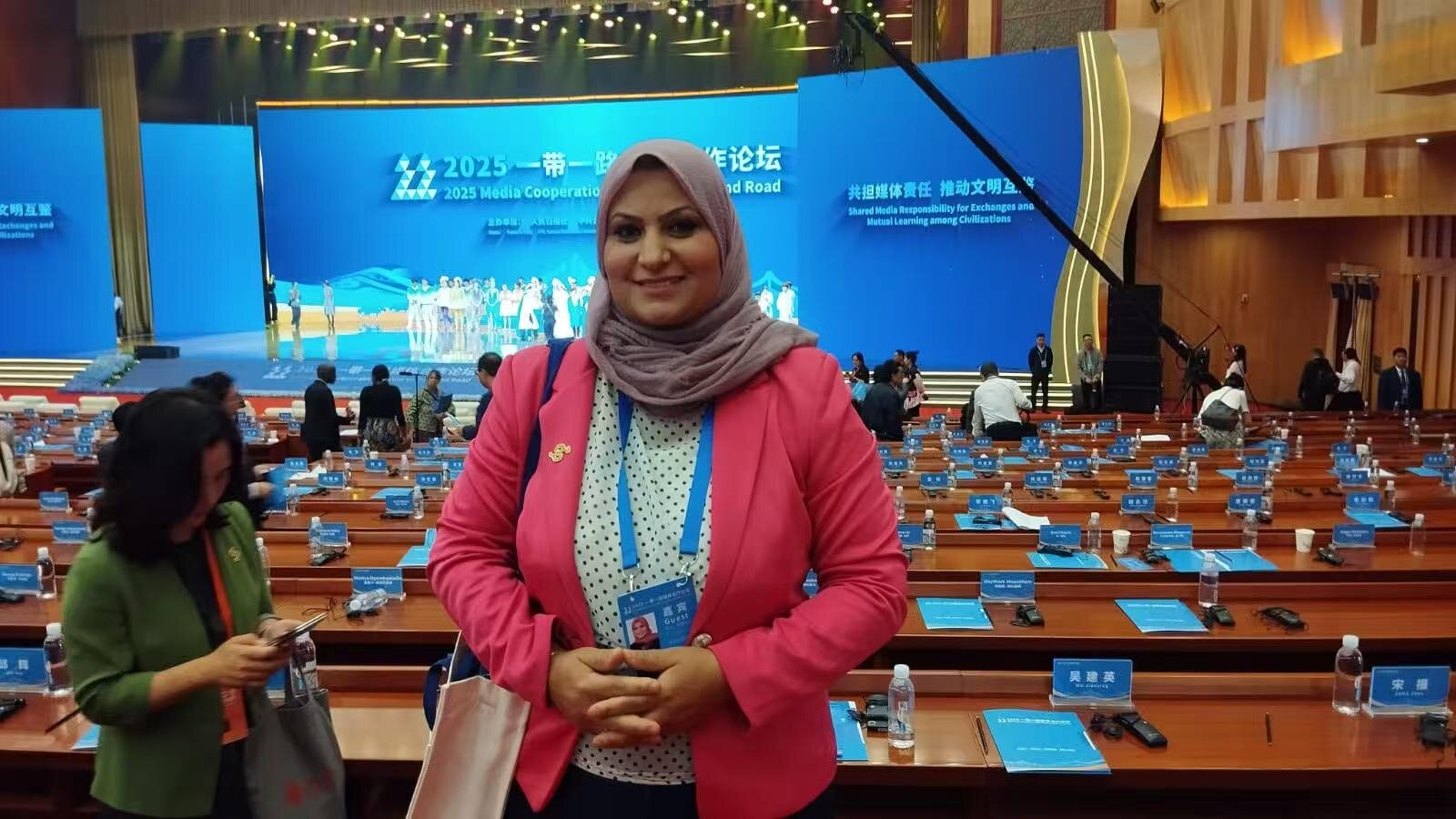
Leila Ben Atitallah attends the 2025 Media Cooperation Forum on Belt and Road. (Photo courtesy of Leila Ben Atitallah)
Visiting multiple sites in southwest China's Yunnan Province during a media exchange, she observed firsthand the picturesque natural scenery across the province and the impact of new quality productive forces on China's development.
During the journey, China's remarkable achievements in sci-tech innovation, ecological conservation, and rural revitalization unfolded before her eyes like a vivid painting, according to Atitallah.
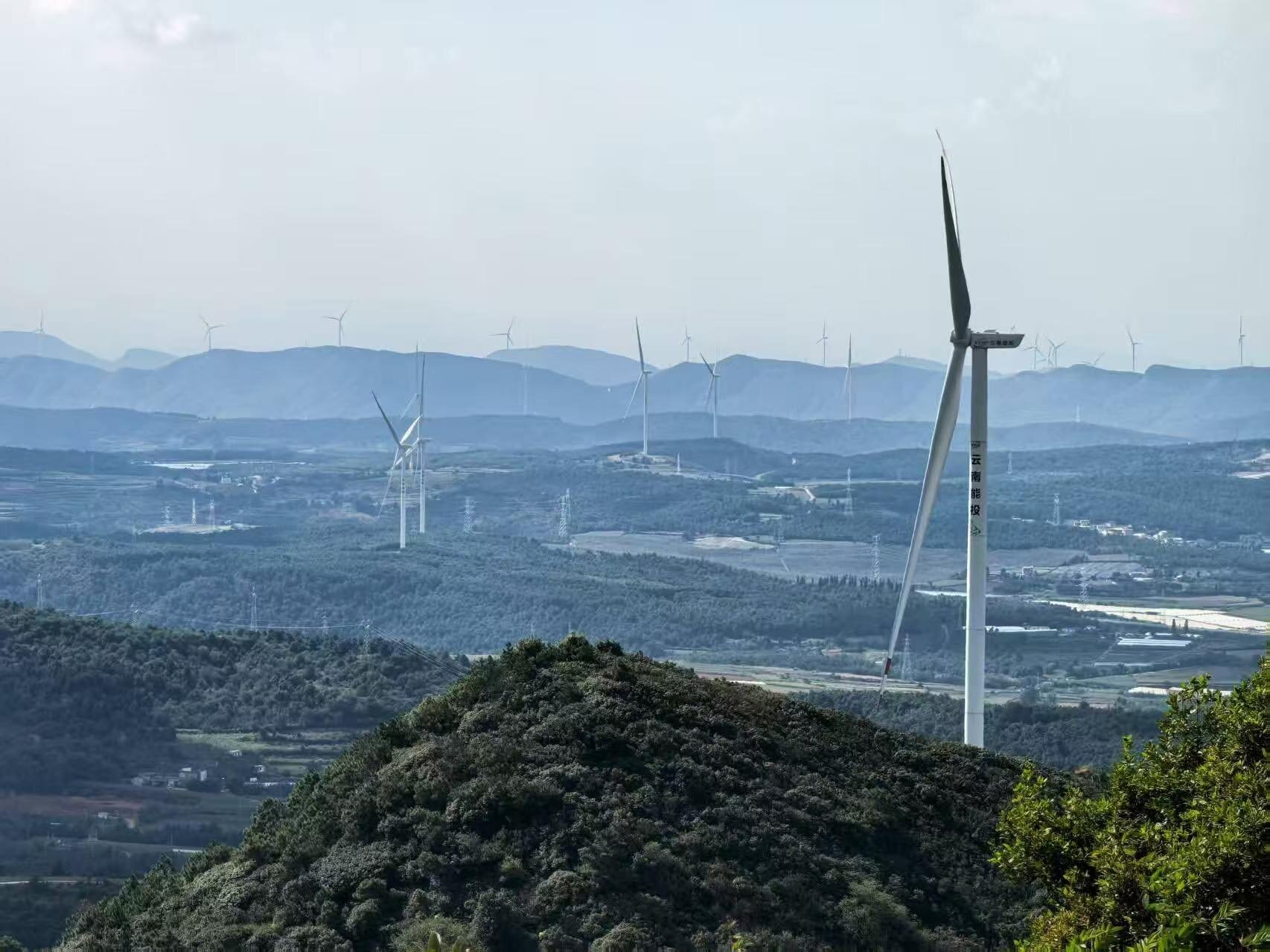
Photo shows a wind farm in Qujing city, southwest China's Yunnan Province. (Photo courtesy of Leila Ben Atitallah)
She visited a wind farm in Qujing city of Yunnan, developing a better understanding of China's achievements in renewable energy.
"Standing before such a magnificent project, I was deeply struck by how China has truly achieved harmony between humans and nature," she recalled. "Those facilities were not only the backbone of clean energy, but also a testament to China's firm commitment to a green transformation."
What impressed Atitallah more was the country's comprehensive achievements in the integrated management of solid waste, including household waste.
"We visited a modern waste-to-energy incineration plant and saw how household waste is scientifically collected, efficiently incinerated, and converted into electricity under strict environmental standards," Atitallah recalled.
"This practice of turning waste into a valuable resource is a vivid illustration of the principles of sustainable development," Atitallah pointed out.
China's experience clearly demonstrates that the green transition of the energy system and the integrated management of solid waste can advance hand in hand in a coordinated manner, she said.
By drawing on China's innovative practices and technological solutions in areas including waste-to-energy incineration, Tunisia could transform environmental pressures into opportunities for development, Atitallah explained.
"My visit to China has given me much to reflect on and provided many insights. What I saw and experienced in Yunnan represent not only successful examples of China's development, but also a new blueprint for international cooperation," said Atitallah.
Leveraging sci-tech innovation to accelerate the cultivation of new quality productive forces, China has moved beyond traditional economic growth models and blazed a path to sustainable development through green transformation, according to Atitallah.
She noted that China has provided practical experience that can be helpful for other developing countries in their pursuit of modernization.
"I look forward to seeing Tunisia and China engage in deeper, high-quality cooperation in areas such as energy transition and environmental governance under the framework of the Belt and Road Initiative," Atitallah added.
Photos




Related Stories
- Interview: People-to-people exchanges key to deepening China-Africa partnership, says Namibian expert
- Xiplomacy: How China-Africa partnership spurs Global South modernization
- Interview: China-Africa Year of People-to-People Exchanges in line with Agenda 2063, says former AU official
- Feature: Namibian TV host finds new creative horizons in Beijing
- Feature: How 2026 will strengthen China-Africa educational ties
- Chinese FM says it's opportune time for China, AU to enhance strategic mutual trust, cooperation
- Chinese Embassy in South Africa unveils 2026 China-Africa Year of People-to-People Exchanges
- Interview: Dakar 2026 Youth Olympic Games to boost China-Africa sports exchanges
- China, Africa usher in new chapter in civilizational dialogue
- One-China principle is political foundation of China-Africa relations: foreign ministry
Copyright © 2026 People's Daily Online. All Rights Reserved.
