



University team decodes ancient fire prevention wisdom to safeguard China's cultural relics
Ji Jie is deputy director of the State Key Laboratory of Fire Science at the University of Science and Technology of China. Since taking charge of a key national research and development program focused on fire spread mechanisms, early warning, and assessment in heritage buildings, Ji and his team have visited nearly 100 cultural heritage sites across the country.
Beyond conducting scientific research, they have systematically compiled the fire prevention wisdom of ancient Chinese builders and transformed these findings into a popular science book. Through science outreach activities in schools, they have sparked greater interest among young people in both traditional culture and fire science.

Photo shows horse-head gable walls of houses in a village in east China's Anhui Province. (Photo/Shi Yalei)
On an early morning, Ji arrived with his team at the entrance of a traditional courtyard in a village in the southern part of east China's Anhui Province for a field investigation. Such field investigations are part of Ji's team's daily routine.
They have discovered that ancient fire prevention wisdom is embedded in the villages of southern Anhui. Narrow fire lanes divide clusters of buildings into separate "fire compartments" and can serve as evacuation passages in emergencies. Water vats in courtyards are always kept full, providing readily available emergency water sources for firefighting. Beneath the wooden floors of attic spaces, layers of fine sand are installed and covered with square bricks. If a fire breaks out and flames burn through the floorboards, the falling sand and bricks can help extinguish the flames.
Among the architectural features they study, the horse-head gable walls of Hui-style homes stand out as particularly representative. Ji said these walls rise 1 to 2 meters above the roofs of adjacent residences, effectively blocking the spread of flames horizontally across wooden rooftops.
Over several years, Ji's team has traveled to more than 10 provincial-level regions, including Anhui, Yunnan, Xizang, and Shaanxi. From Hui-style residences in southern Anhui to the Potala Palace in Xizang, from the Mogao Grottoes in Dunhuang city of Gansu Province, to the Palace Museum in Beijing, they have surveyed many cultural heritage sites.
"Each one is a living fossil of ancient fire prevention wisdom," Ji said, adding that his team aims to understand the fire prevention wisdom embedded by ancient builders.
"The fire prevention wisdom behind these ancient buildings still serves practical purposes today. Visitors often admire only the beauty of ancient buildings while overlooking the information they contain," Ji said.
Several years ago, armed with extensive research materials, his team conceived the idea of compiling a popular science book.

A picture of horse-head gable walls drawn by Ma Ruishan.
"Through storytelling, we aim to help young people understand history, strengthen cultural confidence, master fire prevention skills, and enhance scientific awareness," Ji added.
"Professor Ji places great emphasis on transforming dry fire knowledge into engaging visual presentations. Through the team's repeated refinement, the stories, illustrations, characters, and knowledge points became increasingly interesting, ultimately achieving a balance between scientific rigor and entertainment," said Tu Ran, who was a doctoral student in fire science at the laboratory at the time.
The popular science book was officially published in January 2024 and quickly became a bestseller. Since then, Ji's team has actively organized public science lectures, book donations, reading sessions, and experimental demonstrations, donating more than 6,000 sets of books to primary and secondary schools, universities, communities, and grassroots fire safety and cultural relic organizations.
Ji's team has developed a dynamic fire risk assessment system for heritage buildings. Through real-time monitoring and calculation, the system rapidly analyzes fire risks in heritage buildings. Once the threshold is exceeded, it immediately triggers an alarm and provides targeted improvement recommendations.
The team has also developed an anti-interference early warning system to detect and mitigate fire hazards in heritage buildings. Using data fusion algorithms that combine smoke sensors, temperature sensors, and video image detectors, the system can quickly and accurately identify fires in their early stages.
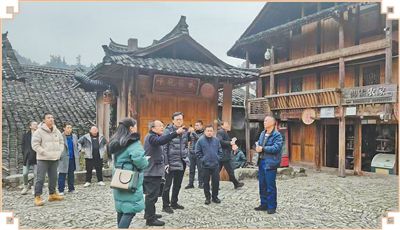
Members of the State Key Laboratory of Fire Science at the University of Science and Technology of China conduct field research on ancient buildings in a village in southwest China's Guizhou Province. (Photo/Hu Haowei)
Currently, the technologies and equipment developed by the team have been deployed at seven World Cultural Heritage sites and major historical and cultural sites protected at the national level, including the Palace Museum, the Potala Palace, and Hongcun village in Anhui. They also supported the compilation of the Fire Drill Guide for National Cultural Heritage issued by the National Cultural Heritage Administration.
"Heritage buildings are irreplaceable cultural heritage. Our goal is to use modern technologies to build a safety barrier for these living fossils of ancient architecture, allowing them to carry forward ancestral wisdom into the future," Ji said.
Photos




Related Stories
- Students engage in cultural heritage education at Xixia Imperial Tombs archaeological site park
- Cultural confidence draws more Chinese to discover, protect the past
- Journey of Han Dynasty brocade from sand to cultural symbol
- Painting with Yi lacquer: A window into China's intangible heritage
- Heritage vision helps shape a shared future
Copyright © 2026 People's Daily Online. All Rights Reserved.
