



Technology drives development of Xinjiang's cotton industry
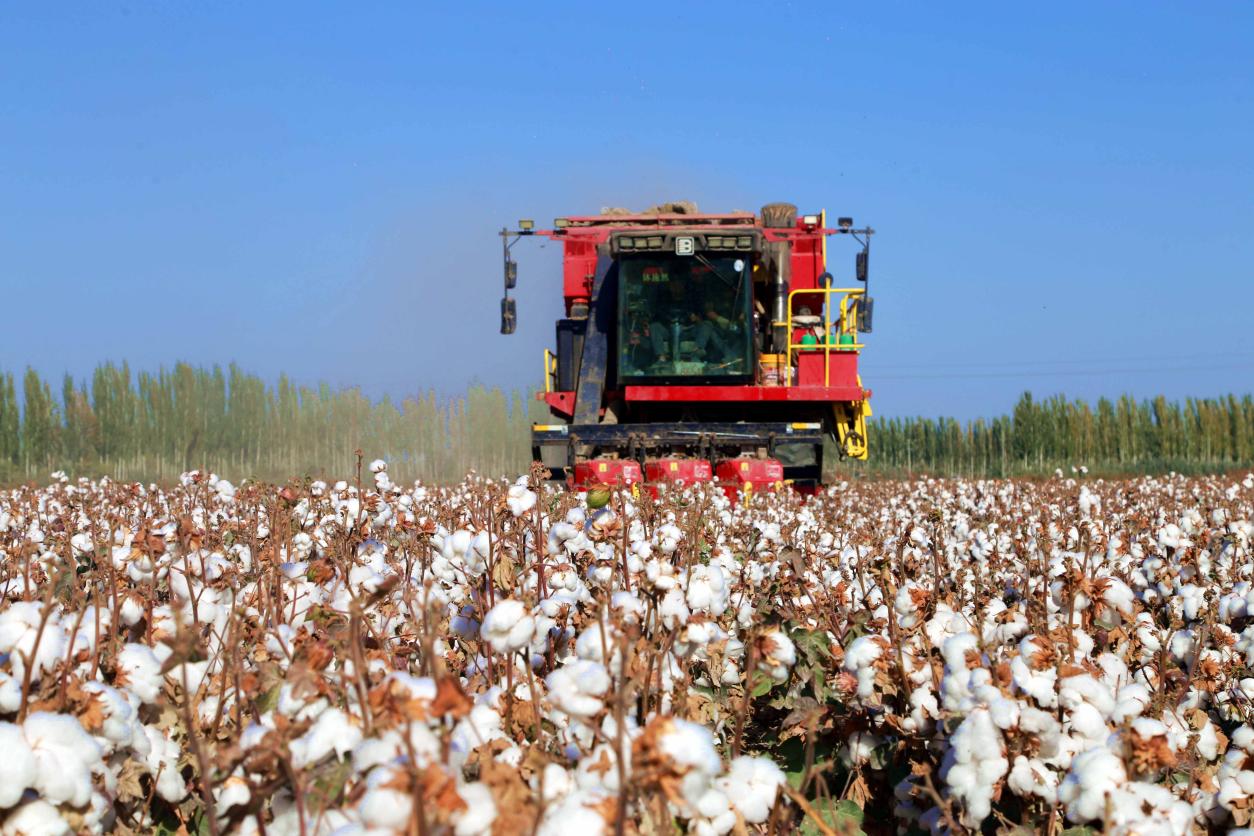
A cotton harvester picks cotton in Awat county, Aksu, northwest China's Xinjiang Uygur autonomous region. (Photo/Bao Liangting)
In the depths of winter, a light snowfall blanketed the vast cotton fields of Xayar County in Aksu prefecture, northwest China's Xinjiang Uygur autonomous region.
Indoors, farmer Ababekri Memet smiled as he reviewed his harvest figures on his mobile phone. "Cotton farming is less labor-intensive now, and the returns are much more stable," he remarked.
According to a 2025 cotton output bulletin released by China's National Bureau of Statistics, in Xinjiang, the country's main cotton-producing region, cotton output reached 6.165 million tons, crossing the 6-million-ton mark for the first time and accounting for 92.8% of the national total.
The evolution from hand picking to mechanized operations, and from a single crop to a complete industrial chain, reflects the cotton industry's steady advancement toward greater intelligence and higher value.
Though not peak season, activity hummed in Ababekri's machinery shed as he and his brother maintained their fleet: 12 tractors, three high-horsepower tractors, one cotton picker and three specialized sprayers. "They are now the backbone of our work," he noted.
In 2007, Ababekri's family planted 100 mu (6.67 hectares) of cotton. "Our greatest concern was the harvest season -- finding pickers and rising wages consumed nearly 30% of our income," he recalled. Back then, fields teemed with manual laborers.
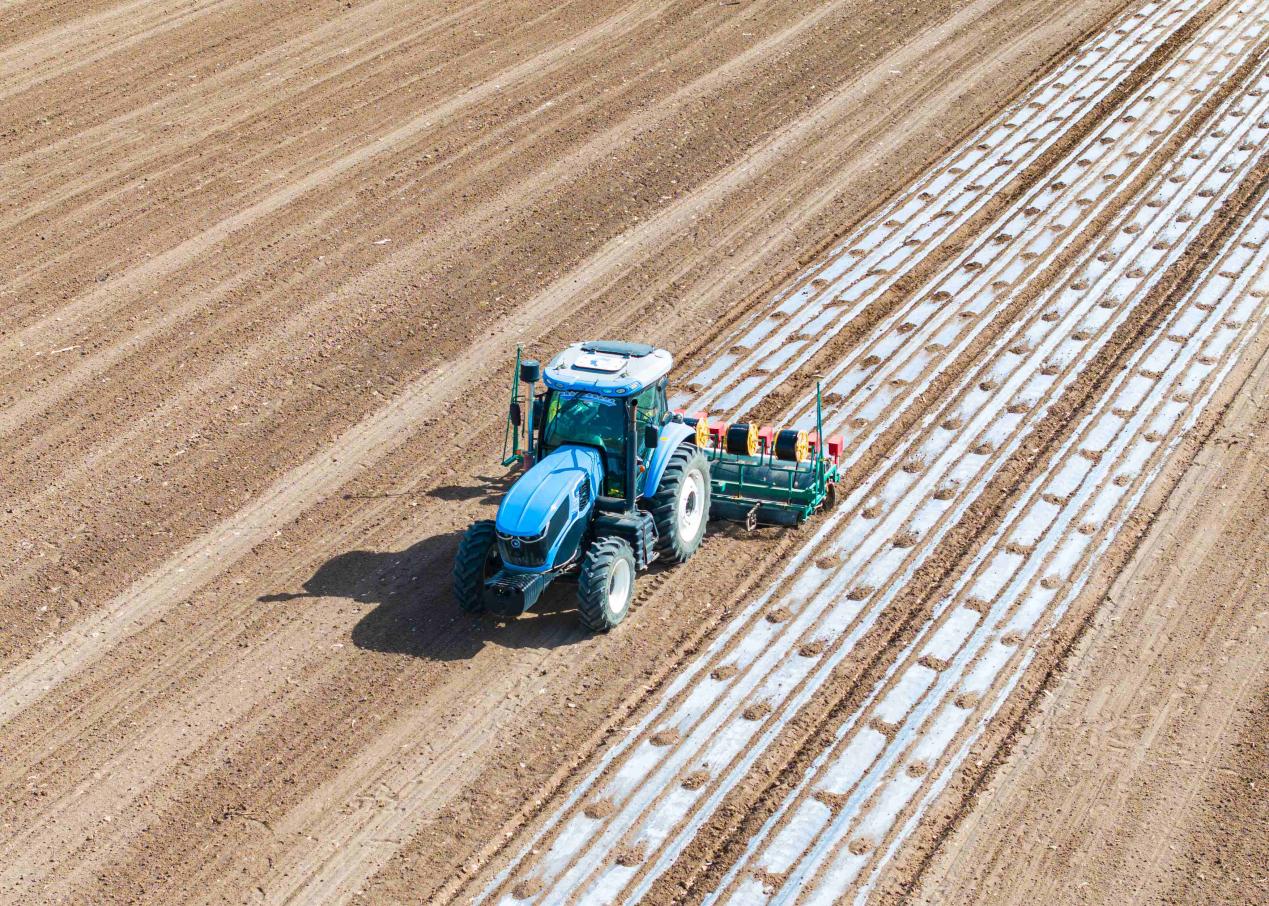
An unmanned tractor guided by the BeiDou Navigation Satellite System sows cotton seeds in Hutubi county, northwest China's Xinjiang Uygur autonomous region. (Photo/He Long)
Specialized sprayers are 50 times more efficient than manual labor while thinning and fertilizing tasks can be carried out with precision. Harvesting is dominated by high-efficiency cotton pickers.
"In the past, harvesting 100 mu required 12 people over two months. Now, one machine harvests 5,000 mu in just 12 days," he explained.
Data from the Xayar county's bureau of agriculture and rural affairs show that the county now operates 54,700 agricultural machines, maintaining a cotton cultivation mechanization rate above 95% for five consecutive years. More and more cotton growers have set up agricultural cooperatives, purchased advanced machinery and provided mechanized services.
Ababekri runs one such cooperative. "Last year, we serviced more than 7,000 mu of farmland," he shared. The cooperative's revenue exceeded 1.1 million yuan ($157,845), with machinery services contributing 40%.
At present, highly automated technologies -- including precision seeding, integrated drip irrigation, and drone-based crop protection -- are widely adopted in Xinjiang, steadily boosting productivity across the cotton industry.
Winter marks a critical period for cotton farmers as they select seeds for the upcoming season."Seeds are the foundation. Choose the wrong ones risks wasting an entire year's effort," explained Ababekri Memet.
At the beginning of each year, the Xayar county seed industry development center organizes variety promotion events and distributes comparative trial reports. Ababekri studies the report carefully, focusing on indicators such as disease resistance, heat tolerance, fiber length and lint percentage. "I check the statistics and combine them with the conditions of my own fields. This approach ensures precision and efficiency," he noted.
In the summer of 2025, Ababekri's cotton fields were hit by a prolonged heat wave. "If I had used the old varieties, the yield would certainly have dropped a lot, he recalled. "But the stress-resistant variety I selected minimized the impact, resulting in strong output and income growth."
Through measures such as releasing region-specific high-yield, high-quality varieties and vigorously promoting improved seeds, Xinjiang has raised the coverage rate of improved cotton varieties to over 98%.
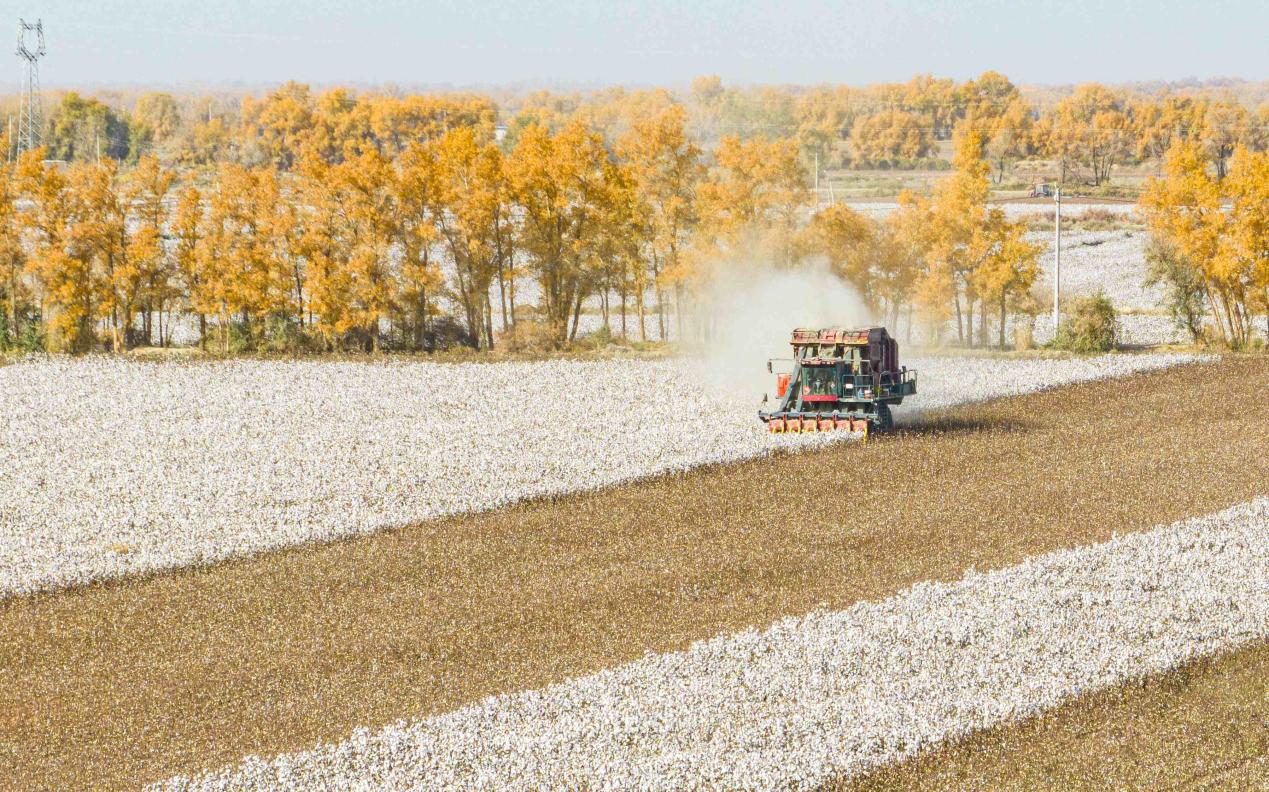
A cotton harvester picks cotton in Yuli county, northwest China's Xinjiang Uygur autonomous region. (Photo/Wang Zhipeng)
In 2025, the Institute of Cotton Research of the Xinjiang Academy of Agricultural Sciences introduced more than 3,400 germplasm resources from home and abroad, developed over 40 new valuable germplasm lines with traits such as drought tolerance, salinity-alkali tolerance and heat resistance, and bred and approved more than seven new types of cotton varieties.
These breakthrough breeding achievements, through a region-wide system of seed multiplication and extension, have been transformed into tangible gains in yield and quality in the fields. In Xayar county, average cotton yield per mu rose from 285 kilograms in 2017 to 442 kilograms in 2025, increasing farmers' income by 1,000 yuan per mu on average.
In Xayar county, the cotton industrial chain is being continuously extended.
"We harvest the cotton in the morning and deliver it to the ginning mill in the afternoon. Processing is finished the next day, and the payment is received within a week," Ababekri said.
In the past, cotton had to be processed hundreds of kilometers away, with transport costs of several thousand yuan for a single trip. Now, the harvested cotton is sent directly to a local ginning plant within 20 kilometers, processed into lint and supplied straight to local textile enterprises.
At a textile company in an industrial park in the county, machines roared as snow-white cotton rolls went through multiple processes to become fine yarn, ready for shipment to coastal cities.
"In the past, we only sold raw cotton, with low added value. Now we can process it locally into fabrics and textiles, and the value added has multiplied several times over," said Zhao Qiqi, deputy director of the county's bureau of commerce, science, technology and industry.
It is reported that Xinjiang has now built a full industrial chain covering cotton, chemical fibers, spinning, weaving, printing and dyeing, garments, home textiles and industrial textiles. This not only enables cotton farmers like Ababekri to secure faster and more stable returns, but also creates more jobs locally and brings about greater industrial value.
Photos



Related Stories
- 'Smart' cotton fields boost productivity, farmer incomes in Shaya, NW China's Xinjiang
- China's Xinjiang reports vigorous foreign trade growth in 2025
- Xinjiang posts robust tourism growth in 2025
- Remote Chinese city Altay thrives in long winter, turning snow into tourism success
- Third Winter Games Around the Altai Mountains opens in Xinjiang
- 19 Chinese provinces, municipalities allocate 19.7 bln yuan in 2025 to support Xinjiang's development
- China's wind frontier learns to build an industry
- Chinese VP meets OIC secretary-general
- Xinjiang launches China's first express cotton freight train service
- Xinjiang reports highest foreign trade growth in China
Copyright © 2026 People's Daily Online. All Rights Reserved.
