



China draws growing number of int'l patients seeking medical care
Viral videos on social media have recently sparked discussions about the growing trend of international patients seeking medical treatment in China.
"My nose isn't blocked anymore. I feel so much better!" said a 68-year-old Canadian patient after trying auricular acupuncture at Peking Union Medical College Hospital in Beijing.
The man first visited the hospital's International Medical Services in 2023 for treatment of intestinal polyps, gastroesophageal reflux, and a Helicobacter pylori infection. Since then, he has traveled to China annually for medical care.
Hospital administrators say foreign patients currently represent a small fraction of their total patient population, but their numbers are rising steadily. With China's expanding visa-free travel policies, more people from overseas are also seeking emergency treatment while visiting the country.
An administrator at the International Medical Center at the Second Affiliated Hospital of Hainan Medical University in south China's Hainan Province said the number of foreign patients remains relatively low but is growing rapidly. Most patients come from Russia, Singapore, the U.S., Indonesia, Malaysia and South Africa.
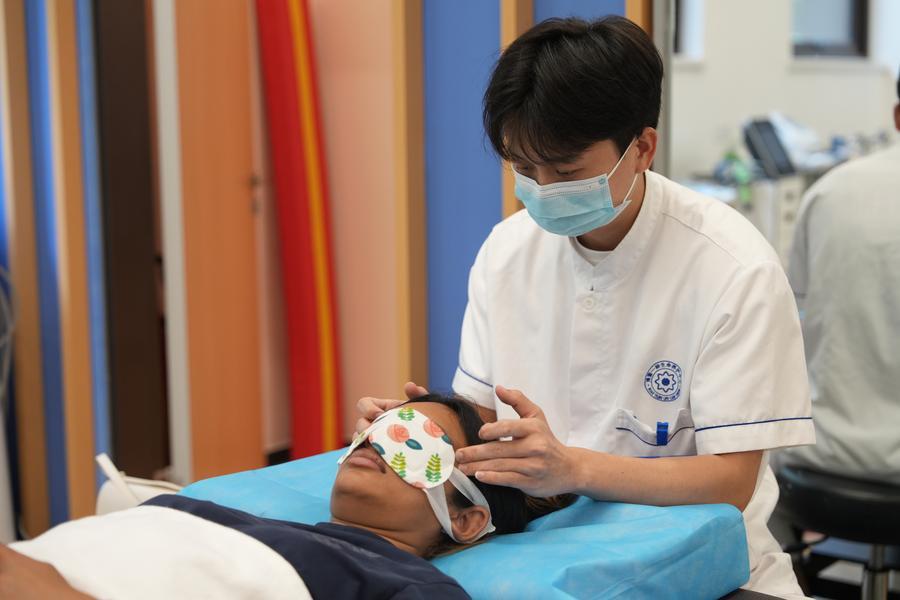
A medical worker gives massage to a Canadian visitor at the Boao Yiling Life Care Center in Boao, a coastal town of south China's Hainan Province, June 13, 2025. (Xinhua)
Hao Siguo, director of the Department of Hematology at Xinhua Hospital, affiliated with Shanghai Jiao Tong University School of Medicine, noted that a drug approved in 2024 for treating relapsed or refractory multiple myeloma has attracted 11 patients from overseas and the Hong Kong and Macao special administrative regions.
According to an industry report from the Chinese Hospital Association, 850 medical institutions in 57 Chinese cities provide international medical services.
Foreigners seeking medical treatment in China include expatriates working in the country, individuals traveling specifically for health care, and those interested in traditional Chinese medicine (TCM). Experts in the field attribute the trend to China's distinct advantages in certain medical services.
A National Health Commission official said China has advanced clinical experience in some specialized fields, with cutting-edge techniques and more affordable costs than developed countries for treatments like proton therapy and targeted therapy.
As TCM gains international recognition, treatments including acupuncture, moxibustion, tuina (Chinese therapeutic massage), and certain traditional remedies are becoming increasingly popular among foreign patients.
Liu Xinyan, director of the International Medical Department at Guang'anmen Hospital under the China Academy of Chinese Medical Sciences, said foreign patients most often seek treatment for oncology, cardiovascular diseases, endocrine and metabolic disorders, and rheumatic immune diseases.
In Suifenhe, a city in northeast China's Heilongjiang Province, Russians frequently visit for TCM treatment to address neck and back pain. In Sanya, a city in Hainan, international visitors are especially attracted to TCM wellness tourism programs.
Beijing has launched 40 TCM international medical tourism service packages in two phases, offering foreign patients treatment plans with clear outcomes, expected efficacy, and predictable treatment timelines.
Photos




Related Stories
- Analyses predict deepened AI healthcare commercialization in China in 2026
- China establishes world's largest healthcare system: report
- Deal helps Chinese investors go global
- AI healthcare solutions make progress, but caution urged
- Healthcare tourism unleashes momentum for China's silver economy
- China maps new healthcare blueprint for world
- China uses digital, intelligent technologies to promote equitable access to public services
- 'Memory clinics' turning back 'silver tsunami' of dementia
- Finding dignity and peace at the end of life
- China's healthcare sector sees progress in expanding foreign participation
Copyright © 2026 People's Daily Online. All Rights Reserved.
