



Chinese humanoid robots enter the global spotlight
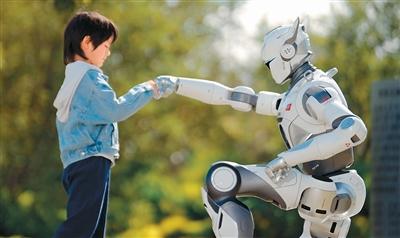
T800 humanoid robot, developed by Chinese robotics startup EngineAI Robotics Technology Co., Ltd., interacts with a child in Shenzhen, south China's Guangdong Province. (Photo courtesy of the interviewee)
In early January 2026, a video featuring a T800 humanoid robot developed by Chinese robotics startup EngineAI Robotics Technology Co., Ltd., headquartered in Shenzhen, south China's Guangdong Province, went viral on international social media platforms.
The footage showcased the 1.73-meter-tall T800 fluidly performing advanced martial arts moves, such as punches, aerial spins, and five consecutive roundhouse kicks, moving as nimbly as a human performer. The video quickly amassed millions of views.
Soon after, at the 2026 Consumer Electronics Show (CES), EngineAI's booth was swarmed by eager attendees. As the T800 walked with a human-like gait and interacted naturally with staff members, the crowd erupted in cheers and applause.
Back in 2016, Zhao Tongyang, founder, chairman, and CEO of EngineAI, established his first robotics company in Shenzhen.
In 2020, Zhao's team achieved its first major breakthrough. Their quadruped robot, through mass production and open-source technologies, slashed market prices ranging from 100,000 to 200,000 yuan (about $14,349- $28,699) to 30,000-40,000 yuan, demonstrating that sector innovations can be affordable and accessible to the general public.
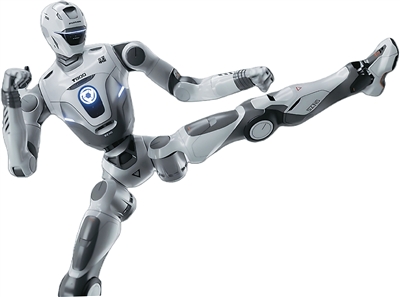
T800 humanoid robot, developed by Chinese robotics startup EngineAI Robotics Technology Co., Ltd., showcases a side kick. (Photo courtesy of the interviewee)
In 2023, after accumulating greater experience and resources, Zhao founded EngineAI. Since its inception, the company has established a comprehensive product development pipeline, spanning technological exploration, commercial application, and future growth.
The T800, launched in late 2025, represents the flagship full-size, general-purpose model in the series, culminating the company's innovations and featuring distinctive features spanning design, performance, and user experience.
The robot strides with an upright posture, combining elegance with energy efficiency. Its fully self-developed core joints deliver a peak torque of 450 newton-meters. Its high degree of joint freedom facilitates exceptional athletic abilities, including running, physical combat, backflips, and roundhouse kicks. Equipped with solid-state batteries and optimized gait algorithms, it achieves an industry-leading four to five hours of continuous walking on a single charge.
The T800 stunned international audiences at CES 2026, optimizing Chinese intelligent manufacturing.
After observing the robot at CES 2026, an American professor remarked that the T800 goes far beyond mere imitation, representing genuine, substantive innovation. Meanwhile, a European industry observer noted that Chinese teams are now setting new benchmarks for experience and standards, rather than merely showcasing functionality.
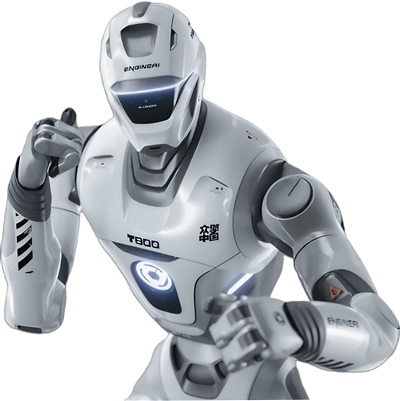
T800 humanoid robot, created by Chinese robotics startup EngineAI Robotics Technology Co., Ltd., demonstrates martial arts techniques. (Photo courtesy of the interviewee)
Long-term national technological policies have supported the development of China's humanoid robot industry. As early as the last century, the National High-tech Research and Development Program (863 Program) began supporting research in related fields, accumulating valuable talent and technological foundations for the industry.
"There's been a narrative claiming our technology came from reverse-engineering products from developed countries, which is completely wrong. The truth is that China's robot R&D and manufacturing have been built on our own efforts, backed by national policies, fundamental research, and talent support," Zhao said.
Zhao credits the advanced R&D and high-quality talent cultivation at top domestic universities for giving him the tools to succeed when starting his business. "Without the dividends from China's early planning, the country's robot industry could not have developed so rapidly," he said.
The proliferation of companies such as EngineAI is not an isolated phenomenon. Leveraging a complete manufacturing supply chain, robust industrial capabilities, and sustained innovation investment, China has established clear advantages in areas such as robot body manufacturing and high-dynamic algorithms.
"Many overseas robots use Chinese-made components. We have every reason to believe that Chinese companies will lead the industry worldwide in this arena," Zhao said.
Zhao noted that CES 2026 became an "international stage" for Chinese robotics companies. Zhao also believes that confidence must not slip into arrogance. "We still have room for improvement in AI models and computing chips, but in humanoid robotic bodies and motion control, we're already at the forefront globally," he said.
Today, EngineAI has a core team of 180 people with an average age of around 30. Among these young engineers are both industry veterans with over a decade of experience and energetic, creative members of the post-2000s generation. "Our young team has the drive and courage to innovate. Our job is to provide them with platforms where their individuality can shine through teamwork," Zhao said.
EngineAI's vision is that humanoid robots will eventually enter thousands of households. In Zhao's view, future humanoid robots should not only be tools but also warm, emotionally intelligent companions and members of the family.
EngineAI has charted its own course in the intelligent R&D of robots, pursuing not only powerful physical and cognitive abilities but also the cultivation of emotional intelligence. "We want robots to have memory systems and thinking systems, to learn new knowledge on the spot, to integrate into family life, and to bring emotional value to users," Zhao said.
He firmly believes that China has the capability to lead the development of this emerging humanoid robot industry and secure a competitive edge in global technology competition.
Photos



Related Stories
- China's UBTECH expands overseas reach with Airbus robot deal
- Chinese researchers develop eye surgery robot
- Shenzhen brings cutting-edge technology to consumers with new retail scenarios
- AI-powered "RoboCops" take up traffic duties in Chinese cities
- China unveils undersea drilling robot to boost deep-sea exploration
- Chinese researchers develop "smart eyes" for grazing robots
- Chinese firms lead global humanoid robot production in 2025: report
- Embodied intelligence industry shows big leap forward in 2025
- Baby robot lion dancers light up Beijing
- Yearender: China's humanoid robots step from spectacle toward scalable industrial reality
Copyright © 2026 People's Daily Online. All Rights Reserved.
