



Feature: Determined partnership makes farming pay handsomely in east China
NANCHANG, Jan. 12 (Xinhua) -- In a winter courtyard in east China's Jiangxi Province, bundles of 100-yuan banknotes were stacked into a small mountain. The scene, at once theatrical and deliberate, marked the highlight of an annual ritual, namely the distribution of year-end bonuses to farmers.
At the center of the scene stood Ling Jihe, 65, his hair completely white, while dressed, as he has been for years, in the same dark jacket. Lifting a microphone, he announced that it was once again time to hand out bonuses.
The crowd responded instantly. Hundreds of farmers pressed forward, many wearing bright red scarves, a traditional rural symbol of recognition and honor. One by one, names were called. Skilled grain growers came to the front of the stage, grinning as they accepted thick stacks of cash, many raising both hands high and holding the bundles aloft to mark a moment of triumph.
The finale followed, with the host declaring Liu Pingxiang the 2025 "champion grain grower," earning Liu a bonus of 381,900 yuan (about 54,473 U.S. dollars), while sparking enthusiastic applause across the courtyard.
In China, year-end bonuses are common in offices and factories ahead of the Lunar New Year. For independent farmers, they are almost unheard of. Yet Ling, who leases farmland from villagers for large-scale intensive cultivation, has handed out such bonuses for 15 consecutive years. Even though mobile payments have become ubiquitous in rural China, Ling insists on paying in cash. This ritual, he believes, is important.
"The jacket holds up," he said, smiling. "I wear it for farm work and for handing out bonuses, it works for both. What counts is that the bonuses get bigger each year, and so do the smiles."
In 2025, Ling and his team managed more than 80,000 mu of farmland (roughly 5,333 hectares), producing 63,500 tonnes of grain. The year's total bonuses reached 21.29 million yuan, setting a new record for what locals call "paddy field dividends." Since 2012, Ling has distributed a cumulative 90.99 million yuan in bonuses.
Such figures challenge a deeply rooted assumption in China -- that farming doesn't pay well on its own.
Ling himself did not begin as a farmer. Before 2010, he ran a successful business in the city focusing on building materials. His partner in farming, Ning Jiang, who graduated from university in the 1990s, previously operated an architectural design firm. Notably, neither had formal agricultural training.
The turning point came when Ling returned to his hometown and saw something unsettling. The lush rice paddies of his childhood lay overgrown with weeds. Young people had left for the cities, while the land had been abandoned.
"It didn't feel right," Ling recalled. "Such good land going to waste seemed a huge pity."
Against family objections, he poured his business savings into a new venture, leasing 4,700 mu of farmland and beginning what he later called his "second startup." The first year was disastrous. Lacking experience, he copied an egalitarian "everyone eats from the same pot" approach. Machinery was insufficient, farming schedules slipped and more than 800 mu of late-season rice failed completely.
"That night, I squatted in the fields until midnight," Ling said. "But I told myself, the losses were due to my decisions. I couldn't let the villagers lose too."
Despite the crop failure, Ling paid full wages and bonuses. The decision nearly wiped out his capital, but it earned him something harder to buy, namely trust.
The setback forced a rethink. Ling spent his days in the fields and his nights consulting experienced farmers. Gradually, a new approach took shape. The land was divided into blocks and assigned to skilled growers, often organized by household. Each received a fixed monthly salary of 5,000 yuan, with substantial year-end bonuses tied to output beyond agreed targets.
The change was decisive. The old mentality, work hard or slack off, it's all the same, now disappeared.
"It's funny," said Sun Gongping, 52. "An outsider came back and taught us old hands how to farm, and did it well."
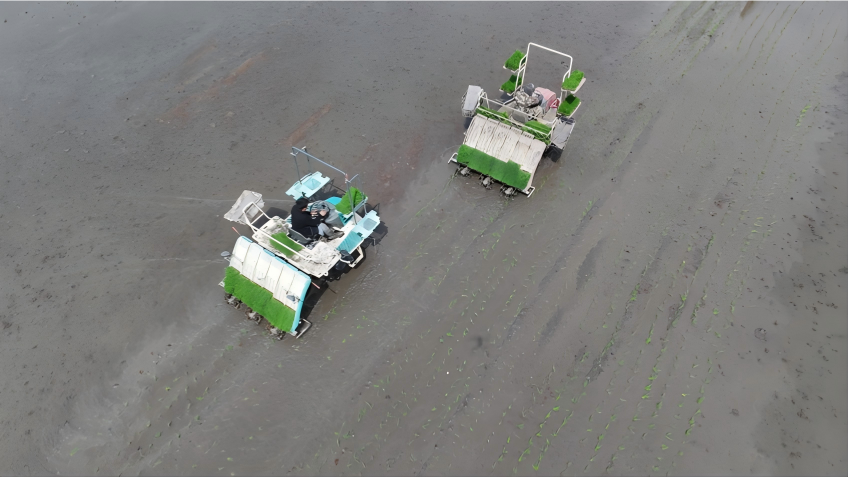
Cash incentives were only part of this transformation. Beginning in 2018, Ling's company invested heavily in professional agricultural services. Farming was reorganized along factory-like lines, with specialized teams handling seedling cultivation, mechanical transplanting, aerial crop protection, harvesting and drying.
Operating at scale brought other advantages. Inputs such as seeds, fertilizers and pesticides were purchased directly from manufacturers, reducing costs significantly. Experimental plots were set aside each year to test dozens of new varieties in cooperation with research institutions, with the best performers promoted across the fields.
"Traditional methods just can't compete," said Nie Yiping, 38, who has worked with the company for a decade. "With better varieties and modern techniques, yields and income both rise."
Over time, Ling's operation grew from an initial team of 11 to more than 500 people. Among them are over 50 Gen-Z workers, a demographic rarely associated with rice farming.
In rural China, conventional wisdom long held that higher education was a ticket out of the countryside. However, Ling wants agriculture to be seen as a viable, even attractive, profession.
Wang Yesheng, a Gen-Z university graduate, returned home and joined the company's technical services team, operating crop-protection drones. In 2025, he began transitioning into rice cultivation himself.
"Uncle Ling made me believe that you can build a career in the fields," Wang said. "I think I can earn bonuses like the skilled growers. I learn fast and I work hard."
In his personal life, Ling is frugal. He has little taste for pastimes like mahjong, and channels most of the company's profits back into production and year-end bonuses.
"Money should become grain in the fields and hope in farmers' pockets," he said.
The farming stakes extend beyond one company. As China continues to industrialize and urbanize, a vast number of rural workers have moved to cities. Ensuring food security while raising agricultural productivity has become a crucial challenge.
Ling's experiment offers one possible answer: Large-scale land leasing, mechanization, precision management and an innovative profit-sharing scheme that aligns incentives and helps retain talent. It is a market-driven response to a structural problem.
At China's recent Central Rural Work Conference, policymakers emphasized the need to "spare no effort to ensure stable income growth for farmers, and refine the mechanisms for ensuring the incomes of grain growers." Ling's courtyard dividends, small in national terms but vivid in effect, offer one of the clearest illustrations of how an abstract policy goal can take shape on the ground.
"My original impulse was simple," Ling said, looking on as the post-ceremony crowd dispersed, still buzzing with laughter. "I couldn't bear to see good land abandoned."
Ling stayed on after the ceremony, wearing his dark jacket, while standing in the empty courtyard. Beyond Ling spread the fields worked by him and his team, presenting an orderly, expansive and silent winter view, but poised for another spring.
"Now I'm thinking about how to make sure Chinese bowls are filled with better Chinese grain, and how to help the people who grow it live good lives."
Photos



Related Stories
- China maps cotton's evolutionary secrets to build better crops
- Scientists uncover mechanism behind natural "fertilizer factory" in plants
- Chinese vice premier stresses importance of wheat field management
- Chinese agricultural products reach 224 countries, regions in first 11 months of 2025
- Apple fragrance from China
Copyright © 2026 People's Daily Online. All Rights Reserved.
