



Chinese agricultural products reach 224 countries, regions in first 11 months of 2025
An increasing number of quality Chinese agricultural products are finding their way to overseas markets. According to statistics, China's agricultural exports grew steadily during the 14th Five-Year Plan period (2021-2025), rising from 544.34 billion yuan ($77.83 billion) in 2021 to 732.75 billion yuan in 2024, an increase of 34.6 percent. In the first 11 months of 2025, Chinese agricultural products were exported to 224 countries and regions worldwide.
This vividly demonstrates the achievements of China's agricultural opening-up and reflects the resilience and vitality of Chinese agriculture in a complex international environment, said an official with the International Cooperation Department of the Ministry of Agriculture and Rural Affairs (MARA).
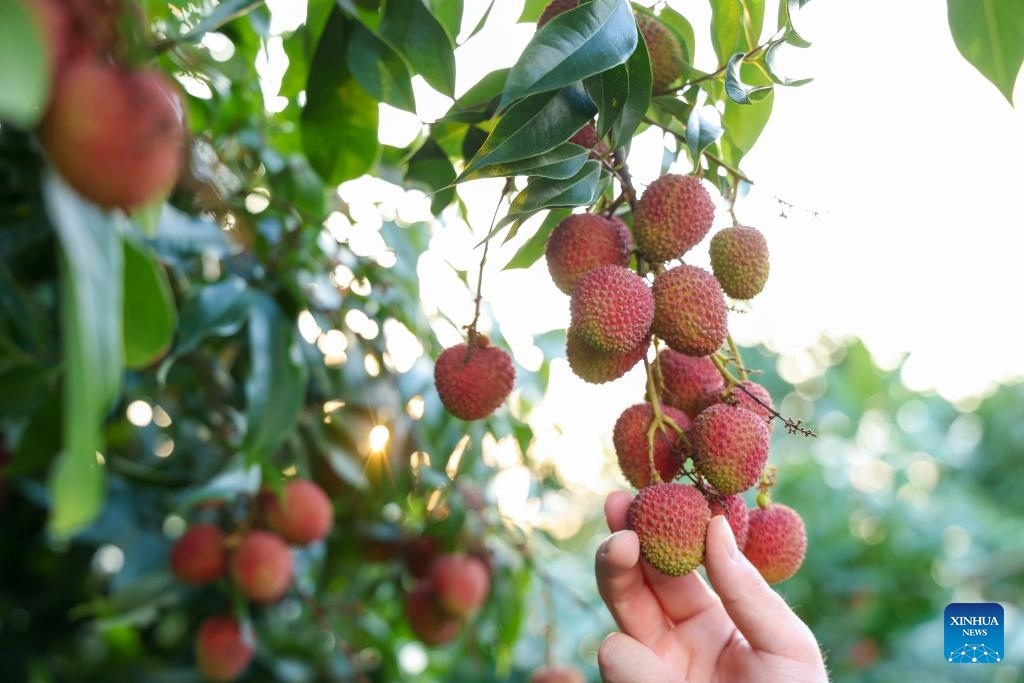
A visitor picks lychees at an orchard in Gaozhou city, south China's Guangdong Province, June 5, 2025. (Xinhua/Mao Siqian)
"We exported over 4,000 tonnes of lychees in 2025, up about 18 percent year on year," said Li Zhuofeng, marketing director of Guangdong Sinolychee Agricultural Group Co., Ltd. Chinese lychees, known for their excellent appearance and flavor, have built strong brand recognition overseas and are typically the first choice for foreign buyers.
"We offer multiple lychee varieties to meet different taste preferences, with supply available from May to September," Li said.
A series of practical measures has paved the way for agricultural products to reach overseas markets. The General Administration of Customs implemented appointment-based inspection services for exported agricultural products, cutting clearance time for fresh produce by 50 percent. China Export & Credit Insurance Corporation launched specialized insurance policies for agricultural exports covering more than 150 countries.
In 2024, China's fruit exports surged over 20 percent year on year, becoming a new engine driving agricultural export growth, with momentum continuing into 2025. In terms of overall product mix, aquatic products, vegetables, fruits, livestock products and beverages accounted for 57.3 percent of total agricultural exports in 2024, highlighting the growing influence of the country's most competitive products.
Emerging markets showed particularly notable growth in agricultural exports from January to October 2025.
Garlic ranks among China's star vegetable exports. "We participated in agricultural export promotion activities organized by the Agricultural Trade Promotion Center of MARA in 2024. We secured orders on our first entry into the Middle Eastern market and reached long-term cooperation agreements with South African clients," said Li Hao, general manager of Jinhaoyuan Agricultural and Trade Co., Ltd. in Jinxiang county, east China's Shandong Province.
Jinxiang county accounts for over one-third of China's total garlic cultivation area. The county has developed over 900 enterprises like Jinhaoyuan with independent import and export rights, selling products to more than 170 countries and regions.
The success of premium agricultural products in diverse markets stems from industrial cluster development, standardized systems, brand portfolios and channel innovation.
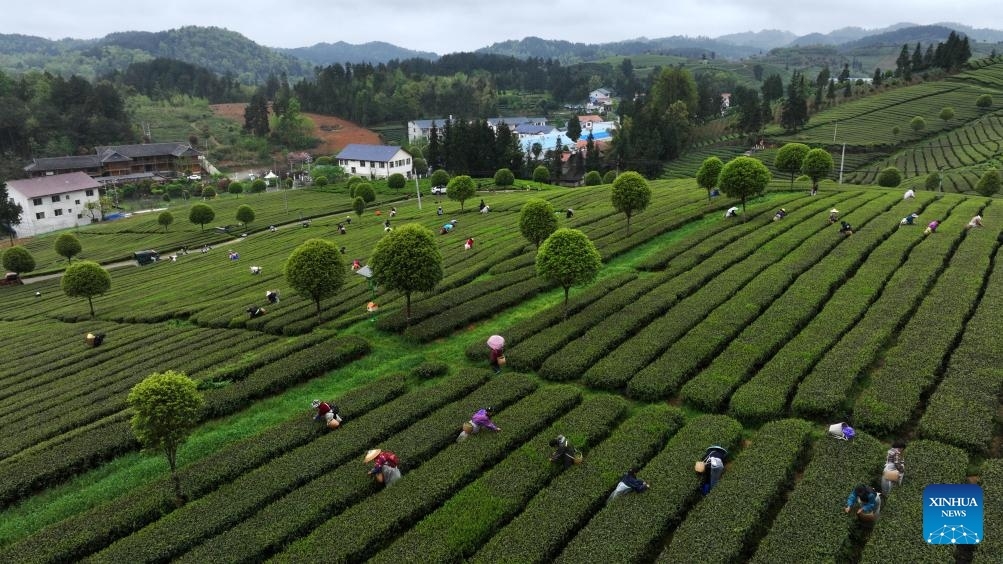
A drone photo shows farmers picking tea leaves at tea gardens in Erlong village in Yuqing county, southwest China's Guizhou Province, April 5, 2024. (Xinhua/Yang Ying)
In Anxi county, southeast China's Fujian Province, strict tea plantation production standards have become the golden key to reaching international markets. Multiple tea enterprises in the county have obtained EU organic, U.S. NOP and Japanese JAS organic certifications, with export unit prices 30 to 50 percent higher than ordinary tea. To help tea companies obtain more internationally recognized certifications, Anxi county established a county-wide platform for monitoring agricultural inputs and tracking logistics, and pioneered a climate-based tea quality certification system.
China has developed a production system for quality agricultural products represented by green, organic, premium specialty and geographically indicated agricultural products, including Jinxiang garlic, Anxi Tieguanyin tea, Gannan navel oranges and Yunnan Pu'er tea, continuously enhancing international market competitiveness.
The diversified market structure has effectively hedged against demand fluctuation risks in certain regions, injecting new momentum into export growth, said the official with MARA's International Cooperation Department. In recent years, the ministry has annually organized delegations to attend major agricultural exhibitions in nearly 10 countries and regions, including in Singapore and Spain. The ministry has also conducted buyer-supplier matchmaking events in the Middle East, such as in the UAE and Saudi Arabia, with nearly 20 agreements signed on site in 2024.
Influenced by tariff rates, foreign consumption cultures and other factors, the path for agricultural products going global presents both challenges and opportunities.
Facing external challenges, it is necessary to move quickly to explore new opportunities for agricultural exports, said Yang Jun, a professor at the University of International Business and Economics.
According to Yang, China should continue to deepen its presence in emerging markets, including Belt and Road partner countries, to reduce dependence on single markets, and actively participate in formulating international standards to enhance its voice in global agricultural trade rules. Meanwhile, it should accelerate the transition from primary processing to deep processing to increase technology sophistication and added value, and cultivate more internationally influential Chinese agricultural brands.
Photos

Related Stories
Copyright © 2026 People's Daily Online. All Rights Reserved.
