



China's 'Pole of Cold' turns 'cold resources' into 'hot industries'
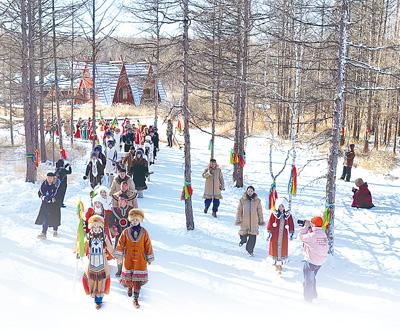
Tourists take part in a cultural activity in a forest in Genhe, a county-level city administered by Hulun Buir in north China's Inner Mongolia Autonomous Region, known as the country's "Pole of Cold." (Photo courtesy of the media convergence center of Genhe city)
At 7 a.m. on a day in December 2025, reindeer herder Gu Musen made his way toward his deer enclosure in Genhe, a county-level city administered by Hulun Buir in north China's Inner Mongolia Autonomous Region, known as the country's "Pole of Cold." Wen Gang, a visitor from south China's Guangdong Province, followed closely behind him.
This was the first time Wen had encountered reindeer. "If I have the chance, I'll come back to see them again," he said.
Genhe, a small city nestled at the northern foot of the Greater Khingan Mountains, once regarded its seven-month-long winter as an obstacle to development.
"Today, we see the cold weather as a rare experience," said Song Ling, director of the Genhe Municipal Bureau of Culture, Tourism, Radio and Television.
In 2022, Genhe launched a reindeer "adoption" program, under which visitors sign "adoption" agreements, receive certificates, and can visit the city at any time to see their "adopted" reindeer in person. Since its introduction, the program has further boosted winter visitor numbers.
"This is not merely a tourism program but a cultural bridge," Song explained. Each adopted reindeer is linked to a family of the Ewenki ethnic group. Most of the adoption fees go directly to reindeer-herding families for herd protection and forest maintenance, while the remainder supports cultural preservation.
Behind the reindeer adoption program lies a full cultural experience chain, including visits to reindeer-herding communities, learning Ewenki birch bark craftsmanship, and experiencing forest life in winter.
Genhe, which faced a difficult transition after the complete ban on commercial logging of natural forests in 2015, has turned its cold climate and remoteness into new assets by promoting deeper integration of culture and tourism.

A tourist poses for photos with a reindeer in Genhe, a county-level city administered by Hulun Buir in north China's Inner Mongolia Autonomous Region, known as the country's "Pole of Cold." (Photo courtesy of the media convergence center of Genhe city)
"Rather than conventional ice-and-snow tourism, we focus on immersive ice-and-snow cultural experiences," Song said.
In Genhe's Lengji village, residents have transformed their courtyards into "low-temperature experiment grounds," where activities such as capturing the spectacle of hot water freezing instantly in midair and comparing the thermal performance of different fabrics have become popular.
Ma Dexin, operations director of Lengji village, said that this winter, accommodation demand has surged, with some rooms requiring reservations up to a week in advance.
Statistics show that from September to December 2025, Genhe generated tourism revenue of 1.32 billion yuan (about $188.07 million), up 12 percent year on year, while receiving 903,600 tourist visits, a year-on-year increase of 14.2 percent.
Photos

Related Stories
Copyright © 2026 People's Daily Online. All Rights Reserved.
