



AI opens new horizons for China's music industry
In a sound mixing room at the China Musical Techno Base in Xiaoshan district, Hangzhou, east China's Zhejiang Province, Ma Zhiyong, a musician and operations director of the base, wore his headphones and focused on fine-tuning a melody using artificial intelligence (AI) tools, employing algorithms to add a more theatrical vocal quality.
"In my view, AI is not meant to replace musical artistry. It's opening up infinite possibilities for music," Ma said.
As AI becomes deeply integrated into China's music industry, the sector is undergoing sweeping transformations across production, consumption and the broader industrial ecosystem.
Dai Qionghai, chairman of the Chinese Association for Artificial Intelligence, noted that the integration of music and technology is an inevitable trend with broad social significance and strong practical value for innovation in the music industry.
In February, the China Musical Techno Base integrated DeepSeek's large language models with the music generation tool Suno V4, significantly boosting music creation efficiency.
"With the popularization of AI tools, our staff can now complete the entire production process — from lyrics and composition to arrangement and vocals — simply by inputting text," Ma said. "In the past, producing a single song cost at least 30,000 yuan to 50,000 yuan ($4,300 to $7,100). Now, with AI assistance, costs have dropped significantly."
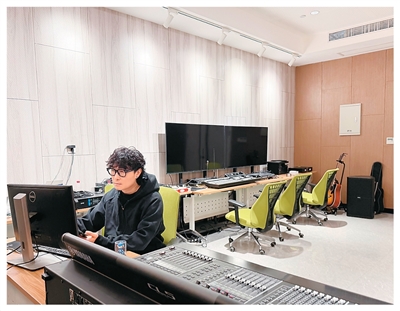
Ma Zhiyong, a musician and operations director of the China Musical Techno Base in Xiaoshan district, Hangzhou, east China's Zhejiang Province, edits AI-generated lyrics. (Photo courtesy of the interviewee)
At the "Light of the Internet" Expo of the 2025 World Internet Conference in Wuzhen, Zhejiang Province, Tencent Music Entertainment Group (TME), a leading online music platform in China, showcased its AI song creation system, attracting numerous visitors eager to experience music creation firsthand.
The system uses technologies such as image recognition and deep learning algorithms to simulate professional musicians' creative processes. It features AI modules for lyric writing and composition, offering multiple creation modes such as generating songs from images, template-based song creation, AI conversational song creation and absolute music generation. These tools are designed to meet diverse needs ranging from music enthusiasts to professional creators.
"Users simply upload a picture or select a style through conversation, and within three to five minutes, a complete song with a full structure is generated," said Wu Bin, senior director of TME's Lyra Lab. This dramatically lowers the professional threshold for composition and lyric writing, making music creation a new form of daily documentation and emotional expression.
"Currently, AI music generation technology in the music industry is relatively mature, capable of quickly and conveniently creating complete works with generally high user satisfaction," Wu said.
To date, over 10 million users have utilized TME's AI music tool for music production, resulting in more than 26 million AI-generated tracks. Many of these works have gained widespread circulation, accumulating over 1 billion plays.
Meanwhile, AI technology is making the music listening experience more personalized and intelligent.
"In music recommendations, we rely on AI technology to continuously improve the precision and personalization of music discovery," said Yue Weijie, general manager of TME's legal management department.
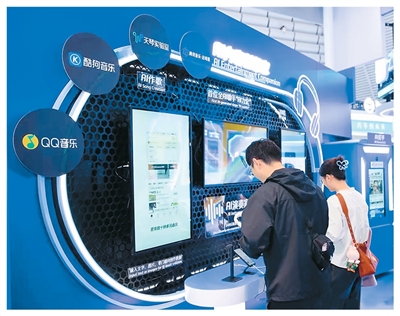
Visitors experience an AI song creation system developed by Tencent Music Entertainment Group, a leading Chinese online music platform, at the "Light of the Internet" Expo of the 2025 World Internet Conference in Wuzhen, east China's Zhejiang Province. (Photo courtesy of the interviewee)
"For example, QQ Music has integrated DeepSeek's large language models into its proprietary AI assistant, significantly enhancing comprehension capabilities and making intelligent interactions more accurate and comprehensive, allowing users to access their favorite content more efficiently," Yue added.
QQ Music analyzes both the audio and text elements of songs in users' playlists, to extract characteristics from each song to recommend music that better matches their moods and tastes.
Beyond more accurate recommendations, the upgraded listening experience also allows deeper emotional engagement. In August, QQ Music launched a special campaign for its 20th anniversary, using AI technology to trace users' song collection data over the past two decades. By combining listening duration, style preferences and emotional tags, the platform enabled each user to generate a personalized song.
"The widespread application of AI technology in music creation, production, distribution and consumption has not only enriched musical forms and content but also introduced new business models and growth drivers for the industry," said Huang Zongquan, a professor at the Central Conservatory of Music.
According to statistics, AI-generated works accounted for 56.9 percent of independently released new songs in China during the first quarter of 2025. NetEase Tianyin, the AI music creation platform of NetEase Cloud Music, has cumulatively produced more than 40,000 original music pieces. The China Musical Techno Base, powered by AI technology, has generated cumulative operating revenue of 65.6 billion yuan over the past five years.
AI technology is also promoting innovation in music education and giving rise to emerging interdisciplinary fields. Since 2019, multiple higher education institutions, including the Central Conservatory of Music, Shanghai Conservatory of Music, and Sichuan Conservatory of Music, have established programs in music and AI, as well as related areas.
Experts recommend that relevant authorities issue timely guidance on AI music development, clarifying copyright ownership, usage norms and profit distribution mechanisms to protect creators' rights. They also call for the establishment of technical standards and evaluation systems to regulate data use and reduce security and ethical risks, ensuring the healthy and orderly development of the music industry.
Photos




Related Stories
- Local Chinese governments establish dedicated AI departments to drive new quality productive forces
- Robotics, AI innovations put elderly care on fast track
- Chinese traditional industries upgrade with intelligence
- China seeks public feedback on draft rules for anthropomorphic AI services
- China's AI shift moves from screens to shop floors
Copyright © 2026 People's Daily Online. All Rights Reserved.
