



Robotics, AI innovations put elderly care on fast track
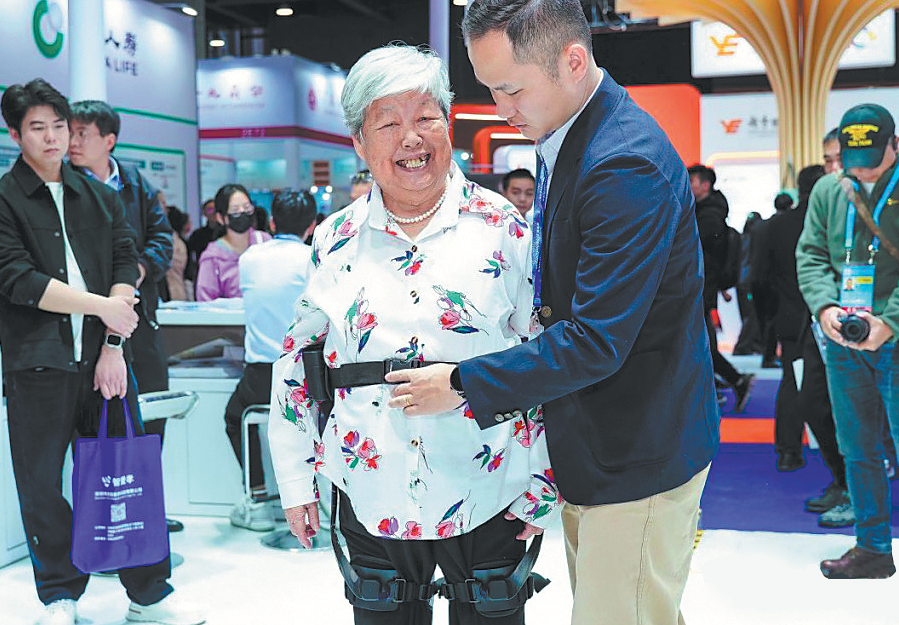
A woman tries an exoskeleton robot at the 11th China International Silver Industry Exhibition held in late November in Guangzhou, Guangdong province. [Photo provided to CHINA DAILY]
Sitting on a sofa at his home in Beijing's Haidian district, a man in his 90s contemplated his next move as he played chess with an artificial intelligence-powered robot. His AI opponent studied the pieces on the board closely, strategized, and occasionally engaged in casual conversation with the elderly man.
Shen Tu, a financial professional, said he gifted the AI robot, named Sense, to his chess-loving grandfather about a year ago, because he was too busy to play. The robot, purchased for around 2,000 yuan ($285), offers companionship and has brought his grandfather great joy, he said.
"On weekends, the whole family takes turns to play chess with Sense, which has in a way strengthened our bond, as we get to spend some quality time together," Shen added.
Companionship is one of the many roles AI-powered robots in China have been programmed to master. In Shenzhen, Guangdong province, such robots provide mobility assistance for seniors, patrol rooms at elderly care institutions, and even offer moxibustion therapy in nursing homes, highlighting an AI revolution in elderly care taking place in the country.
According to data from the Ministry of Civil Affairs, China's population age 60 and above reached 310 million by the end of 2024, accounting for 22 percent of the total population. Among them, nearly 35 million have lost the ability for self-care, and that number is expected to rise to 46 million by 2035.
As conventional elderly care models face numerous challenges, including a shortage of professional caregivers, a lack of service efficiency and difficulties in meeting personalized needs, robots that integrate cutting-edge technologies such as AI and the internet of things are becoming a core support force for smart elderly care.
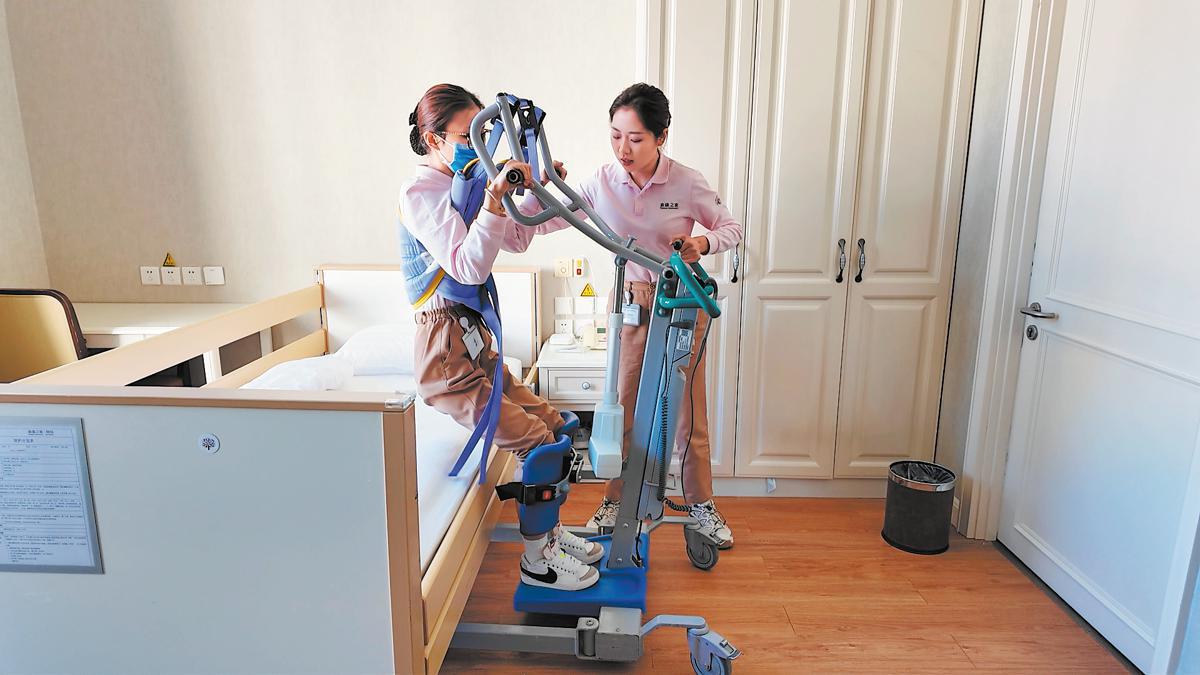
Nurses practice using a nursing transfer machine at the Beijing Taikang Yanyuan Rehabilitation Hospital. GUO YANQI/CHINA DAILY
Home, safe home
Providing services that range from emotional companionship and daily assistance to safety monitoring and health management, robots are becoming sought-after personal housekeepers for the elderly.
Ai.care.live, a family service robot built by Beijing Robint Technology Co, is designed to offer a comprehensive home safety protection network. The robot's IoT feature helps it connect with home appliances, such as gas stoves, and it initiates video calls in case of an emergency.
"Based on a large vision model, the robot's contactless safety monitoring feature can automatically detect if an elderly person falls down and can contact family members," said Dai Zhongyuan, director of the company's elderly care products department.
Equipped with facial-recognition technology, the robot identifies elderly individuals and actively supervises medication intake, he said, adding that family members are alerted if a daily dose is missed.
Furthermore, integrated devices such as blood pressure monitors and blood glucose meters, automatically sync health data and provide necessary assistance, making home-based elderly care safe and worry-free.
Robots built by the company are being used at elderly care institutions in several districts of Beijing, including Haidian, Fengtai and Chaoyang. Through cooperation with government departments and communities, the robots are also being deployed in the homes of elderly residents.
"In the future, we plan to integrate offline services, such as having robots contact community canteens to deliver meals, allowing the elderly to enjoy community canteen services at home," Dai said.
For elderly individuals with mobility issues, the exoskeleton robot from Shenzhen Kenqing Technology Co has made walking much easier. The robot, which weighs 2.4 kilograms, uses AI algorithms to intelligently adapt to different walking postures and speeds.
"Elderly people who can barely walk with a cane can walk independently and easily once they wear the exoskeleton," said Yu Yunbo, founder of the company. "For active seniors, our product helps them explore the outdoors with more confidence, without worrying about being a burden for their families."
The next generation of the product will deeply integrate AI with flexible materials, he said, adding that in the future, a user might only need to wear a special pair of pants.
"Meanwhile, we also plan to launch a customized version for seniors, further optimizing the load-bearing structure and algorithms to reduce the price to around $1,000," Yu said.
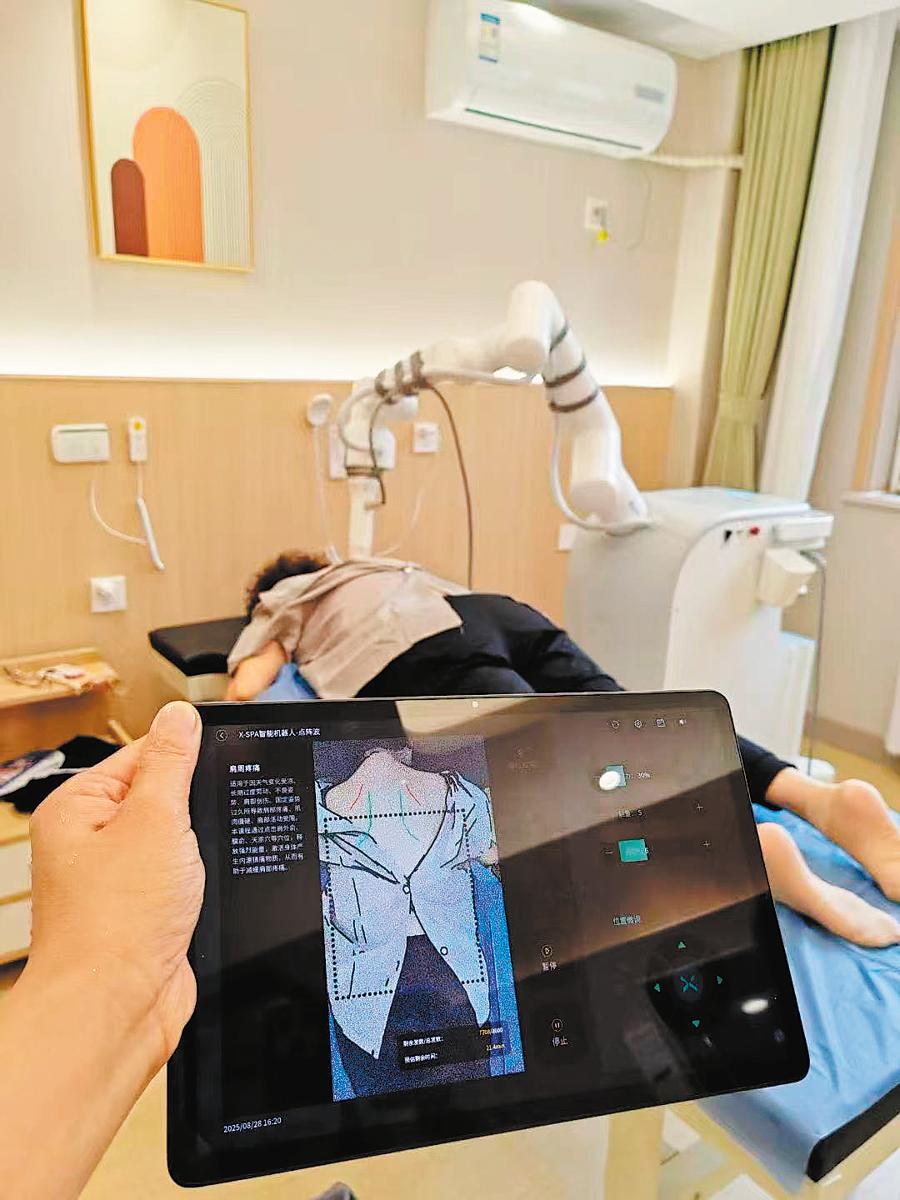
A resident experiences the X-SPA Rehabilitation Therapy Robot from Agile Robots at an elderly care institution in Beijing. [Photo provided to CHINA DAILY]
Community leverage
As key hubs for elderly care services, communities are becoming important areas for the deployment of AI-powered robots.
The Silver Age Technology Experience Center, located in Longgang community in Haidian's Dongsheng town, has become a model of community elderly care robot applications. The center has a dual track record of technological experience and elderly dining assistance, covering over 6,000 people in more than a dozen neighborhoods.
Upon entering the center, visitors can experience over 10 types of age-friendly smart devices, including exoskeleton robots, cloud doctor facial diagnosis, rehabilitation robots and smart sleeping beds. The exoskeleton robots, a terahertz microcirculation energy cabin and fascia massage devices are the most popular products with the elderly.
Liu Fang, a 67-year-old resident, said she had more waist mobility after using a fascia massager, and would like to check out some of the other devices.
Miao Fanghe, director of the center, said they regularly conduct smart device training, organize free clinics and health lectures, and offer targeted functional yoga courses to help the elderly improve joint and muscle degeneration issues.
The center has also introduced the innovative concept of "a living manual" to help elderly visitors use smart devices.
"It's not about explaining technical steps; it's about helping these people gradually achieve functional restoration of their bodies in familiar community settings through personalized guidance that matches their health conditions and learning abilities," Miao said.
At the Elderly Service Center located in Shenzhen's Xiangmihu community, room-patrolling robots and companion robots have joined the service.
Zhao Haiyang, director of the center, said the demand for service robots at large elderly care institutions continues to grow, as they can help medical staff conduct checkups, keep records and provide feedback.
In addition, these robots can serve as entertainers, playing music or telling jokes following just a voice command. "With the introduction of standards for elderly care robots, we believe more safe and reliable products will enter community elderly care institutions," Zhao said.
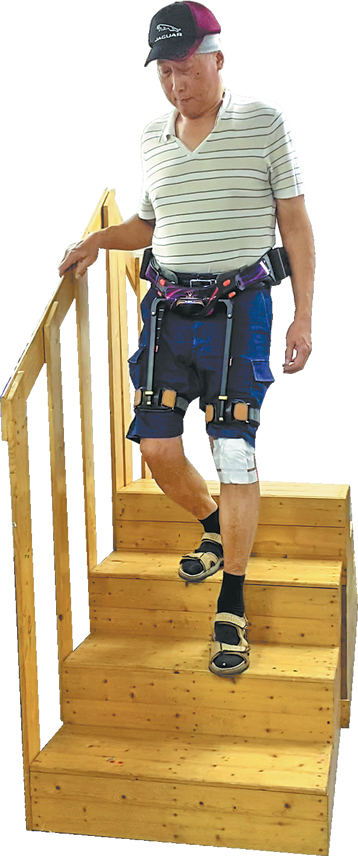
A man tries an exoskeleton robot developed by Shenzhen Kenqing Technology Co in Shenzhen, Guangdong province. [Photo provided to CHINA DAILY]
Boosting institutional rehab
Elderly care institutions and rehabilitation hospitals are important application sites for AI-powered robots, as they require higher degrees of functionality and stability.
The Beijing Taikang Yanyuan Rehabilitation Hospital in Changping district provides integrated medical and elderly care services to Taikang community's 3,700 permanent residents, while also opening its doors to patients from outside the community. The facility uses special lower-limb robots and smart mattresses to support patient rehabilitation and monitoring.
"The devices are easy to operate, comfortable for patients to use, and can help the elderly with hindered mobility regain limb functions," said Zhao Huanhuan, a rehabilitation therapist at the hospital.
A nursing transfer machine is used at the nursing center of Yan Garden. Yi Meijing, a nurse, said the machine helps to safely transfer the elderly, preventing falls, fractures and other risks.
"It can also help to prevent muscle atrophy and pressure sores among bedridden seniors, significantly reducing the physical burden on caregivers," she added.
At a public-private elderly care institution in Haidian, the X-SPA Rehabilitation Therapy Robot from Agile Robots is highly favored.
The device, which integrates visual guidance and AI technology, incorporates three functions — moxibustion, precision vibration and endogenous heat, providing customized therapy for different pains.
Xu Duo, a company employee, said that when a session is selected on the operation end, a traditional Chinese medicine program is automatically activated and the device concentrates on the acupuncture points of the body.
"The most used functions by the elderly, moxibustion and endogenous heat, help regulate the energy flow in the body and relieve fatigue, respectively," Xu said.
As the first domestic company focused on developing products for the nursing needs of elderly people who have lost self-care ability, Shenzhen Zuowei Technology Co manufactured intelligent bowel management robots, intelligent beds, portable bathing machines, transfer machines, walking-assistance robots and dining-assistance robots.
These have been widely used at nursing homes and high-end sanitariums in more than 20 provincial-level regions.
"The intelligent bowel-management robot achieves four fully automatic functions based on the patient's condition without manual intervention, helping the elderly maintain their dignity, which is very important," said Cai Yitong, an assistant to the company chairman.
The dining-assistance robots use AI visual recognition and voice interaction technologies to achieve their tasks, providing an independent and dignified experience for those with upper-limb mobility issues. "During the whole process, we achieve another goal of easing the workload of caregivers," Cai added.
Beijing AI-Robotics Technology Co, a pioneer in the exoskeleton robot industry in China, has seen its rehabilitation series products enter 379 medical institutions nationwide, including Peking Union Medical College Hospital and the Chinese PLA General Hospital, helping numerous elderly patients who are undergoing gait rehabilitation training.
"Many elderly people require rehabilitation training due to lower-limb injuries, muscle function loss, or skeletal issues," said Zhao Pengcheng, a marketing representative of the company. "Our 'Aikang' and 'Aijia' series robots can effectively improve joint and muscle strength through scientific gait training, helping patients stand and walk again."
At the 11th China International Silver Industry Exhibition held in late November in Guangzhou, Guangdong province, a variety of intelligent senior care products focused on health and rehabilitation, attracting industry professionals and visitors to experience them firsthand.
The "Youlong" bilateral hip-assist exoskeleton from Changsha Eulon Robot Co garnered significant attention.
"The smart wearable device can accommodate different body types and straps on for a snug fit," said He Feng, the company's marketing director. "It precisely maps the user's movements and provides adjustable assistance in scenarios such as walking, climbing stairs and hiking, effectively reducing lower-limb burden."
The "Youmai" smart wheelchair, developed by Suzhou Medical System based in Jiangsu province, is designed specifically for senior care institutions. It features easy joystick controls, supports movement in all directions and includes automatic obstacle avoidance, significantly reducing the workload of caregivers.
The product can also be equipped with modules for monitoring vital signs, such as heart rate and blood pressure, with automatic alarms for abnormalities.
"Our products are popular in the overseas markets," said Liu Jiacheng, an employee of Suzhou Medical System. "In the future, we hope to lower costs through technological optimizations, benefiting more ordinary senior care institutions."
Strong policy support
In recent years, a series of policy measures have been introduced at both central and local levels, providing strong support for technological research and development.
In September, the Ministry of Industry and Information Technology and the Ministry of Civil Affairs jointly initiated the intelligent elderly care service robot pairing research and scenario application pilot work, announcing a list of pilot projects.
Their implementation will accelerate the transformation and application of technological achievements in elderly care robots and promote collaborative innovation across the industry chain.
In September 2024, Beijing unveiled a policy involving several measures to strengthen the service guarantee for the elderly age 80 and above, explicitly proposing to advance the development and application of smart elderly care scenarios.
The measures focus on supporting the development of the elderly care robot industry, steadily promoting smart care service management systems and care service terminals, and actively advancing the construction of smart nursing homes.
The policy aims to benefit 698,000 elderly people age 80 and above, as well as 157,000 seniors under 80 suffering from disabilities or dementia, creating a favorable environment for the promotion and application of elderly care robots in the Chinese capital.
Despite significant progress made by China's elderly care robot industry, it still faces many challenges that impede its high-quality development.
"While researching elderly care technology, we need to focus on technological innovations that adhere to scientific principles, introducing new technologies to solve previously unsolvable or poorly solved problems," said Li Jian, a researcher at Beijing University of Posts and Telecommunications. "On the other hand, the innovations need to be practical and grounded in actual applications to accurately address the pain points and common issues affecting elderly care."
Tao Chunjing, a professor at Beihang University, recommended building highly standardized and unified smart elderly care scenarios to promote their development and control costs.
"Robotics has been developing for a long time and, currently, we are in a transition phase — from technical demonstration to scenario tackling. All rehabilitation and companion robots and services can be seamlessly integrated through a mature, comprehensive system involving management, education and supervision," Tao said.
"Elderly care institutions can tap into this solution to avoid high hidden costs and complex management burdens, making promotion much easier," she added.
Li Zhucui, a researcher at the sociology research office of the Heilongjiang Provincial Academy of Social Sciences, said that using smart elderly care options could ease some of the challenges related to China's aging population.
"Smart elderly care devices can beat geographical limitations, extending high-quality medical care, health monitoring and other services to remote rural areas," she said. "The technological advantage can significantly narrow the gap between urban and rural elderly care services, allowing seniors in marginalized areas to conveniently enjoy high-quality services."
However, Li pointed out that smart elderly care devices have certain limitations and technical shortcomings. "For example, in meeting the spiritual comfort needs of the elderly, intelligent devices can achieve human-machine language interaction but cannot replace interpersonal emotional connections," she said.
"For special groups, such as those with dementia or severe disabilities, the ease of operation and functional adaptability of intelligent devices need further improvement to better meet their needs," Li added.
Photos



Related Stories
- Chinese traditional industries upgrade with intelligence
- China seeks public feedback on draft rules for anthropomorphic AI services
- China's AI shift moves from screens to shop floors
- Vlog: Check-in at the 2025 'AI for All: China-ASEAN' Competition Gala
- China core AI industry scale exceeds 1 trln yuan in 2025
Copyright © 2026 People's Daily Online. All Rights Reserved.
