



Small businesses in China see rapid growth over past five years
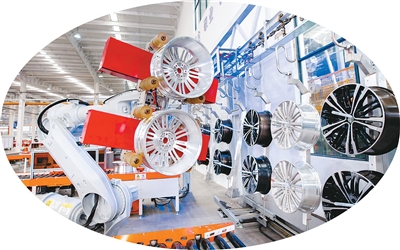
Photo shows a scene at the smart workshop of Anhui Jinfei Wheel Co., Ltd. in Lu'an city, east China's Anhui Province. (Photo/Zhang Jun)
China has more than 60 million small- and medium-sized enterprises (SMEs), with an average annual increase of more than 4 million since 2021, according to the Ministry of Industry and Information Technology (MIIT).
During the 14th Five-Year Plan period (2021-2025), the number of SMEs that are specialized, refined, distinctive and innovative expanded from fewer than 40,000 to over 140,000. Meanwhile, the number of "little giant" enterprises, which stand out for their deep focus on innovation, rose from just over 5,000 to 17,600.
China is the world's largest producer and exporter of furniture, sanitary ware and related products. In recent years, clustered development has emerged as a key development strategy for SMEs in these sectors.
In Jiaozhou city, east China's Shandong Province, the smart home manufacturing industrial cluster has formed a comprehensive industry chain integrating R&D, design, manufacturing, installation and after-sales services.
Shaohaihui, a company that operates a platform connecting upstream and downstream SMEs in the smart home industry, is part of this cluster.
"The platform covers whole-house customization, system doors and windows, custom furniture and prefabricated bathrooms. We provide tailored home solutions and promote integrated smart living spaces that combine home appliances and furnishings," said Du Chunlong, head of overseas markets at the company's channel center.
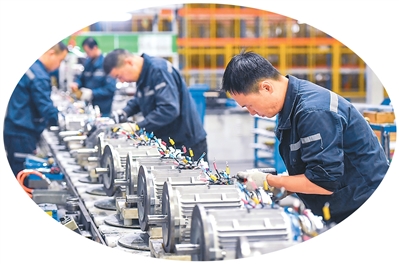
Workers manufacture motor products at Jiangxi Special Electric Motor Co., Ltd. in Yichun city, east China's Jiangxi Province. (Photo/Zhou Liang)
As of October 2025, China had 397 national-level characteristic industrial clusters for SMEs. They include both traditional clusters with strong competitive advantages and emerging clusters founded by researchers and overseas returnees. The national-level clusters have also driven the development of more than 1,400 provincial-level clusters, creating a multi-tiered, wide-ranging, and clearly differentiated cluster development landscape.
Digital transformation has become a primary driving force for the high-quality development of China's SMEs.
Florasis, a Chinese beauty brand based in Hangzhou, east China's Zhejiang Province, offers a product portfolio that spans cosmetics, skincare and fragrances. Following its digital transformation, the company's on-time order fulfillment rate increased to 96 percent, first-pass yield rose 5 percentage points, unit production costs fell 10 percent, and production plan completion reached 98 percent.
Li Guang, senior director of digital intelligence at Florasis, said that between 2021 and 2025, the company's smart factory carried out a comprehensive digital upgrade of its production lines.
Florasis reflects the broader digital transformation underway among China's SMEs.
According to the MIIT, during the 14th Five-Year Plan period, local governments across China introduced a range of long-term mechanisms to support SMEs in their digital transformation. More than 10,000 "small, fast, light and precise" digital solutions were rolled out, more than 1,000 specialized digital service providers targeting niche industries were cultivated, and nearly 30,000 "digital craftsmen" and "digital specialists" were trained.
During the same period, a series of targeted, business-friendly policies created a more supportive environment for SME growth.
Some firms have benefited directly from policies aimed at strengthening financial support for the real economy.
At the second session of a 2025 precision financial services matchmaking conference for private enterprises in Changsha, central China's Hunan Province, Hunan Xingfulianlian Technology Co. Ltd. successfully connected with Bank of Changsha and reached a preliminary loan agreement.
"With this financing in place, I feel much more confident about the company's future. We expect to open 20 franchise stores in Changsha before the Chinese New Year and expand to 200 outlets next year," said Li Qun, chairman of the company.
According to Long Fei, director of the Research Institute of Small and Medium Enterprises at the China Center for Information Industry Development, which operates under the MIIT, China's SME support policies during the 14th Five-Year Plan period focused on three main priorities. These included easing pressure on businesses through tax and fee reductions, cultivating high-quality enterprises through a tiered development system, and strengthening the support system by building a nationwide network of SME public service institutions spanning the national, provincial, municipal and county levels.
Photos



Related Stories
- Specialized, sophisticated SMEs listed with Beijing Equity Trading Center hit 1,000
- Drive to spur SMEs gains momentum
- Loans to China's tech SMEs grow over 20 pct annually in 2021-2025: central bank
- China’s SMEs development index stands at 89.0 in July as pro-growth policies continue to take effect
- SMEs fuel China's innovation edge, GDP
- Arrears clearance for SMEs facilitated
- Improved development environment for Chinese SMEs in 2024: report
- Government-backed guarantees ease financing strains for China's SMEs
- China's SMEs report improved performance in Q1
- China unveils new regulations to guarantee payments for SMEs
Copyright © 2026 People's Daily Online. All Rights Reserved.
