



China livestreams groundbreaking 'Mount Everest-level' surgery, captivating global audience of five million
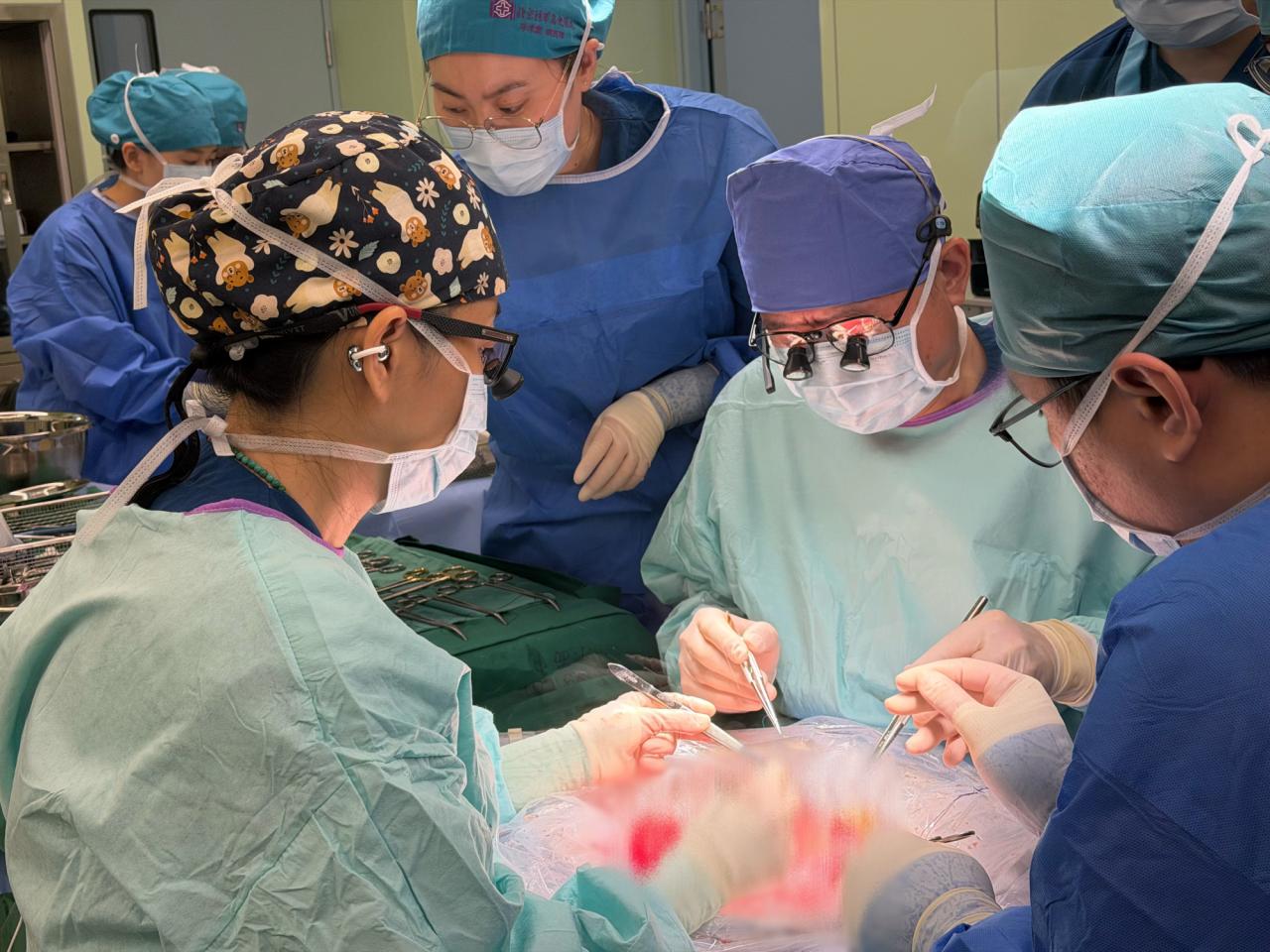
Dong Jiahong (second from right) and his team perform the surgery. (Photo provided by Beijing Tsinghua Changgung Hospital)
Just over two weeks ago, a highly complex surgical procedure, often described as a "Mount Everest-level" challenge in surgery, was successfully carried out at Beijing Tsinghua Changgung Hospital, affiliated with Tsinghua University. The operation, led by Academician Dong Jiahong, involved an extracorporeal liver resection and replantation on a patient suffering from recurrent end-stage hepatic echinococcosis.
The surgery was broadcast live to a global audience during the 37th Italian Congress of Digestive Surgery, with simultaneous coverage from multiple media outlets. More than five million viewers worldwide watched the procedure online, setting a world record for live surgical viewership and highlighting both the excellence and international influence of China's precision surgery.
The patient, from Tibetan autonomous prefecture of Golog in northwest China's Qinghai province, had previously undergone two liver resections due to echinococcosis. However, upon recurrence, the lesions had become tightly encased around the heart and critical hepatic vessels, rendering conventional surgical approaches unfeasible.
To mitigate the risk of catastrophic intraoperative bleeding, Dong's team conducted meticulous preoperative evaluations and ultimately chose one of the most technically challenging procedures in modern surgery. The procedure involved fully removing the liver from the body, performing it bloodless perfusion under hypothermic conditions, precisely excising the lesions, reconstructing major blood vessels, and then reimplanting the patient's healthy liver back into its original position.
The surgery commenced at 9 a.m. and was successfully completed after nine hours. Li Qiang, a hepatobiliary surgery expert, described the operation during the live broadcast as "a perfectly orchestrated symphony, with moments of intense challenge followed by remarkable composure in the face of extreme risk." He commended the procedure as a prime example of the principles and practice of precision surgery.
The success of the operation was the result of meticulous planning and precision at every stage. Dong explained the team's confidence, stating, "We used an AI-based surgical planning system, developed through medical-engineering collaboration with the team of Academician You Zheng at Tsinghua University. The system allowed us to design and simulate the surgical procedure with remarkable accuracy, and the actual procedure closely aligned with our preoperative projections."
Throughout the surgery, multidisciplinary collaboration played a critical role. The surgical team maintained smooth coordination, with the liver undergoing nearly zero blood loss. Stable circulation was preserved during the anhepatic phase through vascular bypass, and the team efficiently completed lesion removal and vascular reconstruction ex vivo. These precise steps ensured minimal bleeding during liver reimplantation and reperfusion, contributing to a stable and successful procedure.
The livestreamed surgery also conveyed a powerful message of hope. Several patients from the Tibetan ethnic group, who had undergone similar procedures in previous years, joined the broadcast to share their recovery stories.
Sonamji, a young woman, now works in cultural tourism in her hometown; Rugden, in his sixties, recently completed a joyful journey across several provinces; and 11-year-old Lawo won a championship in a regional youth football tournament. Their renewed vitality and radiant smiles showcased the profound life-changing impact of this pioneering surgical technique.
The procedure received widespread acclaim from international experts at the Italian Congress of Digestive Surgery. Giorgio Palazzini, president of the Italian Congress of Digestive Surgery and a professor at Sapienza University of Rome, commented: "This extremely complex surgery was performed with near-textbook precision. It was an outstanding and deeply impressive demonstration of Chinese surgical excellence, which continues to lead in both professional competence and technical standards."
Beijing Tsinghua Changgung Hospital performs more than 10 such procedures each year. Dong said: "Through live broadcasts of these surgeries, we hope to demonstrate how advanced medical technologies can overcome the most complex and critical diseases for the benefit of patients, while sharing China's pioneering precision surgery paradigm and technical expertise with the international medical community."
Photos



Related Stories
- Interview: China a global source of biomedical innovation, says Bayer CEO
- Chinese scientists use allergy-like immune response for cancer therapy
- Mind-machine tech leaps from lab to life, powering up future industry
- China-Indonesia medical training program aims to curb cardiovascular deaths
- Chinese researchers help realize non-invasive insulin delivery through skin
- Chinese scientists reveal potential driver of ulcerative colitis
- Chinese scientists develop broad-spectrum nanobodies for tick fever treatment
- Building a healthy China for modernization
- Chinese researchers reveal nicotinamide's heart-protective effect in tumor treatment
- China OKs world's first functional cure for hepatitis B
Copyright © 2026 People's Daily Online. All Rights Reserved.
