



Digital technology revitalizes Jingdezhen's ancient porcelain tradition
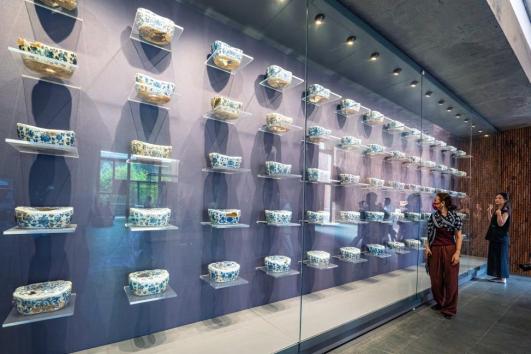
Tourists visit the Jingdezhen Imperial Kiln Institute in Zhushan district of Jingdezhen, east China's Jiangxi province. (Photo/Zhang Feng)
Imagine creating a unique piece of pottery without any prior experience in ceramics. What is the solution? Today, a ceramic 3D printer can bring your creative vision to life. At a ceramic 3D printing experience center in the Taoxichuan cultural and creative block in Jingdezhen, east China's Jiangxi province, digital files are used to layer clay, crafting intricate porcelain objects.
Jingdezhen, recognized globally as China's porcelain capital, is witnessing a revitalization of its traditional ceramics industry, propelled by the seamless integration of digital technology. The shift from conventional manufacturing to smart manufacturing, where age-old techniques meet modern advancements, allows Jingdezhen ceramics to preserve the warmth of its historic kilns while embracing a future that is intelligent and personalized.
"Jingdezhen porcelain is famous worldwide, but it's largely the work of master artisans. Would this place really embrace new technology?" This question led American ceramic artist Michael May to Jingdezhen over a year ago. After traveling to more than 20 countries, he decided to settle here, drawn by the city's potential to merge tradition with technology.
In May's studio at the Taoxichuan cultural and creative block, visitors are greeted by a towering ceramic jar, its surface adorned with petal-like impressions made by 3D-printed stamps. The piece exudes a luminous, flowing quality. May's work is a testament to the harmonious integration of modern technology with traditional ceramic art.
"First, you translate the design into a digital drawing, then upload it into a program, which feeds it into the 3D printer," May explained.
Previously, creating unconventional ceramic shapes was constrained by time-consuming and labor-intensive methods, often yielding unsatisfactory results. However, 3D printing has expanded the boundaries of possibility, vastly enhancing both creativity and efficiency. Today, May not only creates art in Jingdezhen but also teaches courses that use new technologies to redefine ceramic art.
"I initially thought Jingdezhen might resist new technology," May said. "But I was surprised to find 3D printing factories everywhere, even in rural villages where you can rent equipment." The city's openness and inclusiveness ultimately convinced him to remain and continue exploring new creative horizons.
At the showroom of Micro Ceramic Technology (Jiangxi) Co., Ltd., also known as Cerawei, located in Jingdezhen's Changnan New Area, rows of uniquely shaped ceramic products created via 3D printing are neatly displayed.
"3D printing enables designers to quickly transform ideas into physical products. It's a critical bridge between concept and realization," said Huang Wancheng, the company's general manager.
"Some designs are too complex for traditional handcrafting, but 3D printing allows us to bring them to life. Our printing technology can maintain dimensional accuracy within 0.2 millimeters," Huang added.
While enabling personalization, 3D printing is also driving the ceramic industry toward standardized production. "In the past, it might have taken 30 days to move from design to mass production," Huang noted. "Now, 3D printing has shortened that cycle to around three days."
Advancements are also evident in materials. Jingdezhen Lanyinzi Ceramics Co., Ltd., a high-tech enterprise in the Jingdezhen High-Tech Industrial Development Zone, combines intangible cultural heritage with modern materials.
"We've created a 'digital glaze color database' containing more than 300 traditional glaze formulas," explained Zhao Lei, the company's general manager. "Through an intelligent proportioning system, we've raised color replication accuracy to 99 percent. This has transformed ceramic color matching from a skill based on experience to a standardized and precise process."
By refining traditional glazes, the company has increased the thermal stability of high-temperature monochrome glazes by 40 percent. With more than 60 design patents, a 12,500-square-meter smart manufacturing base, and an annual production capacity of 1.2 million pieces, Jingdezhen's ceramics industry continues to thrive.
In 2024, Jingdezhen's advanced ceramics industry generated an output value of 25.32 billion yuan ($3.59 billion), marking a 111.16 percent year-on-year increase, and driving the total ceramic industry output to surpass 90 billion yuan for the first time.
Digital technology is also playing a crucial role in preserving Jingdezhen's ceramic cultural heritage, supporting research, revitalization, utilization, and collection across a wide range of contexts.
"These samples were all chosen from ceramic shards unearthed during archaeological excavations," said Tong Yuting, a researcher at the Jingdezhen Imperial Kiln Institute. "We first document the archaeological information and create 'gene samples,' extracting core data such as shape and decoration, along with extended information from museum collections, historical records, and academic research, to build a comprehensive database."
In recent years, the Jingdezhen Imperial Kiln Institute has introduced three innovative restoration techniques: 3D-printed pattern infill, transparent material infill, and porcelain-to-porcelain restoration. These methods aim for meticulous, craft-level excellence, ensuring that historical ceramic artifacts are restored to their former glory.
Wu Lang, president of the Jingdezhen Ceramic Research Institute, noted that the deep integration of digital technology not only enhances the preservation of traditional ceramic techniques but also injects new energy into the inheritance and innovation of this ancient cultural heritage, allowing the millennium-old ceramic tradition to shine anew.
Photos




Related Stories
- Trending in China | Reviving Ru porcelain: from lost techniques to cultural heritage
- In pics: Ru porcelain enthusiast molds passion into career in China's "porcelain capital"
- China's ceramics industry flourishes, expands global presence
- Chinese artist Liu Zhen and his delicate procelain paintings (13)
- Chinese artist Liu Zhen and his delicate procelain paintings (11)
- Chinese artist Liu Zhen and his delicate procelain paintings (12)
- Chinese artist Liu Zhen and his delicate procelain paintings (14)
- Chinese artist Liu Zhen and his delicate procelain paintings (7)
- Chinese artist Liu Zhen and his delicate procelain paintings (9)
- Chinese artist Liu Zhen and his delicate procelain paintings (6)
Copyright © 2026 People's Daily Online. All Rights Reserved.
