



'Green energy oasis' takes shape in gravel desert in NW China's Xinjiang

Photo shows wind turbines at the 6.1-million-kilowatt renewable energy section of a large-scale new energy transmission base, named Tianshan North Slope Gobi Energy Base, in Hami, northwest China's Xinjiang Uygur Autonomous Region. (Photo/Chen Zhen)
On the vast gravel desert of Santanghu township in Hami, northwest China's Xinjiang Uygur Autonomous Region, the country's first large-scale new energy transmission base built in regions collectively known as "Shagehuang," a Chinese term referring to deserts, gobi, and barren lands, is taking shape.
The base, named Tianshan North Slope Gobi Energy Base, covers 1,651 square kilometers and has a planned total installed capacity of 14.2 million kilowatts (kW), of which more than 70 percent comes from new energy sources.
The base is designed to be a major power source for the ultra-high-voltage (UHV) direct current (DC) power transmission project sending Xinjiang's green electricity directly to southwest China's Chongqing Municipality.
Once fully operational, the entire base will deliver 36 billion kilowatt-hours (kWh) of green electricity each year through the Hami-Chongqing ±800 kV UHV DC power transmission project, turning the once barren gravel desert into a true "energy oasis."
An 8.1-million-kW new energy component of the project, led by one of the major developers, China Huadian Corporation Ltd. (CHD), is expected to supply 14.2 billion kWh of green electricity annually, saving 4.27 million tonnes of standard coal and reducing carbon dioxide emissions by 11.72 million tonnes, according to Chang Jiaxing, general manager of CHD's subsidiary, Huadian Xinjiang Power Generation Co., Ltd.
Construction of the base began on Feb. 26, 2024. Now it is racing toward full-capacity grid connection, with rows of wind turbines over 100 meters tall rising from the gravel desert and dark photovoltaic (PV) panels stretching across the ground, shimmering like mirrors in the sun.
"The project adopts an 'integrated wind-solar-thermal-storage' model, allowing multiple energy and storage technologies to complement and coordinate with each other," explained Liu Yongqing, director of the engineering materials department at Xinjiang Huadian Tianshan Power Generation Co., Ltd., a key participant in the project.
When one energy source is affected by weather or other factors, another can partially compensate for the shortfall, while thermal power and storage provide flexible adjustments to ensure continuous and stable energy supply, enabling a high proportion of new energy to be transmitted out of the region, Liu said.
Hami was chosen as the site for the country's first "Shagehuang" large-scale new energy transmission base by virtue of its unique geographical features.
The city has 94,600 square kilometers of gravel deserts, accounting for two-thirds of its total area, and receives 3,100–3,300 hours of sunshine annually, along with nearly 200 days of strong winds each year, providing ideal conditions for large-scale renewable energy development.
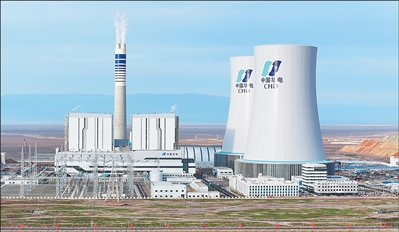
Photo shows two 1-million-kilowatt coal-fired units supporting a large-scale new energy transmission base, named Tianshan North Slope Gobi Energy Base, in Hami, northwest China's Xinjiang Uygur Autonomous Region. (Photo/Chen Zhen)
A signature feature of the project is its deployment of China's largest grid-forming energy storage system in "Shagehuang" regions.
"Gravel deserts are prone to extreme weather and have fragile ecosystems. Combined with the intermittency and volatility of renewable power generation, these factors pose significant challenges to the safe and stable operation of the power systems," Liu said.
"Conventional energy storage works like a 'temporary water bucket,' passively filling gaps," explained Liu.
The new grid-forming storage used at the base includes a key component that functions like an intelligent pump, sensing fluctuations and actively adjusting its output, he noted.
Alongside storage upgrades, supporting coal-fired units are also being transformed to operate more flexibly.
At a plant more than 100 kilometers away, two 1-million-kW units built specifically to complement the renewable base can reduce output to 20 percent of rated capacity, allowing clean energy to take priority whenever wind and solar generation surge.
The engineering team is also focused on ensuring the project operates economically and efficiently across all stages, from generation and transmission to transformation, distribution, and consumption.
In the centralized control center of the base's coal-power section, a 5-meter-wide screen displays the real-time operating status of every unit.
A smart scheduling system leverages a large model to determine the optimal mix of thermal and renewable output based on grid demand, improving renewable absorption by an estimated three percent, according to Zhang Mingjie, an executive of Xinjiang Huadian Tianshan Power Generation Co., Ltd.
At one of the base's converter station in Barkol Kazakh Autonomous County, Hami, construction of a medium-voltage direct current (MVDC) system is in full swing.
"Modern PV panels and wind turbines generally generate DC. Using conventional generation systems requires additional conversions between alternating current (AC) and DC," Liu said. "This MVDC system can connect directly, reducing inversion and AC voltage-boosting steps, lowering line losses and improving stability."
At the coal-power section, a 210-meter-tall cooling tower has been built, consolidating the previously separate towers for the main and auxiliary units.
This integrated system cuts water use by more than 60 percent, consuming just 0.13 cubic meters per megawatt-hour of electricity, according to Lu Gang, general manager of a branch of Xinjiang Huadian Tianshan Power Generation Co., Ltd.
Continuous advancements in system design and technology have resulted in lower coal consumption, reduced internal electricity use, and higher steam pressure, said Yang Jinfa, general manager of Xinjiang Huadian Tianshan Power Generation Co., Ltd.
"The base not only provides a stable source of green electricity for the Hami-Chongqing power transmission project, but also helps overcome technical challenges in developing renewable energy in the gravel deserts, offering a replicable and scalable model for future 'Shagehuang' energy bases and the building of a new-type power system in China," Yang added.
Photos

Related Stories
- Xinjiang's Horgos port handles over 9,000 China-Europe freight trains in 2025
- Influx of int'l tourists helps illuminate the real Xinjiang
- China's Xinjiang hosts regional forum to boost Central Asia links, trade
- Xinjiang sees 26-fold surge in tourist tax refunds in first 10 months
- Major land port in China's Xinjiang sees over 7,000 China-Europe freight train trips
- Students in Xinjiang's prestigious ski destination to embrace 1st "snow break"
- Free trade zone drives foreign trade, industrial development and opening up in Xinjiang
- Xinjiang launches consumption voucher program to boost winter tourism
- Xinjiang stir-fried rice noodles capture domestic market, eye global expansion
- Two years on, free trade zone catalyzes Xinjiang's opening up, development
Copyright © 2026 People's Daily Online. All Rights Reserved.
