



Under BRI, China-Africa agricultural cooperation delivers tangible results: African scholar
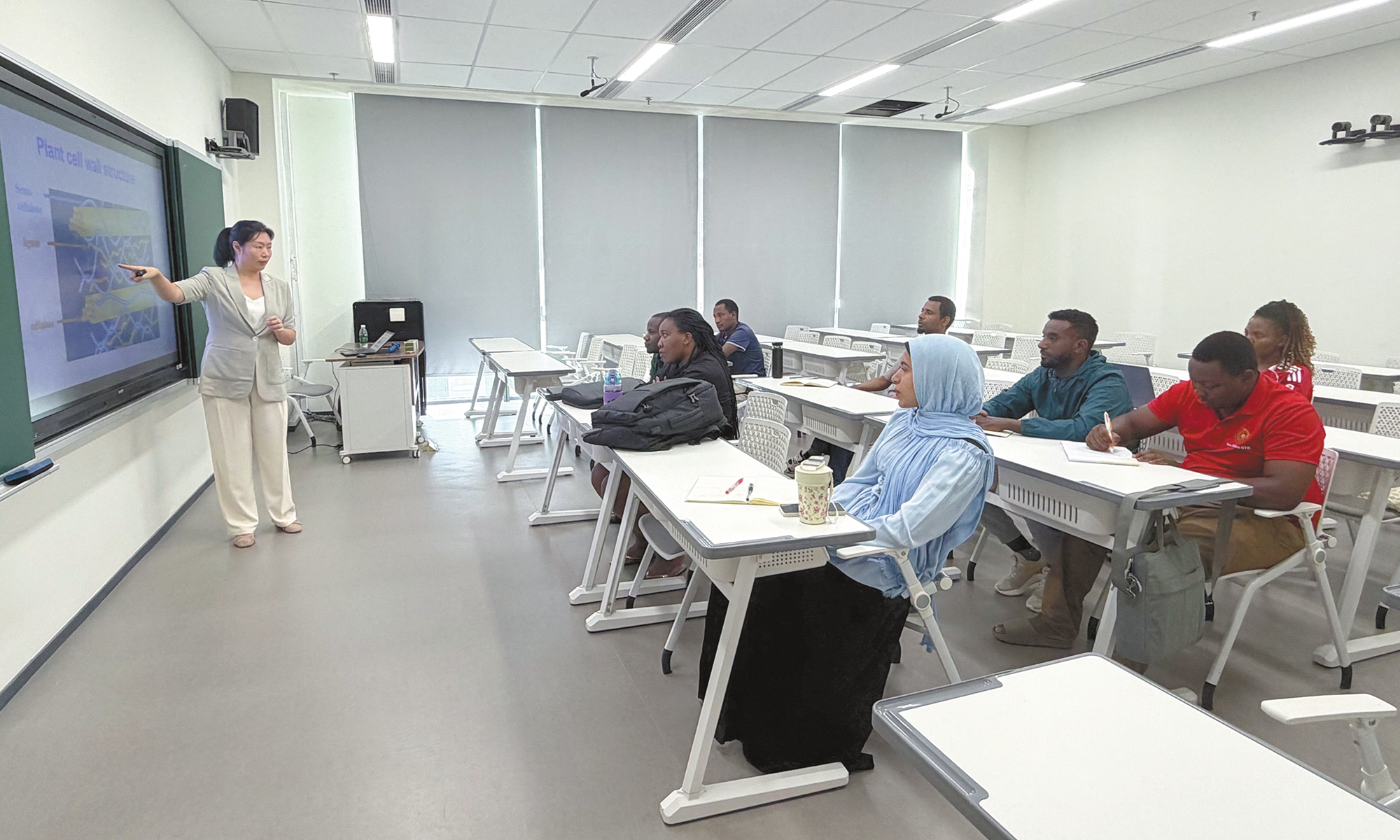
A classroom of China-African Science and Technology Backyard program at the Sanya Institute of China Agricultural University in South China's Hainan Province on December 2, 2025 Photo: Zhang Weilan/GT
In a neat, compact classroom at the Sanya Institute of China Agricultural University (CAU) in Sanya, South China's Hainan Province, eight African doctoral students leaned forward, notebooks open and pens moving, as Zhang Ying brought the mysteries of tropical soil science to life.
What's unfolding here is part of the China-Africa Science and Technology Backyard (STB) program - an agricultural initiative launched by CAU to share Chinese agricultural know how with Africa. Over the past 16 years since its launch, the STB program has expanded rapidly, with over 5,000 branches nationwide and overseas, including 17 in Belt and Road partner countries in Southeast Asia, Africa and South America.
The program has yielded measurable gains in farm productivity and strengthened China African cooperation, Zhang, a supervisor of the China-Africa STB at the Sanya Institute of CAU, told the Global Times, noting that the program has enrolled 131 students from 13 African countries.
Aiming to "move classrooms into the fields," the program cultivates high-caliber agricultural talent for Africa and accelerates the continent's rural development. For instance, it zeroes in on key crops - Malawi's bananas, Kenya's tea and more - matching Chinese technological know-how with Africa's flagship value chains and contributing to global food security and South-South cooperation, Zhang said.
'Deep impression'
"The motivation for me studying in China is to learn about technology, particularly in agriculture, which is a significant challenge in Africa. I want to incorporate leading agricultural practices from China to improve food security in Zimbabwe," Solomon Lovemore Siduna, a PHD student from Zimbabwe, told the Global Times.
Noting the growing use of Chinese agricultural technologies in Africa, including digital irrigation tools, precision fertilizer applications, drones and soil moisture sensors, Siduna said that China is not only providing technological and innovative solutions in agriculture, but also opportunities for African students to study in China, facilitating knowledge exchange and innovation between China and African countries.
"China's scientific advances and its rich research infrastructure have left a deep impression on me," Felix Dakora, senior advisor to the National Nanfan Research Institute (Sanya) of Chinese Academy of Agricultural Sciences (CAAS) from South Africa, told the Global Times.
Beyond its rich pool of advanced technologies, China is also willing to share cutting-edge technologies and academic resources with the Global South. Under the China-proposed Belt and Road Initiative (BRI), China-Africa agricultural cooperation has already delivered tangible results - joint laboratories, technology exchanges and capacity-building programs - that give real momentum to South-South collaboration in agriculture, Dakora added.
Beyond technological know-how, the STB program also trains students in marketing, agro-product processing and other skills, creating extra income through value addition across the entire chain and the economic returns of local agriculture, Zhang said.
And many of these efforts have already paid off. Zhang recounted the story of a student from Malawi, who after a year of practical training at an STB program in Quzhou County, North China's Hebei Province, returned home and helped raise yields from roughly two tons per hectare to about eight tons per hectare. In his village, the adoption of simple, practical planting methods learned in China has helped lift local farmers out of poverty by quadrupling per hectare output, according to Zhang.
"This is undoubtedly a vivid and powerful example of how the program can help improve productivity in rural Africa and help farmers increase their income and become prosper through technology promotion," she said.
Greater opportunities
Beyond educational programs like the China-Africa STB, China is also offering comprehensive policy support for Africa's development in various industries, including agriculture. This is also on vivid display in Hainan.
Hainan, a tropical island, enjoys climatic conditions similar to those in much of Africa, making it an ideal hub for exchange. Meanwhile, highlighting China's high-level opening-up, the Hainan Free Trade Port (FTP) will officially launch an island-wide independent customs operation on December 18, which will provide even more opportunities for products from around the world, including agricultural products from Africa.
With China's zero-tariff treatment for African products now in force, a new series of agricultural cooperation measures will be rolled out in Hainan after the end of this year, according to Zhang.
"After Hainan completes its special customs operations and related policy rollouts, exchanges with African and international experts will become far more convenient," Zhang said, adding that provincial policies, including visa-free entry for personnel from more than 100 countries, will bring great convenience to students from Belt and Road partner countries to study in China and to cross-border collaboration by China-Africa joint expert teams, building a smoother bridge for international cooperation and exchange and injecting new vitality into global agricultural development.
China's high-level opening-up manifested by special customs operations in Hainan FTP is expected to enable African and other developing countries to accelerate agricultural modernization and safeguard food security, Dakora said.
"The reason I chose to study agriculture in China is that I want to feed the nation back in my country, Nigeria. I think China is one of the leading countries when it comes to agriculture. I want to stand on the shoulders of giants to make sure I learn something that can also have an impact on combating food insecurity in the world," Bankole Oluwasey, a student from Nigeria, told the Global Times.
He added: "Here in Sanya the research atmosphere is open, fast and collaborative. Paddy fields are among the greatest emitters of greenhouse gases, and I have already conducted experiments that found a way to reduce methane emissions. With that, I have achieved my goal of finding solutions to climate change. My coming to China has been a successful outcome for me."
From China Agricultural University's STB programs to the Nanfan Breeding Research Center in Sanya, these initiatives show that China's pledges to support Africa's development are concrete rather than rhetorical, He Wenping, a senior research fellow at Institute of West Asian and African Studies of CAAS, told the Global Times.
The move meets the development needs of countries from the Global South, highlighting China's commitment to sharing development opportunities with nations worldwide through tangible action, He Wenping said.
Photos
 Mesmerizing views of common cranes roaming banks of Yellow River in C China's Henan
 Harvest begins for income-boosting medicinal fruit in C China's Henan
 Artists of China National Opera House perform in dance drama "Qiuci" in Beijing
 Pomegranates fuel art and economic growth in Zaozhuang, E China's Shandong
Related Stories
- Interview: BRI opens new trade opportunities for Kyrgyz city, says official
- Feature: China's BRI-backed hydropower station in Cambodia empowers locals with skill transfers
- Interview: Georgia strengthens connectivity capacity within BRI, says Georgian PM
- Feature: China's BRI-backed hydropower station in Cambodia provides clean energy, transforms lives of local villagers
- China, Bulgaria mark anniversary of BRI cooperation
- China (Kashgar) - Central and South Asia Forum on the Rule of Law (2025) kicks off
- China grants market access to 15 food categories from Belt and Road countries
- BRICS, BRI vital to enhance infrastructure, solidarity among Global South countries: Cambodian official, expert
- BRI annual Chinese character unveiled in SW China's Chongqing
- Eurasian nations forge new bonds along ancient trade routes
Copyright © 2025 People's Daily Online. All Rights Reserved.
