



Journey to Xinjiang: experience a rich culture and colorful life
I have always believed that culture, with its invisible impact and magical power, brings people closer to each other. Culture makes people fall in love with a particular region and change their stereotypes about it, and brings back lots of good memories years after they have left it.
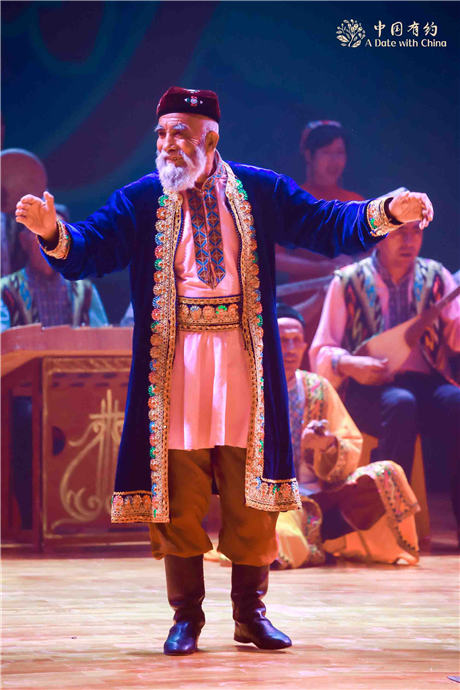
A stage photo of the original musical Twelve Muqam in Shache county, Kashgar, northwest China's Xinjiang Uygur Autonomous Region. (Photo courtesy of “A Date With China” media tour)
I have had a taste of the endless charm and unique power of Chinese culture three times during my years in China. The first time was when I watched performances during the Zen Shaolin Music Grand Ceremony at the famous Shaolin Temple on Songshan Mountain in central China’s Henan province.
The second time came while visiting the iconic Terracotta Warriors and watching the dance show the Song of Everlasting Sorrow, which is about the tragic romance between Emperor Xuanzong of the Tang Dynasty Li Longji and his concubine Yang Yuhuan, in Xi’an, capital of northwest China’s Shaanxi province. And my recent trip to Xinjiang was the third time that I was charmed by Chinese culture.
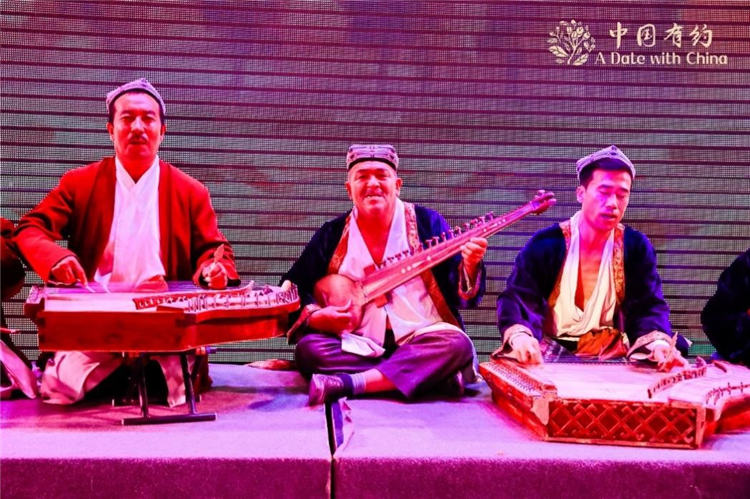
A band plays traditional Uygur musical instruments. (Photo courtesy of “A Date With China” media tour)
Xinjiang is a land of art. Most amazingly of all, the region’s art is very much alive, and found not only in museum exhibitions and theatrical performances, but also in people’s daily lives. One can easily find traces of art while wandering along the region’s streets and bazaars or walking into local restaurants or residential dwellings.
Music is the most precious and universal art in Xinjiang, and the region’s music-loving people have an innate musical talent. You can always see traditional musical instruments with local characteristics everywhere in bazaars large or small, stores, and residents' homes. In short, music is the soul of Xinjiang's culture.
In some restaurants, you'll meet people who have never formally studied art or music but can play melodious Muqam, the traditional music of the Uygur ethnic group. In a large theater of Twelve Muqam in Shache county with its small population in Kashgar, I watched a wonderful musical, whose artistic value rivals that of performers in some internationally known theaters. The musical makes you feel that you are back in the old days of the ancient Silk Road.
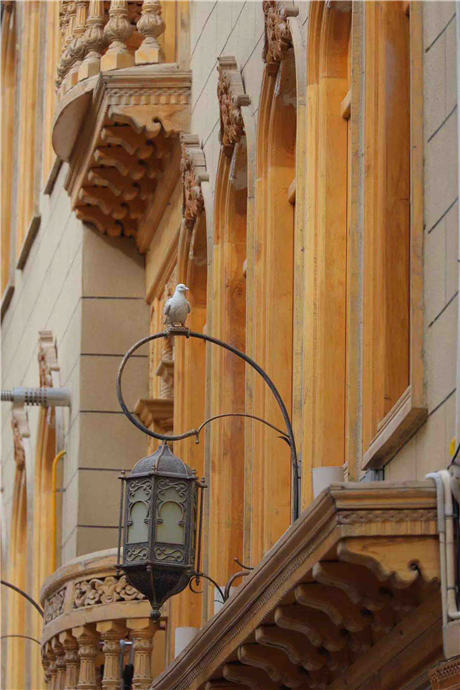
Photo shows the façade and decorations of a building in Hotan, northwest China's Xinjiang Uygur Autonomous Region. (China Central Television/Chen Shangyu)
Xinjiang's distinctive architecture is also a knockout. The dominant color of buildings with different styles in the region is earthy yellow, while traditional patterns are extensively used on their facades and ornate wooden crafts and curtains remain key elements in interior design. Some ancient buildings are of historical importance, but they feature fewer traditional architectural elements than the renovated ones. I saw some gorgeous buildings in Kashgar's old city and Hotan city, which are architectural masterpieces.
I was also deeply impressed by the laid back lives of people in Xinjiang, which form a stark contrast with the hustle and bustle of life in some big cities. For example, you might see an elderly man sitting on a chair in front of his house, smoking a cigarette and watching passersby, or children playing in narrow lanes. But I seldom witnessed similar scenes in Beijing and other big cities.
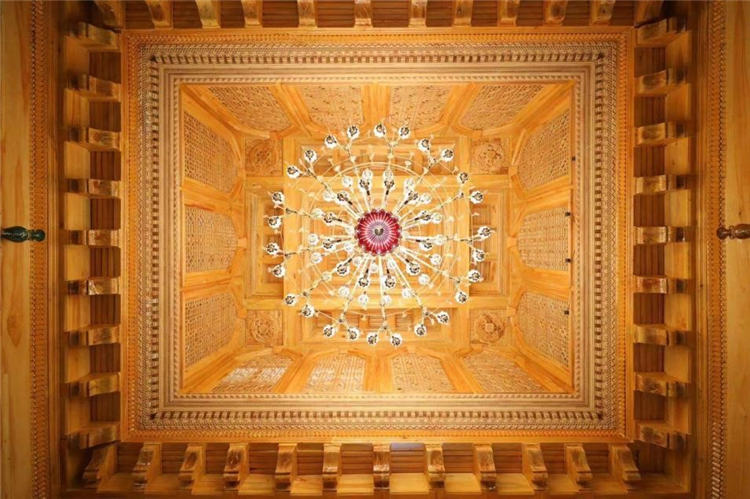
Photo shows the woodcarved ceiling of a teahouse in Hotan, northwest China's Xinjiang Uygur Autonomous Region. (China Central Television/Chen Shangyu)
People in the region have always held an optimistic attitude, which can be partly explained by their love for upbeat music and dance. Men and women, young and old will dance every time the music starts. Families and restaurant owners often place small tables on tetragonal low beds indoors so that people can sit around it and play music.
Xinjiang's traditional costumes, especially those for women, feature bright colors, which, in my opinion, are evidence of the local residents' happy lives.
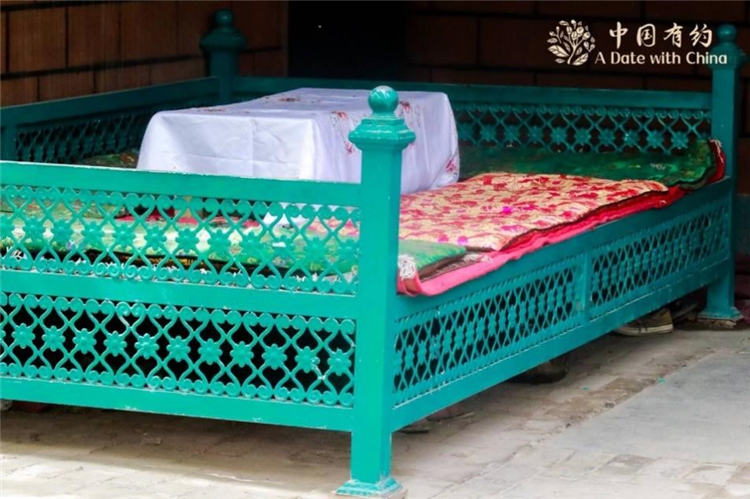
Photo shows a tetragonal low bed in a villager’s home in Shache county, Kashgar, northwest China's Xinjiang Uygur Autonomous Region. (Photo courtesy of “A Date With China” media tour)
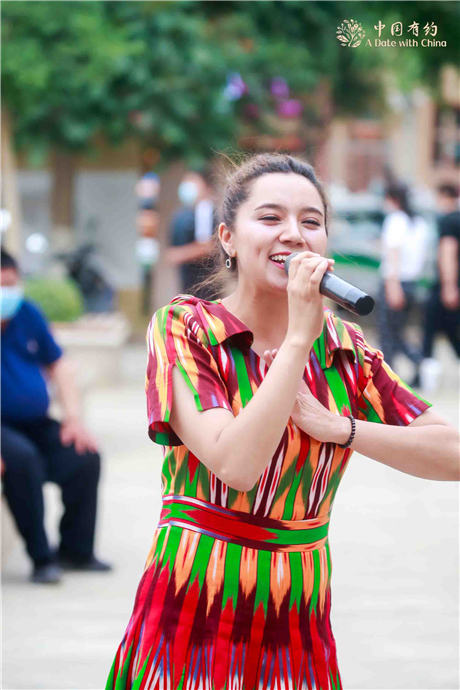
A Uygur lady wearing a traditional dress sings. (Photo courtesy of “A Date With China” media tour)
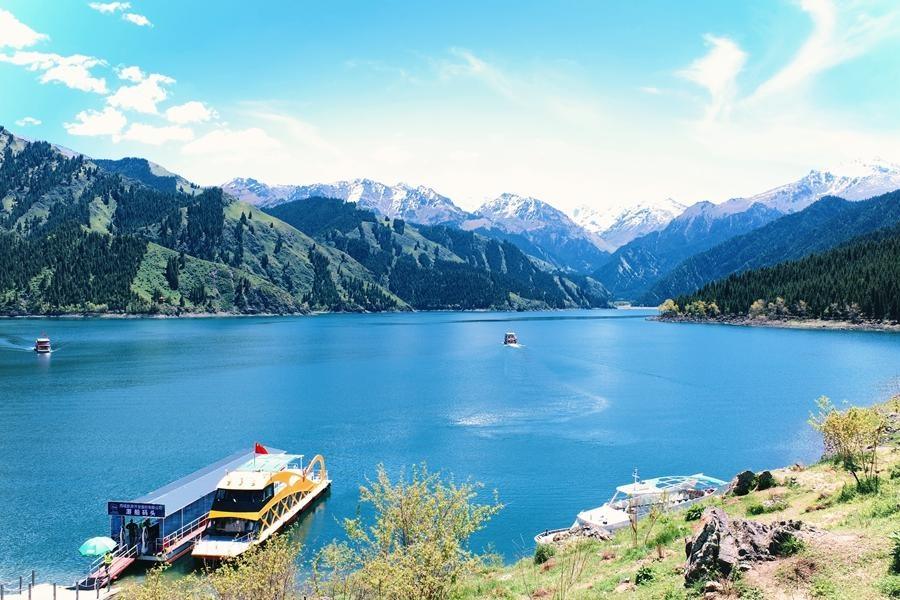
I have been living in China for 13 years, and it was the first time that I have taken a trip to Xinjiang. I was amazed by the beauty of the region, its rich culture and artistic atmosphere, as well as the happy and rich lives of the local residents. Although I have left Xinjiang, I wish I could stay longer there, and I very much look forward to returning to that beautiful land.
The author is an editor with People's Daily Online's Arabic version.
Photos

Copyright © 2021 People's Daily Online. All Rights Reserved.
