
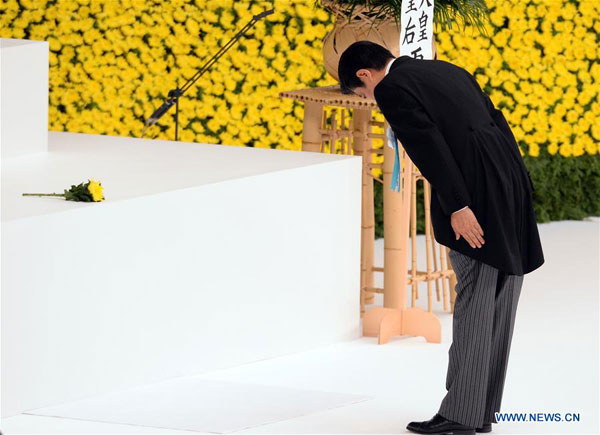
Japanese Prime Minister Shinzo Abe attends the ceremony marking the 71st anniversary of Japan's unconditional surrender in World War II in Tokyo, Japan, Aug. 15, 2016. [Photo: Xinhua]
The marking this week of the 71st anniversary of Japan's surrender at the end of World War II is once-again raising questions about the language Japanese officials are using to describe that country's position on its past actions.
One of the issues that arise every year on the anniversary of Japan's unconditional surrender is whether a formal apology will be issued.
Like past years, Japanese Prime Minister Shinzo Abe has vowed to adhere to the road of peace and not repeat the calamity of war.
However, the word 'sorry' was not included in the remarks.
Kurt Piehler, director of the Institute of World War II and the Human Experience with Florida State University, says a formal apology from Japan would go a long way toward creating a lasting peace in the region.
"I hope that there can be a formal apology. I hope there can be peace treaties between China and Japan, and between Japan and Russia. I hope we could have a model like the model between Germany and Israel where there have been a great deal of reconciliation, and part of that reconciliation was a formal apology."
At the same time, Piehler says domestic politics are still a major factor holding the current Japanese government back.
"I would agree that an apology would be the right thing to do. And I also think in the long-term interest and stability in East Asia would be a very good thing to do for diplomatic relations for Japan. I just wish Japan could really put World War II behind it and really come to a full reckoning. I would say the left Japan has a full reckoning, and Japanese are very divided over the legacy of World War II."
In marking the August 15th anniversary, Japanese Emperor Akihito did use the term "deep remorse" during the national memorial service, the second time in a row he's used that expression.
Kurt Piehler says while this may be viewed by some as headway toward a formal apology, he says he's still somewhat confused as to why Japanese authorities remain reluctant to officially say 'sorry.'
"I find it hard that the Japanese prime minister, or even more to the point the emperor, has never formally given an apology and has used these sort of semantic terms "regret" and so forth. I think an apology, very similar to what the West German president did it in the 1985, would really clear the air. But I know he faces still lingering political opposition on the right to making such an apology."
The lack of a formal apology for Japan's invasion of China remains a sore point to this day in diplomatic ties.
A lack of recognition among certain groups in Japan to the Nanjing Massacre is also a major problem.
This is when Japanese troops began a 6-week long orgy of rape and murder through the former Chinese capital in December of 1937 which left some 300,000 people dead.
 World's fastest bullet train to start operating next month
 Huangluo: China's 'long hair village'
 Spectacular bridge with one of the tallest piers in the world
 Magnificent view of Hukou Waterfall
 A glimpse of Stride 2016 Zhurihe B military drill
 US Navy chief tours Liaoning aircraft carrier
 Chinese American woman wins Miss Michigan
 Centenarian couple takes first wedding photos
 Traditional Tibetan costumes presented during fashion show
 Top 10 livable Chinese cities
 Top 20 hottest women in the world in 2014
 Top 10 hardest languages to learn
 China’s Top 10 Unique Bridges, Highways and Roads
 Foreigners get a taste of Chinese officialdom in villages
 Painful divorce shouldn’t be public fodder
 Online broadcasting proves to be lucrative
 Chinese filmmakers are losing touch with audiences, is there a turning point ahead?
Day|Week


