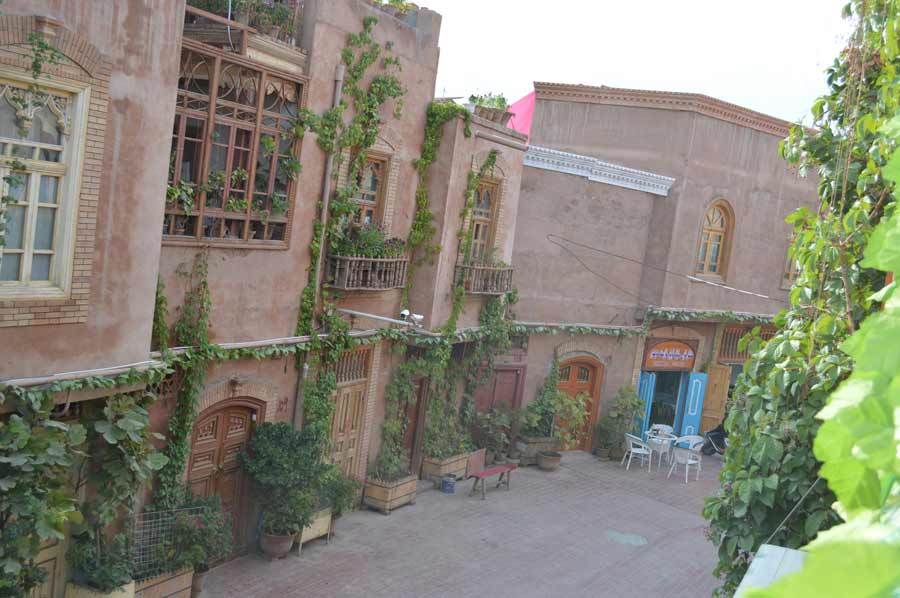
Located near Xinjiang’s Id Kah Mosque in Kashgar, Ustangbuyi Tea House remains popular among residents and tourists alike. It is the only century-old tea house in Kashgar, and it maintains very reasonable prices, with a pot of ordinary tea sold at five yuan. For two more yuan, one can also purchase a nang, a kind of crusty pancake common in Xinjiang. The cheap snack is popular among locals, while tourists usually prefer slightly more expensive medicinal teas, such as those containing rose, saffron, honey and other ingredients.
In southern Xinjiang, where the weather is dry and the local diet is meat-heavy, tea-drinking is an important tradition, just as it is in other parts of China. The tea house acts as a public gathering place for people to come and socialize. Few of the elderly residents are able to speak Mandarin, but they are nevertheless willing to communicate with Mandarin-speaking tourists through hand gestures and other movements.
In contrast with the old tea house, three young entrepreneurs have set up a new tea house named Guli Tea in the nearby Atush Alley, aiming to promote seven kinds of traditional Xinjiang tea as well as Xinjiang’s Uyghur culture.(Photo/Courtesy of Najibullajan)
 |  |
Day|Week

 Who Will Fit The Chinese Roles In Game Of Thrones?
 China's Hubei Shennongjia added to World Heritage List
 Cute Dog At Fruit Stand Becomes Latest Internet Sensation
 Thai most beautiful transgender Nong Poy release new photos
 Top 10 livable Chinese cities
 The last primitive tribe in China
 China's first intelligent security robot debuts in Chongqing
 A Total of 3,552 Subscribers Vanish In Two Days; YouTube Closes All Doors to Users’ Inquiries
 Out of this world! Futuristic UFO-shaped yacht has its own garden and a stunning underwater viewing deck
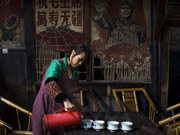 An old tea house in Chengdu