
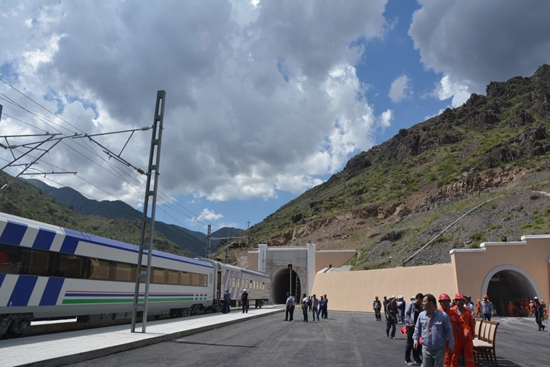
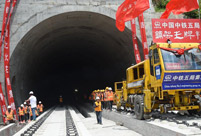
A trial train emerges from the Qamchiq Tunnel. (Photo: Xie Yahong from People's Daily)
As Chinese President Xi Jinping is kicking off a four-day state visit to Uzbekistan on Tuesday, the Qamchiq Tunnel, a cooperation project between China and Uzbekistan, has drawn attention since Xi will attend a ceremony marking the completion together with Uzbek leaders.
The 19.2km Qamchiq Tunnel, part of the Angren-Pap railway line that connects the capital city of Tashkent with the eastern city of Namangan, is also the longest railway tunnel in Central Asia.
The project was undertaken by the China Railway Tunnel Group (CRTG). The company, after beating their European and US counterparts in the bidding process, began the construction in 2013, and completed it in late May, nearly six months earlier than the original plan.
The Angren-Pap railway line has drawn attention as the 169km Angren-Pap railway line is important to Uzbekistan’s national strategy of internal connectivity. Upon completion, it can relieve traffic pressure for about 10 million people, over a third of the country’s population.
The tunnel, as the largest cooperation project between the two countries outside of the sector, is also a key project in the China-proposed "Belt and Road" initiative.
The tunnel, which required 47 kilometers of excavation, was also the most difficult part of whole railway project.
The unfavorable geological conditions, as well as the extremely cold working environment where as cold as minus 40 degrees centigrade, have all stood in the way of construction.
To complete the project on schedule, the constructors tackled these tough problems. Xiao Chenyu, the site construction manager of CRTG, said that the workers even need to work in such temperature for five months.
Because of the complicated geological faults, construction teams encountered frequent rock bursts when blasting the mountain. During construction, moderate rock bursts occurred more than 3,000 times. The most serious rock burst caused the collapse of nearly 2,000 cubic meters of rock, severely threatened for construction workers.
Rock seepage was also a problem during construction. When excavating in some sections, the staffs even had to work half-submerged in water.
But the CRTG showed China's efficiency to the world with its outstanding performance and laid a foundation for other companies that want to test the waters in overseas markets.
Highly acknowledging this project, the Uzbek government has signed a letter of intent with China for further cooperation.
 Five made-in-China hi-tech breakthroughs
 Beijing Style: Hot pants
 HK-Zhuhai-Macao Bridge to open to traffic
 China opens its first combined transport service to Nepal
 Students take stylish bikini graduations photos
 Charming dancing students pose for graduation photos
 Guizhou, Yunnan section of Shanghai-Kunming railway connected
 Naked models transformed into landscapes, birds and even DRAGONS by body painting artist
 World’s biggest cruise ship Harmony of the Seas to start maiden voyage
 Top 20 hottest women in the world in 2014
 Top 10 hardest languages to learn
 10 Chinese female stars with most beautiful faces
 China’s Top 10 Unique Bridges, Highways and Roads
 US missile network hurts strategic balance
 Govt urges Wukan to avoid radical actions
 Sexy student selfies a risky form of debt collateral
 Mother stealing for sick child highlights poverty caused by serious illness
Day|Week


