
An enormous black hole has been spotted in the sun - but do not fear, it doesn't spell the end of our solar system.
Instead the giant dark spot is a gap in the sun's corona - its scorching hot atmosphere.
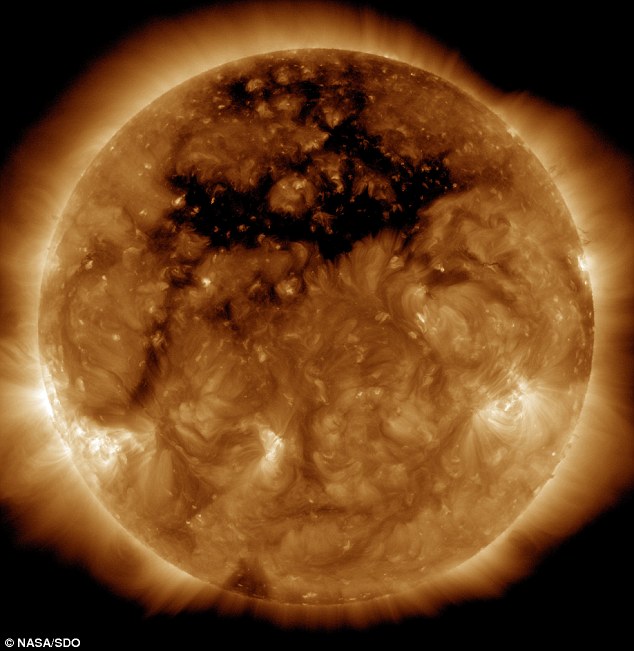
Holes in the sun's atmosphere are a regular feature and Nasa's Solar Dynamics Observatory (SDO) has detected a particularly large one covering the northern hemisphere of our star.

This imagery of the sun captured by NASA's Solar Dynamics Observatory from May 17-19, 2016, shows a giant dark area on the star's upper half, known as a coronal hole
The coronal hole was spotted using the orbiting telescope, which stares constantly at the sun to monitor its activity, earlier this month.
Coronal holes are regions of the corona - the aura of plasma surrounding the sun - where the magnetic field reaches out into space rather than looping back down onto the sun's surface.
This results in solar material speeding out in a high-speed stream of solar wind.
Footage captured by the Solar Dynamics Observatory shows parts of the corona where the particles leave the sun, causing the glow to be much dimmer, so the coronal hole looks dark.
These fast solar winds can interact with Earth's magnetic field, creating a geomagnetic storm - a type of energy which acts like a large battery around the planet and causes magnetic energy to vary.
Geomagnetic storms also cause the Northern Lights to appear.
This video was captured in extreme ultraviolet wavelengths of 193 angstroms – a type of light that is typically invisible to our eyes, but can here be seen as purple.
This is not the first coronal hole to be recorded, it is a fairly regular occurrence. Another coronal hole is pictured here in October 2015
The SDO is a spacecraft that was launched by Nasa in the hopes of understanding the causes of solar variability and its impacts on Earth.
The goal of the SDO is to determine how the Sun's magnetic field is generated and stored, and how this stored magnetic energy is converted and released.
It is hoped that results from the SDO could give us clues on how solar winds can affect communications or satellites near Earth.

These fast solar winds can interact with Earth's magnetic field, creating a geomagnetic storm - a type of energy which acts like a large battery around the planet and causes magnetic energy to vary. This is the process that causes the Northern Lights to appear (pictured)
 French girl ties the knot with Chinese boy
 Beijing Style: ready for bare legs
 Century-old station sees railyway evolution
 Enthusiasts perform Kung Fu at Wudang Mountain
 Stunning photos of China's fighter jets in drill
 Monk's mummified body to be made into a gold Buddha statue
 Former Chinese solider of the French Foreign Legion seeks wife online
 Asia's longest and highest suspension bridge to open to traffic
 China's first interactive robot looks like a beauty
 Top 20 hottest women in the world in 2014
 Top 10 hardest languages to learn
 10 Chinese female stars with most beautiful faces
 China’s Top 10 Unique Bridges, Highways and Roads
 Can US win a new Cold War upon China?
 China sitting on data goldmine
 Experts say Sino-US space collaboration is likely to stay sci-fi
 Chinese NGOs receive less from overseas backers as new law stresses national security
Day|Week


