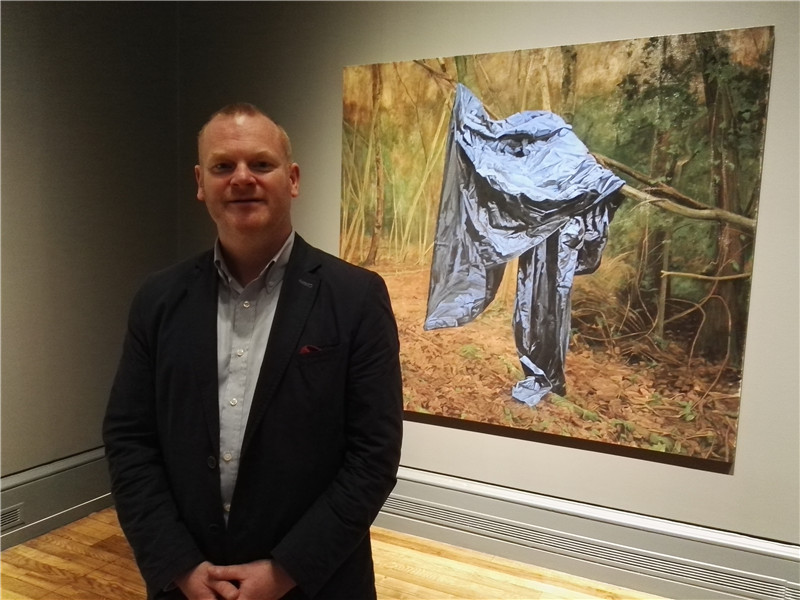
LONDON May. 17 (People's Daily Online)—— George Shaw is an English contemporary artist who is noted for his suburban subject matter. George Shaw has been the National Gallery’s Rootstein Hopkins Associate Artist for the past two-and-a-half years, but a fan of the Gallery all his life.
Since 2014, Shaw has been based in a studio located in the heart of the National Gallery. From here, he's had swift and unrestricted access to the Gallery to explore the collection out of hours at his leisure, draw from the pictures, observe the public, and find inspiration in great art for his own work... The result is George Shaw: My Back to Nature.
The world George found in the paintings of the National Gallery could hardly be in greater contrast to the estate where he grew up. During his teenage years, Shaw would often explore an area of neglected woodland around his home, strewn with abandoned rubbish. He remembers finding soggy, snail-nibbled pornographic magazines – the women in these pages providing a contemporary contrast to the nudes he was discovering populating the pictures of Titian and Poussin. Walking through that woodland he remembers feeling “something out of the ordinary could happen at any time there, away from the supervision of adults.”
As a youth, he once described the National Gallery Collection as “naked women and pictures of Jesus” and as such, representations of the bloody body of Christ (as in Carlo Crivelli’s The Dead Christ Supported by Two Angels) also became an area of fascination, which we see explored in his exhibition.
More than 50 new paintings and drawings – predominantly woodland landscapes – are included in 'George Shaw: My Back to Nature', and feature his investigation of the clash of cultures; classical stories linked with the traces of similar, timeless behaviour in the modern world, also the portrayal of religion.
Some of the earliest works he made are a series of 14 self-portrait drawings in the various poses taken up by Christ in traditional Stations of the Cross compositions. Although Shaw is not an artist known for working from the human figure, these drawings were an important step on his way to making the work for this exhibition. By positioning them as the first thing the visitor encounters on entering the Sunley Room, Shaw encourages us to read his images of trees as carrying other, deeper ideas, rather than being just a ‘rehash’ of traditional landscape imagery.
Shaw is known for his highly detailed approach and his favoured medium is Humbrol enamel paints – more often used to paint model trains and aeroplanes – which give his work a unique, almost photographic, appearance. If pushed, he concedes that he likes the fact that they have no historical resonance.
Shaw says:“I think the best person for the job would have been me at 15 or 16. He would have been in the Gallery 18 hours a day for two years. I accepted it on his behalf and did the best job I could. As it turns out, the longer I spend here, the earthier and more profane the collection gets. Even the religious paintings eventually get down from their high horse and meet you on your level. It’s all sex, death, bowls of fruit and flowers, and the odd landscape. That may sound somewhat dismissive, but it’s kept artists busy for 700 years and continues to do so. As such, I flip from feeling moderately confident to feeling utterly insignificant on a daily basis, every time I walk through the Gallery. I have dragged these big themes through my own little history. In the woods I played in as a child, I found Calvary, nymphs in the forest, the gods of drinking and naughtiness, rituals of transformation and transgression, and the futile attempts to leave something behind that said I was here.”
The Rootstein Hopkins Foundation Associate Artist Scheme enables leading contemporary artists to work with the National Gallery Collection for a period of two years. (Bai Tianxing)
 |
Day|Week

 China's first intelligent security robot debuts in Chongqing
 A Total of 3,552 Subscribers Vanish In Two Days; YouTube Closes All Doors to Users’ Inquiries
 Out of this world! Futuristic UFO-shaped yacht has its own garden and a stunning underwater viewing deck
 An old tea house in Chengdu
 Furious Customer Crushes All the Buns from Vendor Just Because He Was Given the Wrong Flavor
 20 post-90s couples hold ’naked marriage‘ in E. China
 Female official wearing traditional Han costume to promote local tourism
 Over 12,000 Runners Seek Medical Care in S China’s Marathon
 Six Luxury Sports Cars Totaled after Fail Attempts to Cross China’s Most Perilous Highway Linking SW China’s Sichuan and Tibet
 Incredible Transformation: “Witch Child”Whose Parents Left Him for Dead in Nigerian Makes Speedy Recovery