
 |
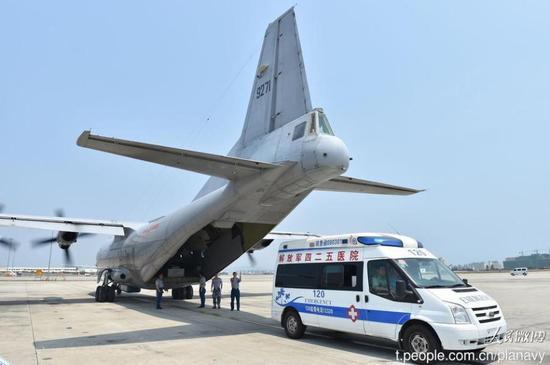
| A PLA Navy flight that was patrolling the South China Sea suspended its task to help transport three severely ill patients from Yongshu Jiao reef in the Nansha Islands to Sanya city in Hainan province on Sunday. (t.people.com.cn/Planavy) |
The Chinese military announced Sunday that a naval patrol aircraft had landed on Yongshu Jiao, part of the Nansha Islands, to pick up three sick construction workers on Sunday morning. They were brought to Sanya in Hainan Province for further treatment. The Pentagon reacted sensitively to the news. In a statement, a Pentagon spokesperson said "it is unclear why the Chinese used a military aircraft, as opposed to a civilian one."
It is noteworthy that the US is the first country to openly oppose China conducting a humanitarian mission using military aircraft on Yongshu Jiao. It proves the direct intervention of the US and the US-China competition in the South China Sea that it provoked are becoming major contradictions in the region. Territorial disputes have been turned into excuses by the US to reinforce containment of China.
The US is busy strengthening its military presence surrounding the South China Sea. Philip Goldberg, US ambassador to the Philippines, announced Monday that Washington would supply Manila with $42 million worth of sensors, radar and communications equipment. A few days ago, US Secretary of Defense Ashton Carter inspected five military bases in the Philippines that the US re-opened, three of which are close to the nine-dash line.
Meanwhile, Washington is solidifying its alliance against China in the region. The Pentagon, with all these provocations, has the nerve to examine the "military meaning" of China's evacuation of the sick.
China announced earlier that it will not militarize the constructed islands in Nansha, but it has never pledged not to use military aircraft, which are needed to defend China's soil. Washington's intensifying military presence in the South China Sea is heightening the need to deploy defensive weapons to the islands concerned. Washington is clear about Beijing's prudence and restraint in its maritime strategies. China's maritime activities are in accordance with its national interests and growth. China has no ambition to challenge US hegemony, nor has it used its strength to pressure its neighboring countries in face of frictions.
In the 20th century, the US faced direct strategic challenges from Japan and the Soviet Union, both of which started to confront Washington when their economies lagged far behind the US. The US is aware of real militarization. Washington should respect China's rise. The rise has profoundly changed the power grid of East Asia and will unavoidably be reflected in the regional order. The time that the US can accept this will perhaps be the turning point when strategic risks in Asia can be peacefully eliminated.
 |
 The evolution of J-10 fighter
 Top 10 Asian beauties in 2016
 What's happening in Xisha Islands?
 When female soldiers meet flowers
 North Sea Fleet conducts drill in West Pacific Ocean
 Old photos record the change of Sichuan over a century
 Breathtaking aerial photos of tulip blossoms in C China
 Horrific: Pit swallows 25 tons of fish overnight
 Vietnamese Su-30 fighters fly over Nanwei Island in South China Sea
 Top 20 hottest women in the world in 2014
 Top 10 hardest languages to learn
 10 Chinese female stars with most beautiful faces
 China’s Top 10 Unique Bridges, Highways and Roads
 High-profile cases of child abuse are just the tip of the iceberg expert
 Film watchdog orders online celebrity’s videos removed for vulgarity
 Narrow-minded opposition against Twitter appointment
 Celebrity kids should be kept out of spotlight
Day|Week


