
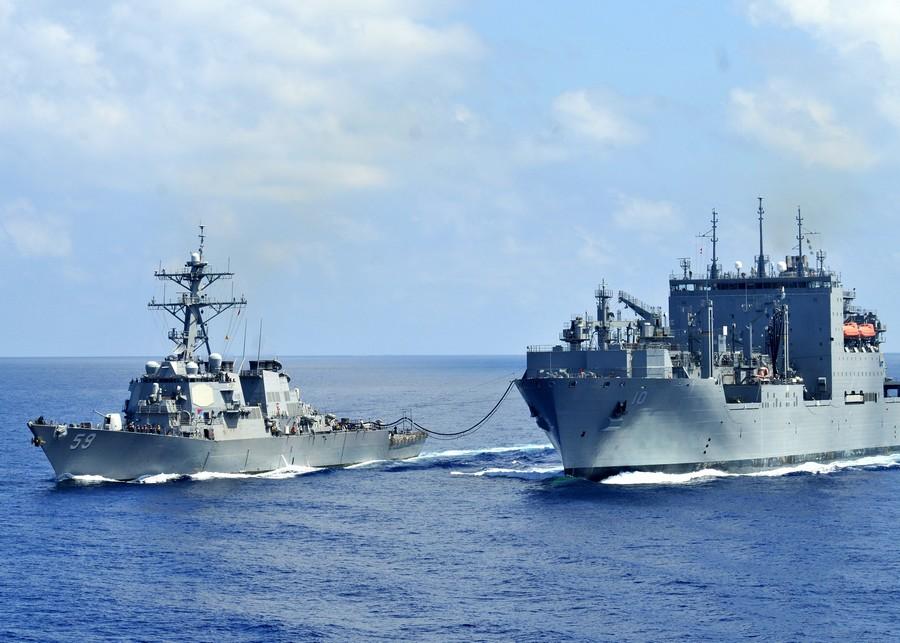
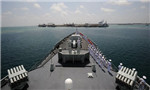
According to the photos released by U.S. Navy on March 10, USS Blue Rigde and USS Russell are still sailing in the South China Sea.
A Chinese expert on military strategy has criticized the U.S.'s attitude towards the South China Sea in his article.
Peng Guangqian said that the U.S. has no reason to blame China for militarizing the South China Sea. Peng questioned about the intention of the U.S. to deploy nuclear submarines, stealth fighters, large warships and nuclear-powered aircraft carrier battle group in the area. Peng said that it is the U.S. that stirs up disorder in the region. The U.S. not only deploys weapons but also organizes joint military drill in that region.
Peng said in the article that the U.S. not only militarizes the South China Sea but also builds a network of military bases in the West Pacific so that it can militarize almost the entire West Pacific.
Furthermore, the U.S. intrudes into waters near islands and reefs in the South China Sea, and even into China's territorial waters without permission from China. However, the U.S. justifies its acts by saying that they sail in "international waters." Peng said that it is ridiculous for the U.S. to do and to say so.
According to Peng, the South China Sea is one of the busiest maritime routes in the world and over 7,000 ships sail in the region every day. Maritime routes in the region are important transportation hinges connecting China and other places in the world. China spares no efforts to protect freedom of navigation in the region.
Peng said the freedom of navigation advocated by the U.S. is the “freedom” to deprive normal navigation of other countries.
Peng said that the U.S. not only stirs up disputes in the region by sending military aircraft and ships to the area but also plotted arbitration of the South China Sea dispute.
According to Peng, the Philippines is playing an active role in the arbitration. The result of the arbitration has not been released yet, but the U.S., along with its allies including Japan, presses China to unconditionally accept the result of the arbitration by whipping up public opinion.
Peng said that China exercises the legitimate right of a sovereign state according to United Nations Convention on the Law of the Sea (UNCLOS). Not participating in nor accepting the result of the arbitration, China safeguards the authority of the convention.
The U.S. is not a country in the region, nor a claimant party for maritime rights in the region. Furthermore, it still refuses to join UNCLOS. In previous disputes with its neighboring countries, the U.S. also rejected arbitration by the International Court of Justice. Peng said that the U.S. has no right to talk about maritime arbitration with China, a member in the UNCLOS.
 Thai most beautiful transgender Nong Poy release new photos
 Now and then photos of Shanghai Jiaotong University
 Is this what air travel will look like in 2050?
 Aerial view of watermelon terraces in S China's Baise
 Traditional wedding of a post-80s Tibetan couple
 Models in cheongsams present classical oriental beauty
 Second commissioned C28A corvette made by China enters Algerian Navy
 Intoxicating Wuyuan in spring
 Gold and silver wares of Qing Dynasty exhibited in Shenyang Imperial Palace
 Top 20 hottest women in the world in 2014
 Top 10 hardest languages to learn
 10 Chinese female stars with most beautiful faces
 China’s Top 10 Unique Bridges, Highways and Roads
 Meet Beijing’s hottest new trend: vaping
 Govt to increase scrutiny of online retail: report
 China’s logistic hub in Djibouti to stabilize region, protect interests
 Myanmar won’t distance itself from China
Day|Week


